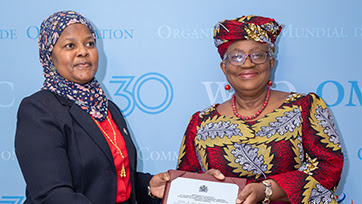
Malawi’s WTO Ambassador Caroline Bwanali-Mussa with WTO Director GeneralRight)
Geneva: The World Trade Organization’s Agreement on Fisheries Subsidies, adopted on June 17, 2022, at the 12th Ministerial Conference in Geneva, is a landmark multilateral trade agreement targeting environmental sustainability by prohibiting subsidies for illegal, unreported, and unregulated (IUU) fishing, overfished stocks, and fishing on the unregulated high seas.
Known as “Fish 1,” it requires ratification by 111 of the WTO’s 164 members to enter into force, with Malawi’s acceptance on May 28, 2025, marking the 100th ratification, leaving 11 more needed.
The agreement, however, deferred critical disciplines on subsidies causing overcapacity and overfishing to a second phase, “Fish 2,” which failed to achieve consensus at the 13th Ministerial Conference (MC13) in Abu Dhabi from February 26 to March 2, 2024, and again at the July 2024 General Council meeting, largely due to objections from India and Brazil.
The United Nations’ Sustainable Development Goal (SDG) 14.6, adopted in 2015, set a 2020 deadline to eliminate harmful subsidies, which was missed due to negotiation complexities, disagreements over special and differential treatment, and COVID-19 disruptions. Global fisheries subsidies, estimated at USD 35.4 billion in 2018, with USD 22.2 billion capacity-enhancing, drive overfishing, depleting 38% of fish stocks beyond sustainable levels, per the Food and Agriculture Organization’s 2022 report.
The concerns of India and Brazil, the lack of progress on Fish 2, and the implications for the WTO’s credibility are central to understanding the agreement’s trajectory.
India’s objections to the Fish 2 draft text focused on equity and developmental priorities. India argued that the proposed rules unfairly burdened developing countries while failing to address historical subsidy advantages of developed nations like China, the EU, Japan, and the United States, which account for over two-thirds of global harmful subsidies.
These countries built industrial fleets with decades of subsidies, enabling dominance in global fisheries, while India, with 6.7% of global fish production, seeks to expand its sector to support food security and livelihoods for its 10 million fishers, mostly small-scale and subsistence-based.
The draft’s requirement for stock assessments and management measures to qualify for subsidy exemptions posed challenges for India, where limited technical and financial resources hinder compliance, risking the exclusion of small-scale fishers from exemptions. India demanded a higher de minimis threshold (1% global catch share versus the proposed 0.8%) and broader exemptions for small-scale fishers within territorial waters, arguing these were critical to protect vulnerable communities.
At MC13, India linked its approval to unrelated agriculture reforms, a strategy criticised by European Trade Commissioner Valdis Dombrovskis for obstructing progress. In July 2024, India’s push to revisit settled provisions, including the scope of sustainability-based exemptions, further delayed consensus, reflecting concerns echoed by Parid Ridwanuddin of the Indonesian Forum for Environment about inequities favouring industrialised fleets.
Brazil shared India’s equity concerns, emphasising its growing fisheries and aquaculture sector. Brazil’s fishing industry supports coastal livelihoods and food security, with subsidies for fuel and vessel modernisation aiding competitiveness against industrialised fleets.
At MC13, Brazil aligned with India in linking fisheries talks to agriculture reforms, particularly farm subsidy disciplines, to secure broader trade concessions. Brazil argued that the Fish 2 draft favoured countries with advanced fisheries management systems, like the EU and Japan, while its small-scale and artisanal fishers faced compliance challenges due to limited infrastructure. Brazil sought exemptions for subsidies supporting these fishers and opposed the proposed subsidy cap for countries with low catch shares, which could restrict its plans to expand fishing to meet domestic demand and reduce import reliance. This linkage to agriculture and demand for wider flexibilities contributed to the failure to reach consensus at MC13 and in July 2024.
The failure to meet the 2020 SDG 14.6 deadline and conclude Fish 2 by MC13 in 2024 has significantly undermined the WTO’s credibility. The 2020 deadline was missed due to disagreements over defining harmful subsidies, balancing environmental and developmental goals, and pandemic-related delays. Fish 1’s adoption in 2022 restored some confidence by showcasing the WTO’s ability to deliver a multilateral environmental agreement, but the inability to finalise Fish 2 at MC13 and beyond has fueled perceptions of ineffectiveness.
The WTO’s consensus-based system, requiring unanimity among 164 members, allowed India and Brazil to block progress, frustrating small island and least-developed countries like Fiji, Papua New Guinea, and Barbados, which suffer most from overfishing driven by major subsidisers.
Ambassador Matthew Wilson of Barbados highlighted that the absence of Fish 2 benefits large fishing nations, eroding trust in the WTO’s commitment to equitable outcomes. The linkage of fisheries to agriculture by India and Brazil exposes systemic vulnerabilities, a concern likened by Rémi Parmentier to “Waiting for Godot.” The sunset clause in Fish 1, mandating termination if Fish 2 is not adopted within four years of entry into force (potentially by mid-2029), heightens the risk that decades of effort could be lost, further damaging the WTO’s reputation.
Progress since July 2024 has been limited and unsatisfactory. Negotiations resumed in September 2024 under Ambassador Gunnarsson of Iceland, refining the MC13 draft text, which had neared consensus on prohibiting overcapacity subsidies with sustainability-based exemptions for stocks at biologically sustainable levels.
The International Institute for Sustainable Development’s self-assessment tool, launched in May 2025, supports the implementation of Fish 1 by helping countries assess their compliance and transparency requirements. The Fisheries Funding Mechanism, with millions in pledges, aids developing countries but awaits Fish 1’s entry into force. Ratifications have gained momentum, with six members, including Georgia and Malawi, accepting Fish 1 in the four weeks to May 28, 2025, suggesting entry into force tentatively by mid-2025, a record pace compared to other WTO agreements.
However, Fish 2’s lack of progress remains a critical gap, as capacity-enhancing subsidies, driving overfishing, remain unaddressed. Analysts like Daniel Skerritt of Oceana estimate Fish 1’s impact as minimal, addressing only a fraction of harmful subsidies, underscoring the urgency of Fish 2 for marine biodiversity and the livelihoods of 260 million fisheries-dependent people, particularly in developing nations.
The WTO’s credibility faces ongoing strain. After 25 years of negotiations since the 2001 Doha mandate, the failure to deliver Fish 2 undermines the organisation’s role in addressing global challenges like sustainability, especially as climate and biodiversity crises intensify. Small-scale fishers, comprising 90% of fisheries workers, face pressure from subsidised industrial fleets, exacerbating inequities. The WTO’s inability to isolate fisheries talks from unrelated issues like agriculture weakens its effectiveness, with India’s and Brazil’s tactics drawing criticism for prioritising national agendas over global goods. Suggestions for a plurilateral agreement, where a subset of members could proceed without full consensus, have surfaced, but risks fragmenting the WTO’s multilateral framework, as noted by Steve Trent of the Environmental Justice Foundation.
If Fish 2 is not concluded by the 14th Ministerial Conference (MC14) in Cameroon in 2026, the potential lapse of Fish 1 could render the WTO a secondary player in global trade and environmental governance, diminishing trust among members, particularly small island states reliant on fisheries.
To address India and Brazil’s concerns, the WTO should offer tailored flexibilities, such as a 1% catch share threshold and simplified documentation for small-scale fishers, while enforcing strict caps on capacity-enhancing subsidies. Diplomatic efforts must secure the remaining 11 ratifications for Fish 1 and prevent linkage with unrelated trade issues.
Expanding the Fisheries Funding Mechanism to include pre-implementation support will ease compliance for developing countries. Strengthening monitoring through partnerships with the FAO and regional fisheries bodies is critical for enforcement.
Failure to deliver Fish 2 by **MC14 in 2026** risks further eroding the WTO’s credibility, threatening its leadership in multilateral sustainability efforts and the protection of global fish stocks for future generations.
– global bihari bureau