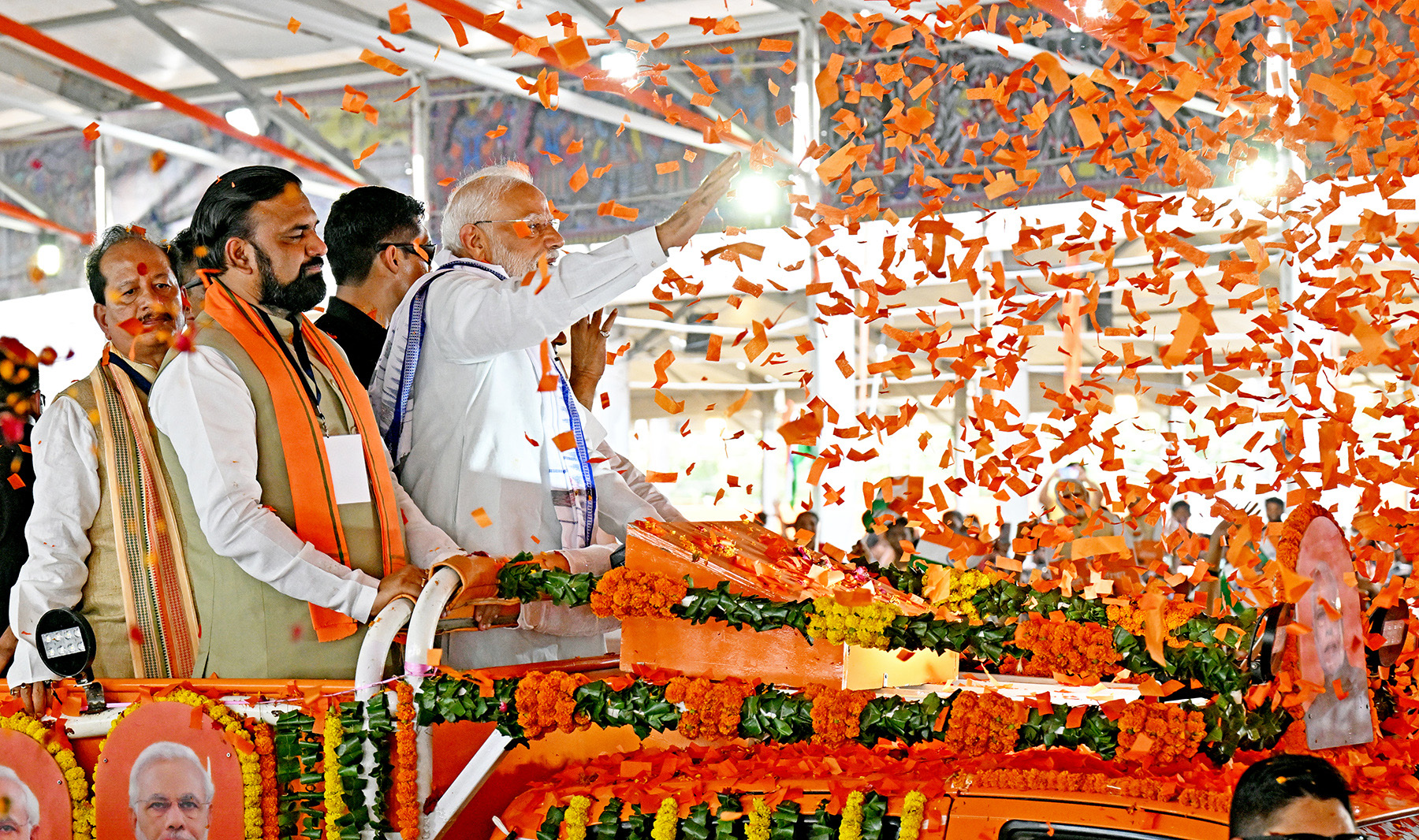
Prime Minister Narendra Modi in Motihari during the foundation stone laying and inauguration of various projects on July 18, 2025.
Motihari/Durgapur: Prime Minister Narendra Modi’s declaration that “this is the era of our eastern states” signals a calculated push to elevate India’s eastern region, with Bihar and West Bengal at the forefront, as the nation gears up for crucial state elections. On July 18, 2025, Modi laid the foundation stone and inaugurated development projects worth over ₹7,000 crore in Motihari, Bihar, and ₹5,400 crore in Durgapur, West Bengal, framing these initiatives as part of a broader vision to transform eastern India into a hub of progress akin to the country’s western powerhouses.
With Bihar’s assembly elections looming and the Bharatiya Janata Party (BJP) seeking to challenge the formidable Trinamool Congress (TMC) led by Mamata Banerjee in West Bengal, where elections are due early next year, Modi’s focus on infrastructure, employment, and social empowerment in these states reflects a strategic blend of governance and electoral ambition.
In Motihari, Modi invoked the historical significance of Champaran, where Mahatma Gandhi’s 1917 Satyagraha movement took root, to underscore Bihar’s potential to shape a new future. The projects, spanning rail, road, rural development, fisheries, and information technology, include the doubling of the Darbhanga-Narkatiaganj rail line (₹4,080 crore), the four-laning of the Ara bypass on National Highway 319, and fisheries infrastructure under the Pradhan Mantri Matsya Sampada Yojana (PMMSY). These aim to enhance connectivity, boost agricultural productivity, and create jobs, with Modi highlighting the allocation of ₹400 crore to 61,500 Self-Help Groups (SHGs) under the Deendayal Antyodaya Yojana-National Rural Livelihoods Mission (DAY-NRLM) and housing support for 40,000 families under the Pradhan Mantri Awas Yojana-Gramin (PMAY-G). He emphasised women’s empowerment, noting that 3.5 crore women in Bihar have Jan Dhan accounts and over 20 lakh have become “Lakhpati Didis” through SHGs, aligning with the NDA’s goal of creating 3 crore such women nationwide. Modi’s critique of the previous Congress-Rashtriya Janata Dal (RJD) governments, which he accused of stalling Bihar’s progress with only ₹2 lakh crore in central funds over a decade compared to the NDA’s ₹9 lakh crore since 2014, positions the BJP-led coalition as a transformative force. The launch of the Pradhan Mantri Dhan-Dhanya Krishi Yojana, targeting 100 agriculturally backward districts, including several in Bihar, underscores a focus on marginalised communities, with 1.75 crore farmers expected to benefit.
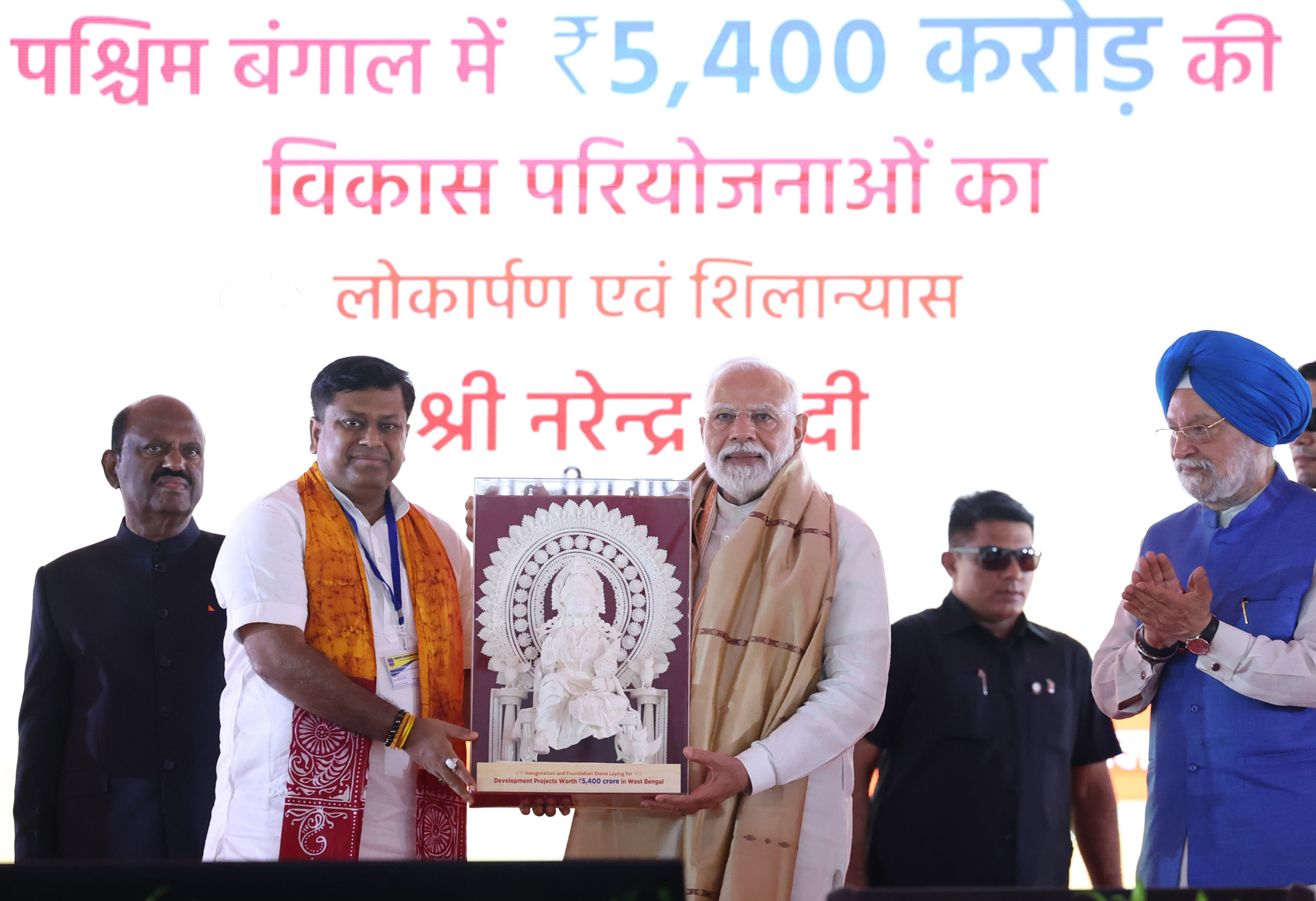
In Durgapur, a key industrial hub in West Bengal, Modi’s projects focused on oil and gas, power, rail, and road infrastructure, including the ₹1,950 crore Bharat Petroleum Corporation Limited (BPCL) City Gas Distribution project in Bankura and Purulia, the ₹1,190 crore Durgapur-Kolkata section of the Pradhan Mantri Urja Ganga pipeline, and the retrofitting of pollution control systems at Durgapur and Raghunathpur thermal power stations (₹1,457 crore). These initiatives aim to integrate West Bengal into the national gas grid, promote cleaner energy, and enhance connectivity through rail line doubling and road overbridges. Modi’s emphasis on “Make in India, Make for the World” and his vision of a developed India by 2047 frame these projects as steps toward economic self-reliance and job creation, particularly for West Bengal’s youth. His reference to the state’s role as a “powerful engine” in India’s development journey subtly challenges the TMC’s dominance by showcasing central government investment.
Also read:
- Bihar, Odisha see infrastructure push amid Bihar’s election season
- Modi’s Vision: Done, Delayed, or Dormant
The political context is critical. In Bihar, the NDA, led by Chief Minister Nitish Kumar’s Janata Dal (United) and the BJP, faces a resurgent RJD-Congress alliance ahead of the 2025 assembly elections. Modi’s Motihari speech, delivered alongside Nitish Kumar and key BJP leaders like Giriraj Singh and the NDA partner Lok Janshakti Party chief Chirag Paswan, reinforces the coalition’s unity and its narrative of delivering development after decades of RJD’s alleged misrule. The BJP is banking on infrastructure projects and schemes like PMAY-G, which has delivered 60 lakh homes in Bihar, to counter the RJD’s caste-based mobilisation. Modi’s focus on backward communities—Dalits, Mahadalits, and Other Backward Classes (OBCs)—and initiatives like the constitutional status for the OBC Commission and the Janman Yojana for tribal communities (₹25,000 crore) aim to consolidate support among these groups, which form a significant vote base. His mention of Operation Sindoor, a military response to the April 2025 Pahalgam attack, and the decline of Naxalism in districts like Champaran and Gaya, projects strength and security, appealing to voters prioritising stability.
In West Bengal, the BJP’s challenge is steeper, as Mamata Banerjee’s TMC remains a formidable force after its 2021 assembly election victory, securing 213 of 294 seats. The BJP, despite increasing its vote share to 38% in 2021 from 10% in 2016, struggles to penetrate TMC’s grassroots network. Modi’s Durgapur visit, attended by Union Ministers Hardeep Singh Puri and Sukanta Majumdar, and Leader of Opposition Suvendu Adhikari, signals an aggressive push to erode TMC’s dominance by highlighting central investments in a state where the BJP won only 18 Lok Sabha seats in 2024 compared to TMC’s 29. The gas pipeline and power plant upgrades align with West Bengal’s industrial aspirations, but Modi’s speech avoided direct criticism of Banerjee, focusing instead on national goals. This restraint suggests a strategy to appeal to voters disillusioned with TMC’s governance, particularly on issues like corruption, while avoiding alienating her loyal base.
The initiatives reflect a dual strategy: developmental governance and electoral positioning. In Bihar, the NDA leverages its track record of central-state collaboration, with Modi crediting Nitish Kumar’s government for transparent job appointments and women’s empowerment through the Jeevika scheme. The ₹1 lakh crore scheme for first-time private-sector job seekers, set to begin on August 1, 2025, targets Bihar’s youth, a key demographic in a state with a median age of 22, per 2021 census data. In West Bengal, the BJP aims to capitalise on industrial growth and infrastructure to challenge TMC’s narrative of central neglect, a claim Banerjee has used effectively. However, TMC’s focus on social welfare schemes like Lakshmir Bhandar, benefiting 2 crore women with monthly stipends, poses a counter-narrative, with Banerjee accusing the BJP of withholding central funds.
The emphasis on eastern states as India’s new growth engine is a strategic pivot. India’s eastern region, which includes states like Bihar, West Bengal, Odisha, Jharkhand, and the northeastern states, contributing 30% of GDP but lagging in per capita income (₹1.2 lakh vs. ₹1.7 lakh nationally, per 2023 NITI Aayog data), benefits from targeted schemes like the Dhan-Dhanya Krishi Yojana and Urja Ganga. Yet, challenges remain: Bihar’s 34% poverty rate (NITI Aayog, 2023) and West Bengal’s infrastructure deficits, with only 40% of rural roads paved (Ministry of Rural Development, 2024), demand sustained investment. The BJP’s ability to translate these projects into electoral gains is uncertain. In Bihar, the RJD’s focus on social justice, as seen in Tejashwi Yadav’s rallies promising caste-based quotas, has the potential to split the OBC vote. In West Bengal, TMC’s organisational strength and Banerjee’s populist appeal, bolstered by 1.5 crore SHG members, remain formidable.
Modi’s vision hinges on execution and perception. The rail and road projects, like the Amrit Bharat Express from Motihari to Delhi and the Purulia-Kotshila rail line doubling, promise connectivity but face delays, with 20% of Bihar’s rail projects behind schedule (Railway Ministry, 2024). In West Bengal, industrial projects may boost jobs, but TMC’s narrative of cultural pride and state autonomy resonates deeply. The BJP’s success depends on convincing voters that its development agenda outpaces regional loyalties, a tall order given Banerjee’s entrenched support and Nitish Kumar’s coalition dynamics.
In conclusion, Modi’s focus on eastern India’s development through substantial investments in Bihar and West Bengal is a calculated move to strengthen the NDA’s electoral prospects while addressing regional disparities. The projects signal a commitment to infrastructure and empowerment, particularly for backward communities and women, but their electoral impact is uncertain against strong regional opponents. The BJP’s narrative of transformative governance must overcome entrenched caste and cultural dynamics to reshape the political landscape in these pivotal states.
– global bihari bureau