Global Diets Grow, but Small Farmers Need a Boost
Rome/Paris: Can clever farms feed everyone and save the planet?
A new study by the Food and Agriculture Organization of the United Nations (FAO) and the Organisation for Economic Co-operation and Development (OECD) says it’s possible, but farms must get smarter to end hunger, cut greenhouse gas emissions, and handle unpredictable weather like droughts or storms. The OECD-FAO Agricultural Outlook 2025-2034, the 21st edition of this key global report, was developed with input from FAO and OECD member countries and commodity groups to guide food policies for the next decade. It predicts that as incomes rise in middle-income countries, people will eat more meat, dairy, and fish. By 2034, the world’s average daily calorie intake from these foods will rise by 6 per cent. In lower-middle-income countries, this jump will be 24 per cent, reaching 364 calories per person per day, above the FAO’s 300-calorie mark for a healthy diet. But in low-income countries, people will get only 143 calories a day from these foods, showing many will struggle to eat enough nutritious food, putting the 2030 global nutrition goal at risk.
Global farm and fishery production will grow by 14 per cent by 2034, mostly because middle-income countries are getting better at farming. Meat, dairy, and egg production will rise by 17 per cent, and the number of cattle, sheep, pigs, and poultry worldwide will increase by 7 per cent. This growth means more animals and farmland, pushing farm-related emissions up by 6 per cent, even though farming is getting less polluting per unit. The study says a 10 per cent increase in food production, paired with a 15 per cent boost in farming efficiency, could end hunger and cut emissions by 7 per cent. Clever tools like precision farming to target crops, better animal feed to reduce waste, smarter water and nutrient use, crop rotation to keep soil healthy, intercropping to grow more on less land, and compost-based nutrient management to recycle waste can make this happen. These methods are the heart of clever farms that could feed everyone while protecting the environment, even as weather shocks like floods or dry spells challenge farmers.
Trade is a big part of the solution. By 2034, 22 per cent of all food calories will be traded across borders, up from 17 per cent two decades ago. Strong global trade rules are needed to move food from places with an abundance to those in need, keep prices stable, and ensure everyone has enough to eat. But better farming methods will lower food prices, which could hurt small farmers who can’t afford new technology. Governments need to offer tailored programs, like training or loans, to help these farmers sell their goods and adopt smart tools. Without this support, small farmers could fall behind, making it harder to feed the world and keep farming green.
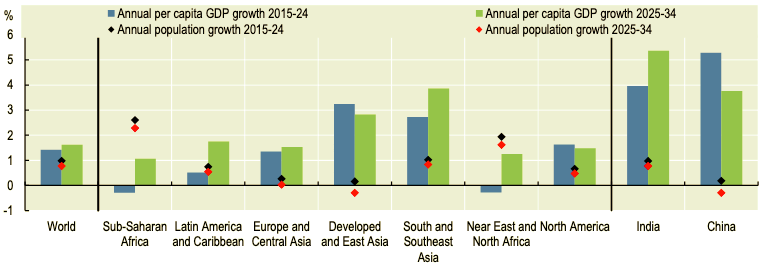
The report shows different trends around the world. India and Southeast Asia will drive 39 per cent of global food demand growth, as their populations and incomes grow. China’s share will drop to 13 per cent from 32 per cent last decade, as its growth slows compared to other regions. Sub-Saharan Africa’s cattle herds, three times larger than North America’s, will grow by 15 per cent, but each animal produces only about one-tenth as much, showing a need for better farming methods. In richer countries, people will eat less sugar and fat because of health concerns. Cereal production will grow by 1.1 per cent each year, with yields rising by 0.9 per cent annually. Farmland will expand by just 0.14 per cent a year, much slower than the 0.33 per cent rate of the last decade. Of all cereals, 40 per cent will be eaten by people, 33 per cent will feed animals, and the rest will go to biofuels and other uses.
Annual GDP per capita and population growth rates
Food demand will rise by 13 per cent by 2034, mostly in low- and middle-income countries where populations are growing and people are getting wealthier. In middle-income countries, half of this growth comes from people eating more per person, but in low-income countries, three-quarters is due to population growth. Rising incomes and city life are pushing people to eat more varied, nutritious foods like meat and fish. Yet, many in lower-middle-income countries will struggle to afford healthy diets, and low-income countries will stay far below nutrition goals, showing deep inequalities that clever farming must tackle.
To make farms cleverer, middle-income countries will use new technology, more investment, and increased fertilisers and feeds. In places like Africa and South Asia, where modern tools are hard to get, farmers will expand fields and herds instead. This makes it vital to invest in better tools, training, and infrastructure, like roads or storage, for small farmers. Global trade is crucial because food production and consumption are happening in different places due to varying strengths and needs. A fair trade system helps move food, supports sustainability, and keeps prices steady, which is essential for ensuring everyone has enough to eat.
Demand for biofuels will grow by 0.9 per cent each year, led by Brazil, India, and Indonesia. But clever farms face risks like trade disputes, geopolitical tensions, or weather shocks, which could disrupt markets by driving up prices, shifting currency values, or slowing economic growth. The report’s projections are based on current data and assumptions about economic, political, cultural, climatic, and technological trends, but these could change. Small farmers need better access to tools, knowledge, markets, and ways to handle risks like price drops or bad weather to protect their incomes and keep farms strong.
OECD leader Mathias Cormann said smart policies can end hunger and improve food security, stating, “We have the tools to end hunger and boost global food security.” FAO’s QU Dongyu added that while more people will eat better, low-income countries need more help, and farming can be greener, noting, “We can do better, and FAO and OECD stand ready to help.” The study calls for big investments in technology, infrastructure, and training to build a future where clever farms feed everyone, protect the planet, and stand strong against challenges like unpredictable weather.
– global bihari bureau