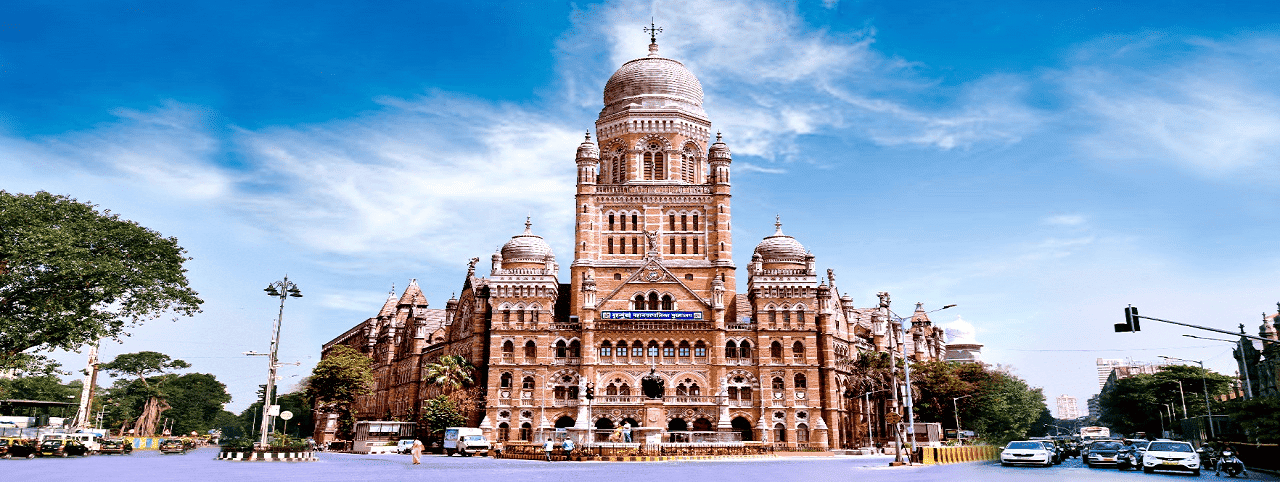
The BMC Headquarters in Mumbai
 By Vinod Raghavan*
Nine Years Later, BJP Still Short of Flag Moment at BMC
Mumbai: One question has loomed large over Mumbai’s political landscape before and after the January 15, 2026, elections to the Brihanmumbai Municipal Corporation (BMC): can the Bharatiya Janata Party (BJP) finally hoist its Green-Orange flag atop the iconic Gothic-style civic headquarters near Chhatrapati Shivaji Terminus, formerly Victoria Terminus? Nearly nine years after the last civic polls, the answer remains uncertain, even though the ruling alliance has crossed the majority mark.
Despite elections being held after a prolonged gap of nine years, with the advantages of incumbency, access to government machinery and a fractured Shiv Sena, the BJP managed to secure only seven corporators more than its 2017 tally. The BJP won 89 seats, compared to 82 in the previous election. Its ally, the Eknath Shinde-led Shiv Sena faction, secured 29 seats, taking the alliance’s combined strength to 118 in the 227-member civic body, marginally above the majority threshold of 114.
The elections were originally due in 2022 but were postponed by the Maharashtra State Election Commission. The delay coincided with major political upheavals in the state, including the split in the Shiv Sena, the fall of the Uddhav Thackeray-led government supported by the Indian National Congress and the Nationalist Congress Party led by Sharad Pawar, and the formation of a new government headed by Eknath Shinde with BJP support. Shinde had taken along 40 Members of the Legislative Assembly and a large number of corporators from the BMC, fundamentally altering the civic political arithmetic.
In the subsequent Maharashtra Assembly elections, the BJP emerged as the single largest party and formed the government under Devendra Fadnavis, with Eknath Shinde of the Shiv Sena faction and Ajit Pawar of the Nationalist Congress Party faction as deputy chief ministers. Since then, no civic body elections have been held in the state until the Supreme Court directed that the BMC polls be conducted by January 2026.
The extended interregnum allowed the state government to exercise administrative control over the cash-rich BMC and highlight major infrastructure projects such as the Aqua Metro line, the Navi Mumbai international airport being developed by the Adani Group, the redevelopment of BDD Chawls and the Mumbai Coastal Road project. Armed with this narrative and the power of incumbency, the BJP and the Shinde-led Shiv Sena contested the BMC elections together.
Yet, the results exposed limits to the BJP’s expansion in Mumbai. The Uddhav Thackeray-led Shiv Sena faction won 66 seats despite having lost a substantial number of corporators to Shinde earlier. Several corporators who had switched sides failed to retain their seats. The Maharashtra Navnirman Sena won six seats, while the Congress and the All India Majlis-e-Ittehadul Muslimeen together accounted for over 30 seats, ensuring a sizeable opposition presence.
The symbolic importance of the “flag” narrative can be traced to Devendra Fadnavis himself. In November 2020, while addressing party workers, Fadnavis had declared that the BJP’s saffron flag would fly atop the Brihanmumbai Municipal Corporation headquarters once the party won the civic polls. The imagery was repeated during the 2026 campaign as well, with alliance leaders emphasising the political significance of installing a BJP Mayor at the BMC.
That brings the debate back to its core. Does Devendra Fadnavis know precisely what he was saying when he spoke of the BJP flag flying at the BMC? Was it a metaphor meant to signal political dominance, or did he mean it literally — the hoisting of the party’s flag atop the civic headquarters? In a broader political sense, Fadnavis has succeeded in keeping the BJP flag “flying high” in Mumbai by consolidating power and remaining central to government formation. Whether his statement was ever meant to go beyond that, however, remains known only to him.
For now, even after crossing the majority mark, the alliance has been unable to settle the question of the Mayor’s post. The Shinde-led Shiv Sena faction has reportedly demanded a rotational arrangement, citing the upcoming birth anniversary of Shiv Sena founder Balasaheb Thackeray on January 23, while the BJP has not publicly committed to conceding the post. Media reports about possible tactical moves by opposition parties remain speculative and unconfirmed.
What is clear from the numbers is that the BJP’s ambition of unchallenged civic dominance in Mumbai has not fully materialised. The party has grown, but only marginally, and not enough to claim the symbolic victory it once promised with confidence. As the city waits for clarity on the Mayor’s election, the larger question persists — not of numbers, but of symbolism. Can the BJP truly hoist its Green-Orange flag atop the BMC headquarters, or will that remain an unfulfilled promise in Mumbai’s fiercely contested civic politics?
*Senior journalist