U.S., China Join ASEAN to End Cambodia-Thailand Clash
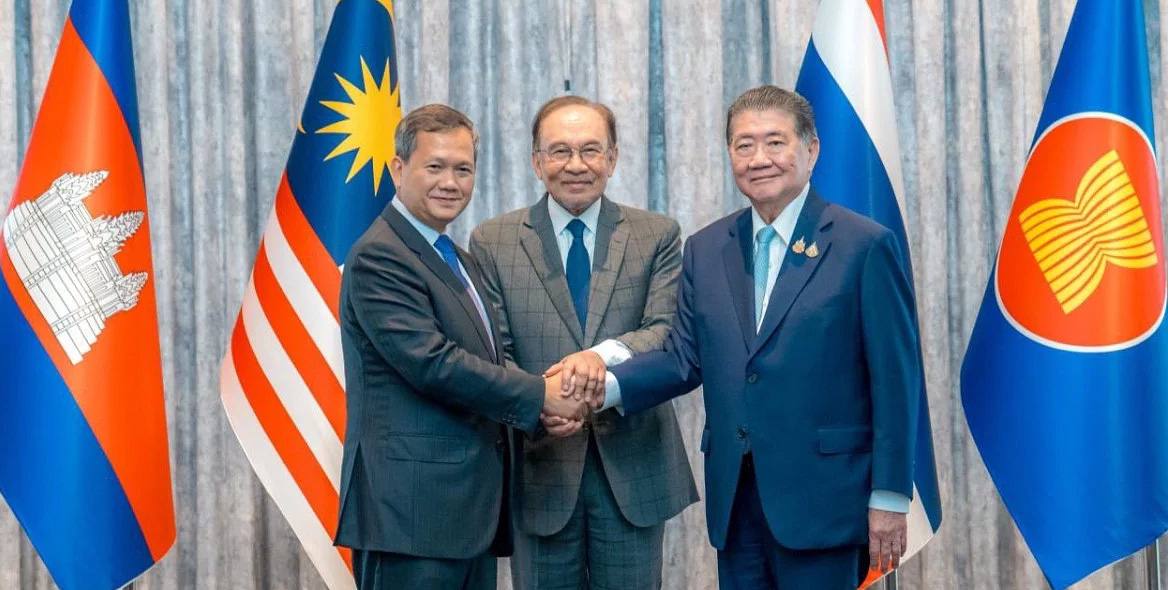
Putrajaya/Washington/Beijing/New York: In a decisive diplomatic breakthrough, Cambodia and Thailand reached a historic agreement today to implement an immediate and unconditional ceasefire, following a Special Meeting chaired and hosted by Malaysian Prime Minister Dato’ Seri Anwar Ibrahim in Putrajaya. The meeting, co-organised by the United States of America with the active participation of the People’s Republic of China, was also attended by Cambodian Prime Minister Samdech Maha Borvor Thipadei Hun Manet and Thailand’s Acting Prime Minister Phumtham Wechayachai.
The Joint Press Release issued by the Governments of Malaysia, Cambodia, and Thailand underscored the collective resolve of the participating nations to promote a peaceful resolution to the ongoing situation along the Thai-Cambodian border. The presence and collaboration of all parties, including Malaysia as ASEAN Chair, the United States, and China, reflect a robust regional and international commitment to peace, dialogue, and stability.
Both Cambodian Prime Minister Hun Manet and Thai Acting Prime Minister Phumtham Wechayachai expressed their positions and willingness for an immediate ceasefire and a return to normalcy. In a critical development, both sides agreed to enact the ceasefire from 24:00 hours local time on July 28, 2025. This move marks what the joint statement described as “a vital first step towards de-escalation and the restoration of peace and security.”
Concrete steps were laid out to ensure sustained communication and verification of the ceasefire. These include the convening of an informal meeting between regional military commanders—specifically, Thailand’s Regional Military 1 and 2 and Cambodia’s Regional Military 4 and 5—scheduled for 07:00 hours on July 29. This will be followed, subject to mutual agreement, by a meeting involving the Defence Attachés led by the ASEAN Chair. Additionally, a General Border Committee (GBC) meeting has been set for August 4, 2025, to be hosted by Cambodia.
As ASEAN Chair, Malaysia will coordinate an observer team to verify and ensure the ceasefire’s implementation. It will consult other ASEAN Member States to involve them in this observation effort, signalling a regional commitment to peace on the ground. Both countries also agreed to re-establish direct communication channels among their Prime Ministers, Foreign Ministers, and Defence Ministers to maintain continuous diplomatic and security engagement.
Further, the Foreign and Defence Ministers of Malaysia, Cambodia, and Thailand have been instructed to develop a detailed and structured mechanism for implementation, verification, and reporting of the ceasefire agreement. This framework is intended to form the foundation for long-term peace and accountability, reinforcing the shared commitment to international law, peaceful coexistence, and multilateral cooperation.
International support was clearly visible. U.S. President Donald J. Trump has been in direct contact with the leaders of both nations, urging a peaceful solution. In a statement issued from Washington, U.S. Secretary of State Marco Rubio commended the outcome of the talks, saying, “President Trump and I are committed to an immediate cessation of violence and expect the governments of Cambodia and Thailand to fully honour their commitments to end this conflict. We are grateful to Malaysian Prime Minister Anwar Ibrahim for his leadership and for hosting the ceasefire talks.” Rubio emphasised continued U.S. engagement in the peace process co-organised by Washington and Kuala Lumpur.
China, too, played a key diplomatic role. At a regular press conference in Beijing on July 28, Foreign Ministry Spokesperson Guo Jiakun affirmed that Cambodia and Thailand are China’s close neighbours and friends. Expressing deep condolences for the casualties, Guo stressed, “Maintaining good-neighbourliness and mutual trust and properly managing differences serves the two countries’ fundamental and long-term interests, and the region’s peace and stability.” He said China had been in close contact with Malaysia, Cambodia, Thailand, and relevant countries to promote dialogue and facilitate the ceasefire, and pledged that China would “maintain its fair and impartial position… and play a constructive role for a ceasefire.”
Guo also acknowledged ASEAN’s efforts over several days to mediate the crisis, stating, “China commends it and welcomes all efforts conducive to de-escalation.” He reiterated China’s continued commitment to active communication with both sides, reaffirming Beijing’s support for peace in the region.
In New York the United Nations Secretary-General António Guterres welcomed the ceasefire agreement as a positive step towards ending current hostilities and easing tensions. While commending Malaysia, US and China for their “dedicated efforts” towards the peaceful resolution of the situation, he urged both Cambodia and Thailand to respect the agreement fully and to create an environment conducive to addressing long-standing issues and achieving lasting peace. “The United Nations stands ready to support efforts aimed at promoting peace and stability in the region,” Guterres said.
Today’s agreement marks a rare moment of unity among Southeast Asian neighbours, backed by global powers, in averting the escalation of a potentially dangerous conflict. The Putrajaya talks have paved the way for a broader framework of cooperation and reconciliation, grounded in diplomacy and multilateral resolve.
– global bihari bureau