
New Delhi: The Union Cabinet, chaired by Prime Minister Narendra Modi, today approved the National Sports Policy 2025, Research Development and Innovation Scheme, Employment Linked Incentive Scheme, and a Tamil Nadu highway project to foster sports, jobs, innovation, and connectivity across India.
The National Sports Policy (NSP) 2025, replacing the 2001 policy, emerged from consultations with Central Ministries, National Institution for Transforming India (NITI) Aayog, State Governments, National Sports Federations, athletes, domain experts, and public stakeholders, aiming to position India as a global sporting powerhouse for the 2036 Olympic Games. Its five pillars guide this vision: fostering excellence through programs from grassroots to elite levels, early talent identification, competitive leagues, rural and urban sports infrastructure, world-class training, coaching, and athlete support systems, governance enhancements for National Sports Federations, adoption of sports science, medicine, and technology, and training for coaches, technical officials, and support staff; driving economic growth through sports tourism, international events, a sports manufacturing ecosystem, startups, entrepreneurship, and private sector engagement via Public-Private Partnerships (PPPs) and Corporate Social Responsibility (CSR); promoting social inclusion by expanding participation among women, economically weaker sections, tribal communities, and persons with disabilities, revitalizing indigenous and traditional games, establishing sports as a career through education integration, volunteering, and dual-career pathways, and engaging the Indian diaspora; creating a people’s movement with nationwide fitness campaigns, community events, fitness indices for schools, colleges, and workplaces, and universal access to sports facilities; and aligning with the National Education Policy (NEP) 2020 by integrating sports into school curricula and training educators and physical education teachers.
The policy establishes a governance framework, uses artificial intelligence and data analytics for performance tracking and research, sets Key Performance Indicators and time-bound targets, serves as a model for states and Union Territories to revise or formulate policies, and integrates sports into all Ministries’ programs through a whole-of-government approach.
The Research Development and Innovation (RDI) Scheme, with a Rs 1 lakh crore corpus, supports private sector innovation in sunrise and strategic sectors to advance economic security and self-reliance. The Anusandhan National Research Foundation (ANRF), chaired by the Prime Minister, provides strategic direction, with its Executive Council approving guidelines, second-level fund managers, and project scopes in sunrise sectors.
An Empowered Group of Secretaries, led by the Cabinet Secretary, approves scheme changes, sectors, project types, and fund managers, while reviewing performance. The Department of Science and Technology (DST) serves as the nodal agency. A Special Purpose Fund within the ANRF allocates funds to second-level fund managers, providing long-term concessional loans, equity for startups, and contributions to a Deep-Tech Fund of Funds for projects at higher Technology Readiness Levels and critical technology acquisitions, driving competitiveness toward Viksit Bharat by 2047.
The Employment Linked Incentive (ELI) Scheme, with a Rs 99,446 crore outlay, targets over 3.5 crore jobs by July 31, 2027, as part of the Budget 2024-25 package for 4.1 crore youth with a Rs 2 lakh crore outlay. Part A supports 1.92 crore first-time employees registered with the Employees’ Provident Fund Organisation (EPFO), offering a one-month wage up to Rs 15,000 in two installments, payable after six and twelve months of service upon completing a financial literacy programme, with a portion saved in a deposit account for later withdrawal. Part B incentivizes employers across all sectors, particularly manufacturing, with up to Rs 3,000 monthly for two years per additional employee earning up to Rs 1 lakh, extended to four years for manufacturing. Employers with fewer than 50 employees must hire two additional workers, and those with 50 or more must hire five, sustained for six months. Incentives are Rs 1,000 for EPFO wages up to Rs 10,000, Rs 2,000 for wages between Rs 10,000 and Rs 20,000, and Rs 3,000 for wages above Rs 20,000. Payments use the Aadhar Bridge Payment System for employees and PAN-linked accounts for employers, formalizing 2.6 crore additional jobs with social security coverage.
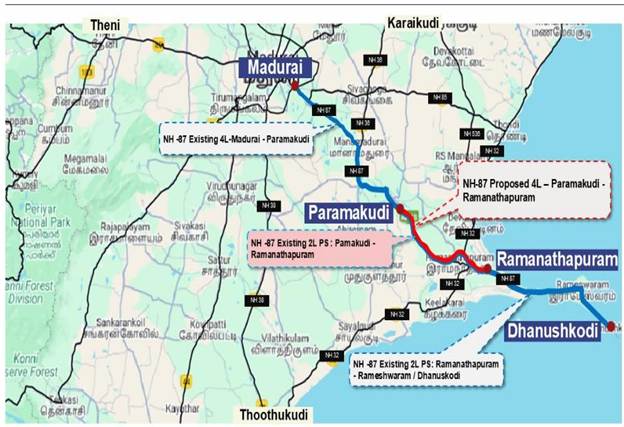
In Tamil Nadu, the Cabinet approved a 46.7-kilometer, 4-lane upgrade of National Highway 87 (NH-87) from Paramakudi to Ramanathapuram, costing Rs 1,853 crore under the Hybrid Annuity Mode. The existing two-lane highway, connecting Madurai, Paramakudi, Ramanathapuram, Mandapam, Rameshwaram, and Dhanushkodi, faces congestion in towns like Paramakudi, Sathirakudi, Achundanvayal, and Ramanathapuram. The project integrates with five National Highways (NH-38, NH-85, NH-36, NH-536, NH-32), three State Highways (SH-47, SH-29, SH-34), Madurai and Rameshwaram railway stations, Madurai Airport, and Pamban and Rameshwaram ports, facilitating goods and passenger movement. It will generate 8.4 lakh person-days of direct and 10.45 lakh person-days of indirect employment, boosting tourism to Rameshwaram and Dhanushkodi and supporting trade and industrial growth.
Map of Corridor
Across India, as per the cabinet, these initiatives reshape lives. In rural villages, young athletes train on new fields, eyeing global stages, while urban workers secure jobs with financial stability. Innovators in tech hubs access funds to pioneer solutions, and Tamil Nadu’s pilgrims and traders travel smoother roads to Rameshwaram. Students embrace sports in classrooms, and communities rally around fitness campaigns. In tribal hamlets and coastal towns, these decisions spark opportunity, from new jobs in factories to faster journeys to sacred sites, weaving a shared vision of resilience and progress toward 2047.
– global bihari bureau