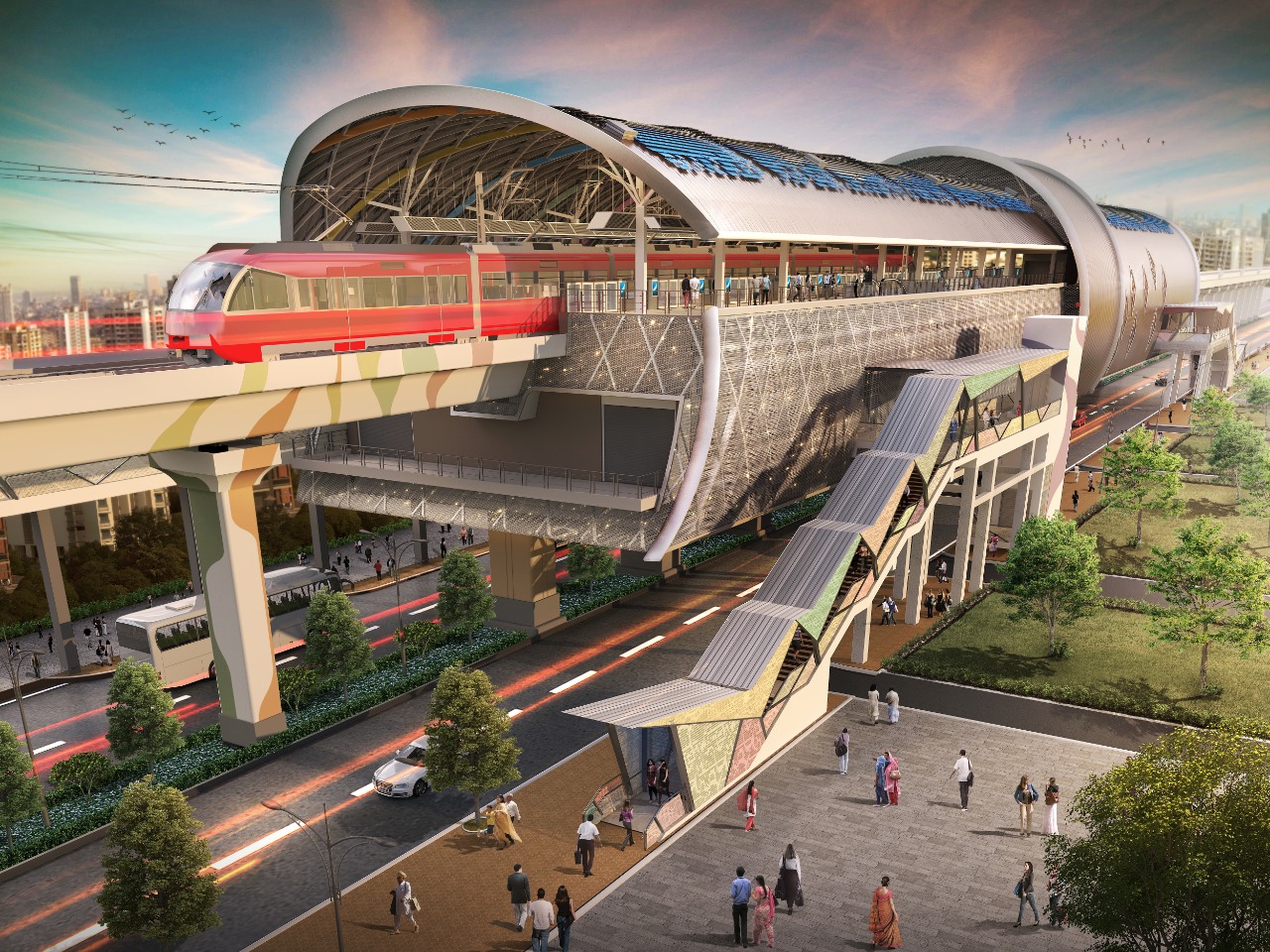
Garware College Metro Station in Pune
New Delhi: A series of decisions approved by the Union Cabinet today addressed environmental challenges in Jharia Coalfield, agricultural development in Agra, urban infrastructure in Pune, and the 50th anniversary of the Emergency declared on June 25, 1975.
To tackle fire, subsidence, and rehabilitation in Jharia Coalfield, the Revised Jharia Master Plan received approval with a Rs. 5,940.47 crore allocation. This plan prioritizes high-risk areas for fire control and land stabilization through a phased approach. Affected families, including Legal Title Holders and Non-Legal Title Holders, will relocate to resettlement sites equipped with roads, electricity, water supply, sewerage systems, schools, hospitals, skill development centers, and community halls, as guided by the Committee for Implementation of the Revised Jharia Master Plan. Each family will receive a Rs. 1 lakh livelihood grant and access to up to Rs. 3 lakh in institutional credit. A Jharia Alternative Livelihoods Rehabilitation Fund will support income-generating activities, with skill development programs in partnership with Multi Skill Development Institutes to promote sustainable livelihoods.
In Agra, Uttar Pradesh, the establishment of the International Potato Centre’s South Asia Regional Centre in Singna was approved under the Department of Agriculture & Farmers Welfare. The centre aims to enhance potato and sweetpotato productivity, post-harvest management, and value addition to improve food security, increase farmers’ incomes, and create jobs in production, processing, packaging, transportation, and marketing. High-yielding, nutrient-rich, and climate-resilient varieties will be developed to support growth in India and South Asia through scientific research.
Pune’s urban transit expansion advanced with the approval of Phase-2 of the Pune Metro Rail Project, comprising two elevated corridors: Vanaz to Chandani Chowk (Corridor 2A) and Ramwadi to Wagholi/Vitthalwadi (Corridor 2B). Spanning 12.75 km with 13 stations, the Rs. 3,626.24 crore project will be funded equally by the Government of India, the Government of Maharashtra, and external bilateral or multilateral agencies, with completion expected within four years. Extending the Vanaz–Ramwadi corridor, the project connects suburbs such as Chandani Chowk, Bavdhan, Kothrud, Kharadi, and Wagholi, serving IT hubs, commercial areas, educational institutions, and residential zones. Integration at the District Court Interchange Station with Line-1 (Nigdi–Katraj) and Line-3 (Hinjewadi–District Court) will enable multimodal transit. Aligned with Pune’s Comprehensive Mobility Plan, the project seeks to enhance east-west connectivity and reduce congestion on roads like Paud Road and Nagar Road. Intercity bus services from Mumbai, Bengaluru, Ahilya Nagar, and Chhatrapati Sambhaji Nagar will connect at Chandani Chowk and Wagholi. The Maharashtra Metro Rail Corporation Limited is overseeing implementation, with pre-construction activities, including topographical surveys and detailed design consultancy, underway. Daily ridership is projected to rise from 0.96 lakh in 2027 to 2.01 lakh in 2037, 2.87 lakh in 2047, and 3.49 lakh by 2057.
Marking the 50th anniversary of the Emergency declared on June 25, 1975, the Union Cabinet resolved to commemorate and honour the sacrifices of countless individuals who valiantly resisted the Emergency and its attempt at subversion of the spirit of Indian Constitution, “a subversion which began in 1974 with a heavy-handed attempt at crushing the Navnirman Andolan and Sampoorna Kranti Abhiyan”. To mark the occasion, a two-minute silence was observed in today’s meeting of the Union Cabinet as a tribute to those whose constitutionally guaranteed democratic rights were taken away and who were then subjected to unimaginable horrors. The Union Cabinet paid tributes to their exemplary courage and valiant resistance to the Emergency’s excesses.
Designated as Samvidhan Hatya Diwas, the day acknowledges the suspension of fundamental rights, press freedom, and the detention of over 1.4 lakh individuals, including political leaders, social workers, students, and citizens, who were denied judicial recourse. The resolution noted the Emergency’s impact, including efforts to influence the judiciary, the passage of the 42nd Amendment, and the suppression of movements like the Navnirman Andolan and Sampoorna Kranti Abhiyan. Speaking at Kumaon University’s Golden Jubilee in Nainital, Vice-President Jagdeep Dhankhar described the Emergency as an “earthquake to destroy democracy,” highlighting the Supreme Court’s ruling that upheld the suspension of fundamental rights, overturning decisions from nine High Courts. Prime Minister Narendra Modi paid tribute to those who resisted, noting the anti-Emergency movement’s role in restoring democracy, and urged citizens to share experiences from 1975–1977 on social media to raise awareness among younger generations. The resolution reaffirmed the commitment to constitutional values and democratic principles.
From Jharia’s coalfields to Agra’s farms, from Pune’s metro tracks to the hallowed memory of democratic struggle, the Cabinet’s decisions on June 25, 2025, charted a course for a nation that builds, heals, and remembers. Each step forward—whether in rehabilitation, innovation, mobility, or reflection—underscores a commitment to a future where progress and principles walk hand in hand.
– global bihari bureau