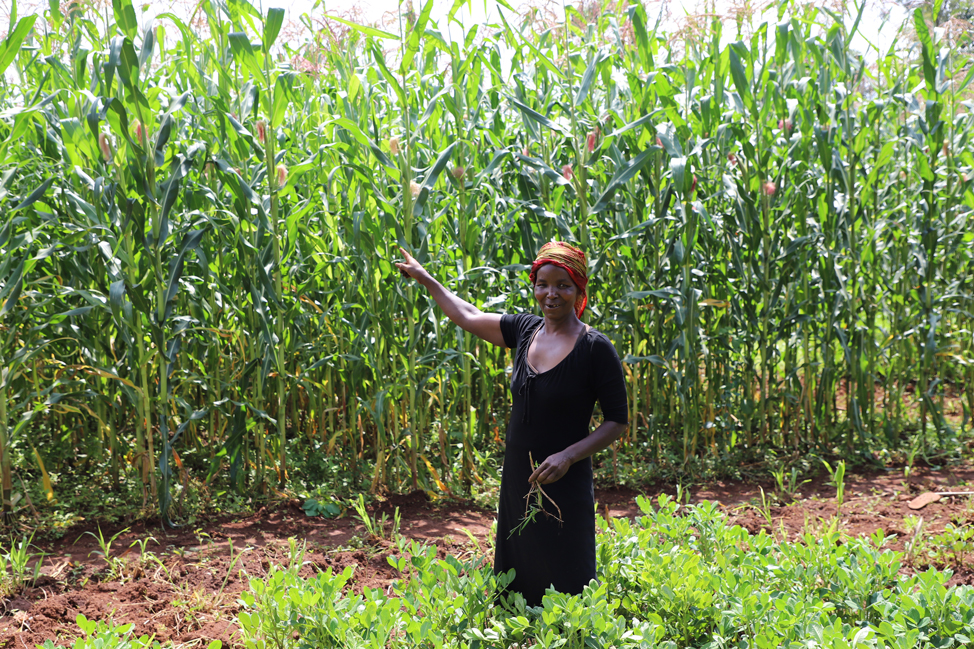
Agnes Barasa and her fellow farmers were not aware that burning crop residues were harming their soils. Implemented by FAO and IFAD together with the Kenyan government and with funding from the European Union, the BOOST initiative taught them about good practices for soil health. ©FAO/Pauline Akolo
Agnes’s Soil Revival Sparks Kenya’s Farming Renaissance
In the sun-dappled village of Maeni, nestled in Kenya’s Kimilili sub-county, Agnes Barasa kneels beside her vibrant garden, gently spreading organic mulch around thriving kale, beans, and tomatoes. The scene pulses with life, a stark contrast to the barren, cracked earth that defined this patch just three years ago. Once, Agnes faced relentless uncertainty, her harvests too meagre to sustain her family of five children despite years of toil. Today, she stands as a testament to transformation, her fields yielding enough corn, groundnuts, bananas, and vegetables to not only feed her household but also carve out a livelihood. This remarkable turnaround, a quiet agricultural revolution, stems from a project called BOOST, which has breathed new life into Kenya’s dying soils and rekindled hope for farmers like Agnes.
Two decades ago, when Agnes moved to Maeni after her marriage, the land seemed cursed with scarcity. Year after year, her hard work yielded little, her family perpetually teetering on the edge of hunger. The culprit, she later learned, was not just misfortune but outdated practices that starved the soil of vitality. “I am among the farmers who used to burn maize residue and dry vegetation in the fields, oblivious of the harm I was causing my soil,” Agnes confesses with a rueful smile, her voice tinged with the wisdom of hindsight. Burning crop residues, a common tradition, stripped the land of nutrients, while monocropping and heavy reliance on chemical fertilisers turned the soil acidic and frail. For years, Agnes and her husband focused on sugarcane, a crop that promised prosperity but delivered late payments and dwindling returns, forcing them to switch to corn—a transition that only deepened the soil’s decline.
Enter the BOOST project, a collaborative effort led by the Food and Agriculture Organization of the United Nations (FAO), alongside the Government of Kenya and the International Fund for Agricultural Development (IFAD), with funding from the European Union. Jimmy Mweri, the FAO coordinator for BOOST, explains the crisis with striking clarity: the issue wasn’t merely sick soils but “dying soils,” suffering from what he calls “malnutrition.” Farmers like Agnes were unaware that soil could be diagnosed, much like a patient, using portable scanning devices to pinpoint deficiencies such as low phosphorus levels or high acidity. “I had never known that, like other living things, the soil is living and if it is sick, it can be taken to the hospital and be treated,” Agnes says, her hearty laugh echoing the astonishment of this revelation. The BOOST training opened her eyes to the harm caused by practices like excessive tilling, which left soil bare and vulnerable to erosion, stripping it of moisture and biodiversity.
Agnes’s journey from struggling farmer to local innovator began with these lessons. She learned to nurture her soil with organic mulch and farm-produced organic fertilisers, reversing years of degradation. The results were nothing short of miraculous. This year, the long rains brought a historic corn harvest—jumping from a meagre three bags to an astonishing 15—restoring her faith in the land. “I am a happy lady because my soil is yielding where it did not,” she recounts, her pride palpable. Her vegetable garden, too, flourishes, thanks to bio-fertilisers, pest and disease control products, and certified hybrid seeds provided by BOOST, coupled with training in their precise application. Techniques like Integrated Pest Management, intercropping, crop rotation, and post-harvest management have transformed her small plot into a beacon of productivity.
The impact extends beyond Agnes’s backyard. Emboldened by her success, she has become a trainer, sharing agroecological practices with farmers in Maeni and beyond. Her ambitions are growing as fast as her crops: she plans to expand her kitchen garden for both household consumption and commercial sales, while aiming for even larger corn harvests next season. Yet, her story is just one thread in a larger tapestry of agricultural decline in Kenya’s western region, where climate change—marked by erratic rainfall and rising pest populations—combined with poor soil management, has driven production to historic lows. The BOOST initiative, active in five Kenyan counties, is tackling this crisis head-on, reaching 40,000 farmers to diagnose and address the root causes of their struggles.
Central to this effort are ten agroecology service hubs, vibrant centres managed by young, newly trained graduates who provide a lifeline to farmers. These hubs, a source of employment for youth fresh out of college, offer services like land preparation, planting, irrigation, composting, agroforestry, pest and disease control, harvesting, and aggregation—all at affordable rates. Farmers learn zone-specific agroecological practices, tailored to their local conditions, and gain access to resources that make sustainable farming viable. For Agnes and her peers, these hubs are more than service points; they are symbols of a new agricultural ethos, one that treats soil as a living entity deserving of care.
As Agnes tends her garden, her hands working the soil with newfound respect, the broader implications of BOOST come into focus. The project is not just about reviving fields but about restoring dignity and security to farmers’ lives. By bringing new life to Kenya’s soils, BOOST is sowing seeds of better nutrition, food security, and economic resilience. For farmers like Agnes, the transformation is both personal and profound—a journey from despair to abundance, rooted in the simple yet revolutionary act of healing the land.
Source: The FAO News And Media Office, Rome
– global bihari bureau