India Storms into Women’s World Cup Final
Rodrigues’ Grit and Kaur’s Power Shatter Australia’s Reign
Navi Mumbai: India is in the final of the ICC Women’s Cricket World Cup 2025. For the third time in their history, the Women in Blue have broken through the glass ceiling of heartbreaks and near-misses— after falling short in the semi-finals of 2009, 2013, and 2022 — storming into the summit clash after defeating defending champions and previously unbeaten Australia by five wickets in a match that will live wherever the story of women’s cricket is told.
The stands began to fill long before the toss, blue flags and drumbeats setting the rhythm of hope. Australia, undefeated so far, carried the air of inevitability as Alyssa Healy chose to bat. Under clear skies that would later give way to a teasing drizzle, Healy and Beth Mooney launched briskly, punishing India’s seamers with timing and intent. Their 63-run opening stand looked ominous until Deepti Sharma’s flight and dip lured Mooney into edging behind.
Phoebe Litchfield then took command, playing what seemed a flawless century — 107 off 116 balls — built on timing, patience, and disdain for width. Healy’s 67 and McGrath’s 45 added muscle, and for much of the innings Australia looked set for 360. Their partnerships were modelled on precision — 63 for the first wicket, 92 for the second, and another 54 between Litchfield and Gardner that threatened to break India’s resolve.
But India’s bowlers, often maligned for leaking runs late, found heart. Renuka Singh Thakur fired yorkers at the death, Deepti varied her pace cannily, and Pooja Vastrakar’s bouncer sent Gardner back. From 331 for 6, Australia collapsed to 338 all out in 49.5 overs — a strong total, yet not the fortress it seemed. The fall of wickets in the final overs — three within ten balls — injected belief back into the Indian dugout and turned the applause in the stands from polite to thunderous.
As India began the chase, a light drizzle slicked the outfield and at times slowed the ball on the turf, but the DY Patil surface still offered true bounce. Hence, deliveries continued to carry and occasionally beat the bat or the fielder. The crowd, their tricolours glistening under the soft mist, chanted into the drizzle. Shafali Verma departed early, miscuing a rising delivery, but the moment Jemimah Rodrigues walked in, the energy shifted. Her first drive pierced cover like a command; her second flick silenced the Australian field. Then came Harmanpreet Kaur — calm, calculating, almost prophetic. Together, they reshaped the match.
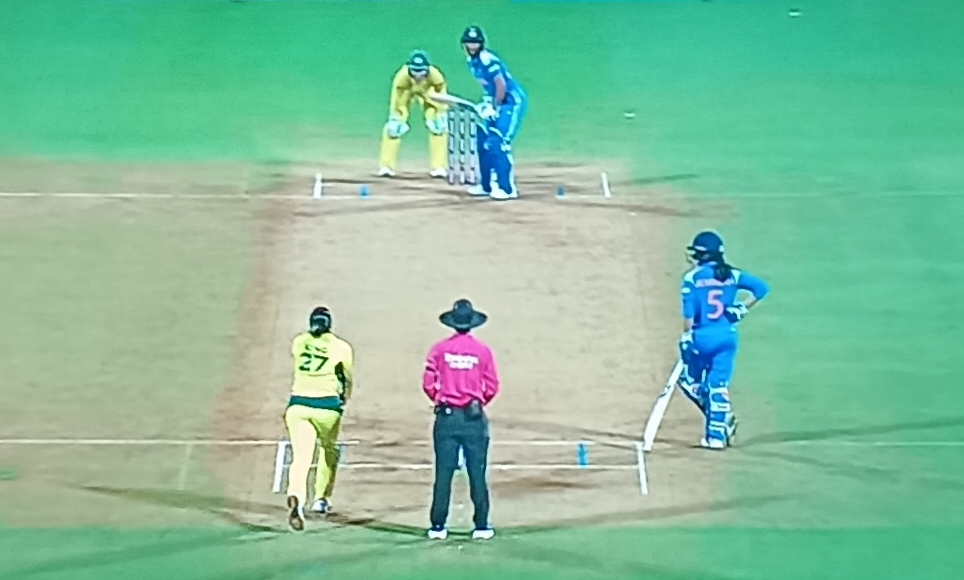
Rodrigues batted through pain, grit stitched into every run. A thudding blow from Annabel Sutherland struck her shoulder, but she waved off the physio and carried on, eyes fierce beneath the helmet. Twice she cramped mid-run, clutching her thigh, and both times she straightened up, tightened her gloves, and took guard again. Her 127 from 134 balls was not just a century — it was an act of endurance, an exhibition of courage under pressure. Harmanpreet matched her composure with precision, steering the innings with 89 off 98, and their 154-run stand became the axis of history.
The drizzle thickened briefly, slowing the outfield, yet Jemimah’s wrists found gaps where logic found none. The Australian fielders, usually hawk-eyed, fumbled on the wet turf. When Harman fell to a mistimed pull, the crowd held its breath — only for Richa Ghosh to unleash a flurry of audacious boundaries. Amanjot Kaur finished the chase with a square cut that raced away under floodlights slick with dew. India reached 339 for 5 in 48.3 overs — the highest successful chase ever in women’s ODI cricket, a world record and the greatest chase in Women’s World Cup knockout history.
What followed was pure release. Jemimah sank to her knees, tears streaking through exhaustion; Harman sprinted from the dugout, arms wide; the DY Patil Stadium roared as if the Arabian Sea itself had joined in. Australia’s unbeaten run ended, their reign toppled, and the Indian tricolour fluttered triumphant above the stands. For Australia, seven-time world champions (1978, 1982, 1988, 1997, 2005, 2013 and 2022), it was the end of another long empire; for India, a new dawn.
Australia’s dominance had lasted generations. Their seven world titles — spanning from 1978 to 2022 — had built an aura few dared to breach. Yet tonight, under the Navi Mumbai haze, the defending champions were disarmed not by fortune but by resolve. For India, this journey has been built on resilience, and this victory was months in the making. India’s campaign began shakily — a narrow escape against Bangladesh after a middle-order wobble, followed by a heartbreaking super over against South Africa that left the dressing room silent for hours. But from that loss came purpose. Against England in Pune, Smriti Mandhana’s century and Deepti’s four-wicket burst reignited the campaign. Sri Lanka were brushed aside clinically; New Zealand were buried under a 300-plus onslaught; and Pakistan fell in a tense thriller at Ahmedabad, where Rodrigues and Richa Ghosh stitched a last-over miracle. Every game built resolves. By the time India reached the semis, they had transformed from a team of promise to a team of destiny.
As the players made a slow lap of honour, the crowd sang in chorus. “India, India!” rolled through the drizzle, through tears, through history. Jemimah Rodrigues, her eyes glistening, said simply, “I know Jesus carried me through today.”
Harmanpreet Kaur, reflecting on the team’s unity, said, “The way we were lifting each other up shows how positive we were.”
India will now face South Africa in the final on November 2, at the same venue. This will be India’s third Women’s World Cup final — their first since the heartbreak at Lord’s in 2017, and two decades after their maiden appearance in 2005, when Australia denied them the trophy in Centurion.
The Women in Blue will return to Navi Mumbai not as underdogs, but as dreamers who turned defiance into destiny. For one night at least, under the rain and roar, Indian cricket rediscovered its heartbeat — and the world stood witness.
– global bihari bureau