Harmanpreet’s India Breaks the Barrier of History
From Rain to Radiance: The Night India’s Women Conquered the World
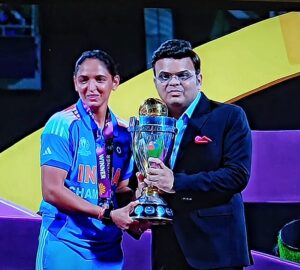
Navi Mumbai: For generations of Indian fans, this was the night they had waited for — a night when the blue jerseys glistened not just under the floodlights but in the pages of history. India’s women cricketers, often carrying the weight of hope with quiet resilience, finally lifted the ICC Women’s Cricket World Cup for the first time in the tournament’s twelve-edition history, defeating South Africa in a pulsating, rain-hit final at DY Patil Stadium, Navi Mumbai, that stretched hearts, nerves and boundaries.
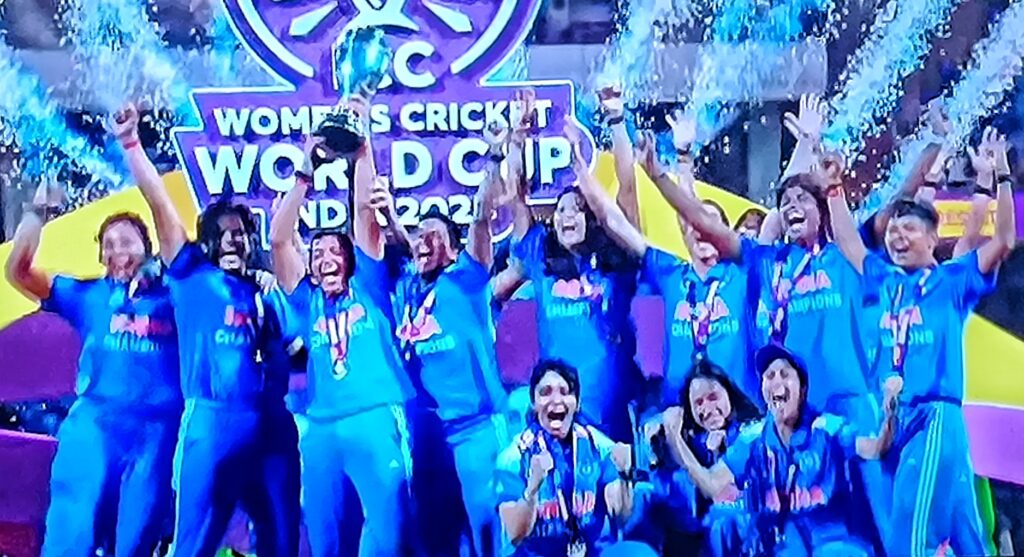
It was not just the culmination of a tournament, but of a long emotional arc in Indian sport — one that began in dusty maidans and underfunded academies, where young girls practised with borrowed kits and unshakable dreams. The journey to this night had been built over years of silent persistence, institutional reform and the quiet rise of a generation that refused to be confined by stereotypes. As dusk fell over Navi Mumbai, every raindrop on the stadium covers seemed to echo the struggles and triumphs that had brought Indian women’s cricket to this defining threshold.
As the echoes of the national anthem faded and the air thickened with anticipation, a stubborn monsoon cloud hovered over Navi Mumbai — reluctant, as if the heavens themselves hesitated to let history begin. The drizzle had started before dawn, turning the DY Patil Stadium into a patchwork of blue tarpaulins and silver puddles. Yet the crowd of forty thousand stayed unmoved, some wrapped in flags, others singing through the downpour. The energy was electric, feverish, collective — a nation’s heartbeat waiting for release. When the rain finally relented, ground staff peeled off the covers to a roar that drowned the last drops.
The toss, delayed by more than an hour, finally took place under heavy floodlights. South Africa’s captain, Laura Wolvaardt, won and chose to bat first, a brave call on a damp surface that promised early swing. India’s captain, Harmanpreet Kaur, calm but steely, simply nodded. “We’ve chased tougher skies,” she would say later.
India had reached the final through persistence, not perfection. Their tournament began under scrutiny after a shaky start against Australia, where a middle-order collapse cost them the opener by 22 runs. But from there, the team’s momentum grew like a rising tide. Smriti Mandhana’s patient century against New Zealand steadied early nerves; Jemimah Rodrigues’ consistency stitched together India’s middle overs; Deepti Sharma’s all-round brilliance gave the side balance. Yet it was the reintroduction of Shafali Verma — who hadn’t even been in the initial playing 15 — that transformed the campaign’s heartbeat. Drafted back midway through the group stage after an injury to opener Pratika Raj, Shafali played with the raw power of redemption. Her fearless strokeplay redefined India’s approach, making her both the crowd’s darling and, eventually, the Player of the Match in the final.
South Africa’s innings was a study in grit and recovery. They held early promise, but India’s bowlers meshed rhythm with discipline. Renuka Singh and Pooja Vastrakar found movement on the surface; Deepti Sharma used the conditions to knot partnerships and break stands. Marizanne Kapp resisted with her clean drives and timing, offering a focal point for South Africa’s resistance, but the Indian fielders didn’t let partnerships run away.
When India came to bat, they did so with clarity of purpose. Smriti Mandhana and Shafali Verma opened with intent; Mandhana’s timing and patience set the platform while Shafali supplied the fireworks. The innings was anchored by Shafali’s match-defining contribution — a courageous, high-temper knock that put India in control — and a vital touch from Deepti Sharma that turned the game. Richa Ghosh’s late-innings cameo provided the acceleration needed to post a formidable total.
India finished on 298 for 7 in their 50 overs — a total that left the Proteas with much to chase under the pressure of a World Cup final and the weight of the home crowd. In pure numbers, the night told its own story: India 298 for 7 in 50 overs — Shafali Verma 87, Deepti Sharma unbeaten 58 — against South Africa’s 246 all out in 45.3 overs: Wolvaardt 101; Deepti 5/39.
South Africa fought hard. Laura Wolvaardt anchored their response with a resolute century that kept the chase alive through several tense phases. But Indian bowling found the seams between bat and ball. Deepti’s five-wicket haul ripped the momentum away; Renuka and seamers backed her with tight lines and dogged energy; fielding moments — a slip catch, a direct hit, a brilliant run-out — stitched the final chapters together. South Africa were bowled out for 246 in 45.3 overs. India had won by 52 runs and with it the World Cup.
The moment the final wicket fell, the stadium heaved. Players collapsed into one another. Harmanpreet Kaur could not hold back her emotion; Smriti Mandhana walked up, wrapped her arms around her captain, and the two remained embraced as the crowd chanted and cried. It was an image that spoke of generational continuity and deep relief. “Every time after every World Cup that we came as a team and we were discussing what we needed to do,” she said later. “The expectations out of us were that they needed something special, and the BCCI really invested in us — that’s why we are standing here. This is the start, and we wanted to break this barrier. The next plan is to make this our habit. We have so many big occasions coming up, and this is not the end; this is just the beginning.”
Shafali, declared Player of the Match for her match-defining contribution, later reflected quietly and sincerely that she had been left out earlier in the tournament, had worked in the nets and drawn strength from her father’s encouragement to stay prepared and fearless. She said she tried to play fearless cricket and that the night belonged to everyone who had believed in her. South African captain Laura Wolvaardt was gracious in defeat: “We gave it our all. India were brilliant — especially Shafali. Finals like these lift the whole women’s game.”
The final’s finer details – the turning points that countless replays would dwell on – were deceptively small: Deepti’s flighted off-break that bowled a set Wolvaardt; Renuka’s probing early swing; a diving boundary save that stopped a certain four; the acceleration in the final five overs; the fielding push that converted chances into matches. In sport, those seem like fragments; together, they crafted history.
The celebrations that followed were noisy and meaningful. Fireworks lit the Navi Mumbai sky; flags fluttered in every corner; legends and fans converged in joy. In the VIP stands sat Sachin Tendulkar, Sunil Gavaskar, Mithali Raj, and Jhulan Goswami, who wiped tears beneath her scarf. Neeta Ambani, Rohit Sharma and his wife Ritika, and Jay Shah joined the applause as the players completed a lap of honour. It was not an evening of hierarchy but of shared history — every generation of Indian cricket seemed to merge in that moment of triumph.
Also read: Blue Storm: India in Women World Cup Cricket Final
India’s route to the final had been built not only in this tournament, but over years of institutional change and fierce preparation. The Women’s Premier League (WPL) had offered domestic players a professional platform since 2023; national contracts, equal match fees and improved infrastructure stabilised the women’s game; training camps in Dharamsala and Vizag refined fitness and skills; national coaching staff, including Amol Muzumdar and Nooshin Al Khadeer, brought international expertise to the system.
The semi-finals had already signalled the script. A tense win over Australia in the knockouts, directed by Jemima Rodigues’ calm under pressure and Harmanpreet’s aggressive stroke-play, demonstrated India’s nerve. Earlier group matches, where they had wobbled — a clutch loss to South Africa, a narrow win over Pakistan — had sharpened their edge. Players who had seemed raw at the tournament’s start grew into match-winners; senior players rediscovered form; young talent blossomed under pressure.
Numbers underpin the story without reducing its scale. India’s final total of 298 was built from a wide base: two players scoring over 45, three more scoring 25-plus, and tight contributions from the tail. Deepti Sharma’s five wickets in the final and 12 across the tournament affirmed her all-round status; Renuka Singh’s outward swing and economy under 4.2 discounted any weakness; Richa Ghosh’s middle-order quick runs added depth. The average squad age was 23, and the team’s strike rate across matches was the highest in the knockouts.
There was an immediate cultural and social ripple. Within 24 hours, the BCCI announced ₹5 crore prize money for the players; state governments promised upgraded facilities for women; WPL franchises reported record viewership. Analysts called it a turning point. From a sport long in the shadow of its male counterpart, India’s women’s team had delivered a moment of national pride on par with any men’s triumph.
For a generation, the human moments matter as much as the scoreboard. Shafali’s tears on the field; Harmanpreet’s embrace with Mandhana, the jubilation of players who had once waited in corridors for opportunities — these visuals will run in highlight reels. But more than that, they will serve as inspiration in playgrounds and school fields nationwide. The bats they lift today, the dreams they entertain, owe much to this blue-jaunt night at Navi Mumbai.
When the team bus rolled out post-midnight, trophy secured, faces shining under streetlights, crowds lined the roads with phones flashing like fireflies. A banner across a bridge read simply: “Champions at Last.” Once the ground staff packed away covers and lights dimmed, the stadium still hummed with energy: officials estimated 65,000 glimpsed parts of the broadcast feed inside or outside the stadium that night.
For Indian women’s cricket, this wasn’t just a letter in the trophy case — it was the confirmation that belief, skill and structure can reshape the game. From maidans to international arenas, from borrowed kits to professional contracts, they had bridged decades of the gap. In the silent moments after the cheers faded, the knock of wood, the sweep of the bat, and the dive in the outfield were now part of their history.
DY Patil stood drenched in light and expectation, echoing the memory of a final that outlasted weather, odds and time. The 2025 ICC Women’s Cricket World Cup had found its rightful place — not just in the trophy cabinet, but in the soul of a nation that had waited too long to say these words: India, world champions.
– global bihari bureau