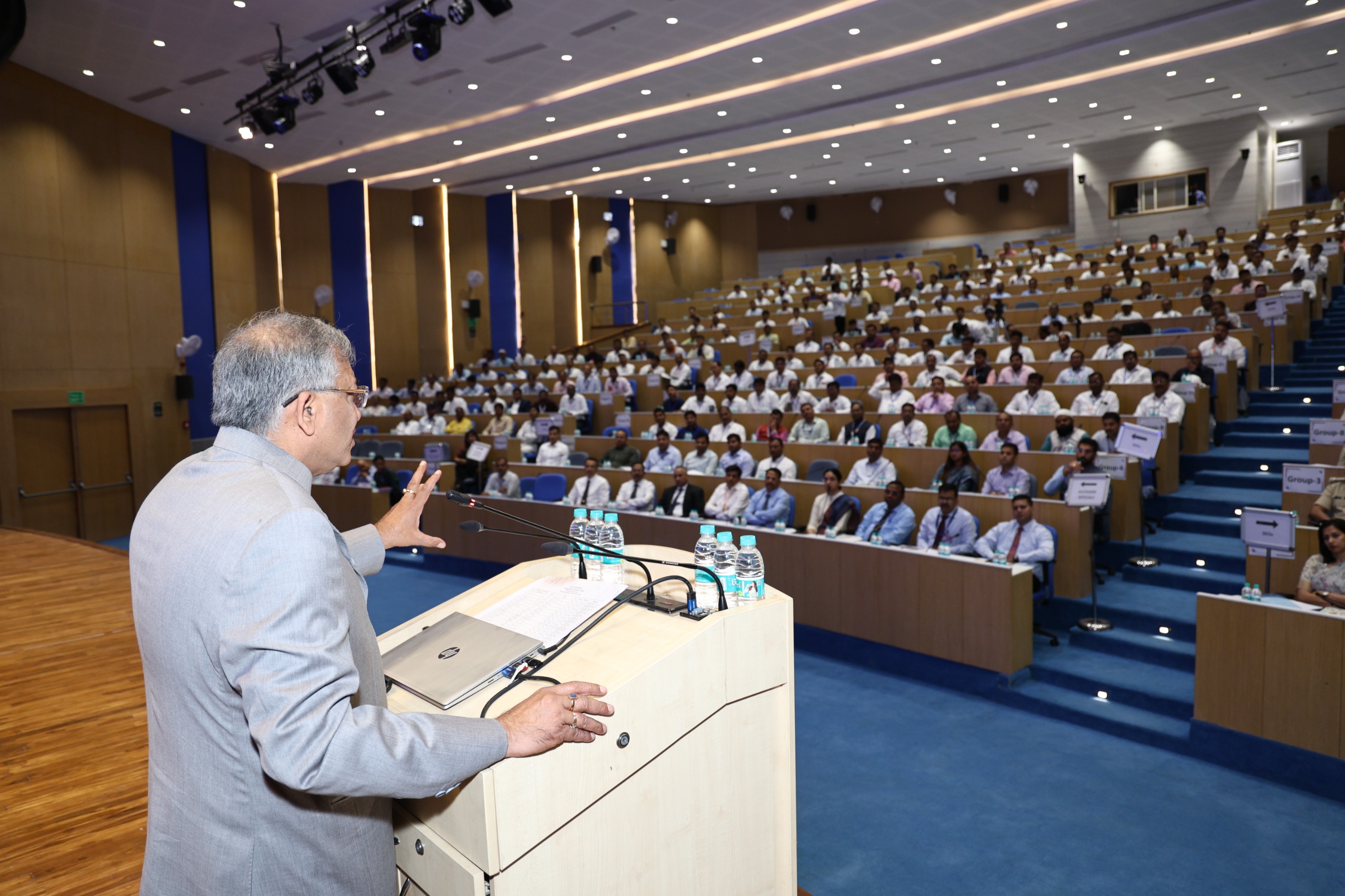
File photo of ECI's two-day training for 250+ Booth Level Agents(BLA) from Bihar in New Delhi on 16th April, 2025
Patna/New Delhi: The Election Commission of India’s (ECI) decision to launch a Special Intensive Revision (SIR) of Bihar’s electoral rolls on June 25, 2025, has ignited a fierce political row, with opposition parties accusing the commission of dismissing their pleas to reconsider a process they warn could disenfranchise over two crore citizens—particularly Dalits, Muslims, and the poor—months before the 2025 Bihar Legislative Assembly elections.
Rashtriya Janata Dal (RJD) Member of Parliament (MP) Manoj Jha, speaking after a meeting with Chief Election Commissioner Gyanesh Kumar yesterday, charged that the ECI’s one-month timeline for verifying 7.75 crore voters is impractical, especially for Bihar’s migrant-heavy electorate, and risks favoring the ruling National Democratic Alliance (NDA). All India Majlis-e-Ittehadul Muslimeen (AIMIM) chief Asaduddin Owaisi’s allegation of a “quiet implementation of the National Register of Citizens (NRC)” has amplified scrutiny, casting the ECI’s actions as a potential threat to Bihar’s democratic integrity.
The Election Commission of India (ECI), which met representatives of various political parties at Nirvachan Sadan yesterday, explained that the entire Special Intensive Revision (SIR) was “well underway “in Bihar and was “progressing smoothly”. The political parties were – Indian National Congress, Rashtriya Janata Dal, Samajwadi Party, Dravida Munnetra Kazhagam, Nationalist Congress Party – Sharadchandra Pawar, Jharkhand Mukti Morcha, Communist Party of India (Marxist), Communist Party of India (Marxist-Leninist) Liberation, Communist Party of India, Shiv Sena (Uddhav Balasaheb Thackrey).
ECI informed the political parties that the SIR exercise was being conducted in a “planned, structured and phased manner”.
Mandated under Article 326 of the Indian Constitution and the Representation of the People Act, 1950, the SIR aims to purge ineligible voters from the electoral roll, which has remained unchanged since 2003, when 4.96 crore voters were listed. The process requires voters added after January 1, 2003, to provide proof of citizenship, such as birth certificates or parental records. Nearly 78,000 Booth Level Officers (BLOs), supported by over one lakh volunteers, are conducting door-to-door verifications across Bihar’s 38 districts, with a draft roll set for publication for public scrutiny before finalisation on September 30, 2025.
The ECI emphasises that 60% of voters can verify eligibility using the 2003 roll and that BLOs are tasked with assisting vulnerable groups—the elderly, disabled, and marginalised communities—to prevent exclusions. However, opposition parties, including the RJD and Indian National Congress (INC), argue the process is unworkable, citing Bihar’s low birth registration rate of 3.7% in 2000, frequent migration affecting 20% of the electorate, and monsoon flooding, particularly in the Muslim-majority Seemanchal region, where connectivity and literacy are limited.
The RJD, a key member of the Indian National Developmental Inclusive Alliance (INDIA) bloc, has labelled the SIR “votebandi,” drawing parallels to the 2016 demonetization’s disruption. Jha stated on July 2 that the ECI’s reliance on post-2003 verification ignores Bihar’s socio-economic realities, including low literacy and seasonal flooding in areas like Seemanchal, where Muslims constitute 67% of the population in constituencies like Kishanganj. He warned that the one-month timeline could exclude legitimate voters, particularly migrants working across India, and accused the ECI of skewing the electoral field to favour the NDA. AIMIM chief Owaisi, in a June 28 letter to the ECI, charged that the SIR’s stringent documentation demands could exclude millions in Seemanchal, where poverty and poor infrastructure hinder compliance. Citing the 1995 Supreme Court ruling in Lal Babu Hussein v. Electoral Registration Officer, which mandated due process and flexible proof of citizenship for voter removal, Owaisi argued the SIR violates this precedent, particularly for Muslims, who form 18% of Bihar’s 20 million voters.
Owaisi’s influence stems from his sway in Seemanchal, where AIMIM’s five-seat victory in the 2020 Bihar elections demonstrated its ability to mobilise Muslim voters in minority-heavy areas. Though not a statewide powerhouse, his outspoken advocacy for Muslim rights and ability to shape opposition narratives make him a significant figure. His “backdoor NRC” charge has drawn widespread attention, particularly given the 2019 Assam NRC’s exclusion of approximately 19.06 lakh people. Owaisi’s legal arguments resonate with Bihar’s Muslim voters, fueling fears driven by right-wing narratives about “illegal immigrants” in border regions like Seemanchal.
The NDA, led by the Bharatiya Janata Party (BJP) and Janata Dal (United) (JD(U)), defends the SIR as essential to eliminate “bogus voters” and “infiltrators.” A senior BJP leader stated that discrepancies from migration, unreported deaths, and alleged illegal immigration since 2003 necessitate the revision. The ECI maintains that the process is transparent, with 78,000 BLOs and over one lakh volunteers ensuring fairness. However, NDA allies, such as JD(U), privately express concerns that the rushed timeline could inadvertently exclude genuine voters. The ECI’s decision to limit party delegations to two authorised representatives during the July 2 meeting, excluding figures like Congress’s Jairam Ramesh, deepened opposition distrust. Congress leader Abhishek Manu Singhvi called the restriction an unprecedented curb on dialogue, noting that the INDIA bloc’s earlier meeting request was deferred due to a lack of confirmation from some parties.
The opposition cites Supreme Court precedents to support their concerns about the SIR. The 1995 Lal Babu Hussein ruling established that voter removal requires notice and cannot rely solely on limited documents, while the 2019 Assam NRC case saw the court criticise hasty exclusions, ordering re-verification to protect voting rights. These decisions, referenced by Owaisi and Singhvi, underpin opposition threats of legal action, with Singhvi signalling a potential judicial challenge if the ECI does not act. Studies like economist Abusaleh Shariff’s, which found 20% of adult Muslims missing from Karnataka’s voter rolls, amplify fears of targeted disenfranchisement in Bihar, particularly in Seemanchal.
INDIA bloc leaders, including Jha and Singhvi, urged the ECI to extend the SIR timeline during their July 2 meeting, citing voter confusion in areas like Saran’s Chhapra town and logistical challenges in flood-prone regions. Owaisi, in a fresh statement, reiterated that the SIR risks excluding legitimate voters, particularly Muslims, and pressed for alternative proofs of citizenship, as mandated by the Supreme Court.
The ECI stated that all concerns were “fully addressed” but has not yet announced changes to the timeline. It elaborated that in the first phase, from June 25 to July 3, 2025, Enumeration Forms (EFs) were being printed and distributed to the approximately 7.90 crore electors in Bihar. Electoral Registration Officers (EROs) were making available partially pre-filled forms, based on existing records as of June 23, 2025, through the 77,895 Booth Level Officers (BLOs) pressed into action for the exercise, and further 20,603 BLOs were being appointed. These BLOs were delivering the EFs door-to-door to all the 7.90 crore electors whose names were on the Electoral Roll as on 24.06.2025 (date of issue of SIR order). In addition, the forms were available for download on the ECI portal, and the BLAs appointed by political parties could also submit up to 50 certified forms per day. In the second phase, the ECI said the Enumeration Forms will be filled and are to be submitted before 25th July 2025. To support this process, volunteers are available to assist the voters alongside the BLOs. Nearly 4 lakh volunteers which including government officials, NCC cadets, NSS, have been deployed to make the process seamless for the voters and help the old, sick, Persons with Disabilities (PwD), poor and other vulnerable groups. The ECI clarified that electors whose names exist in the Electoral Roll as on 1st January 2003 are only required to submit the Enumeration Form along with an extract of the roll, without the need for submitting any other documents. In the third phase, running from June 25 to July 26, 2025, the completed Enumeration Forms will be collected by the BLOs along with the self-attested documents and will also upload the data through the BLO App/ECINET daily. In the fourth phase, the Draft Electoral Roll will be published on August 1, 2025, while in the fifth phase, from August 1 to September 1, 2025, any member of the public can file claims and objections.
However, the opposition’s unified push, backed by Owaisi’s legal arguments, has escalated pressure on the commission. With political parties appointing over 1.5 lakh Booth Level Agents to monitor the process, the SIR’s outcome could reshape Bihar’s electoral landscape. As monsoon rains and poor infrastructure complicate verification, the controversy tests the ECI’s credibility and the delicate balance of fairness in a state where every vote is pivotal.
– global bihari bureau