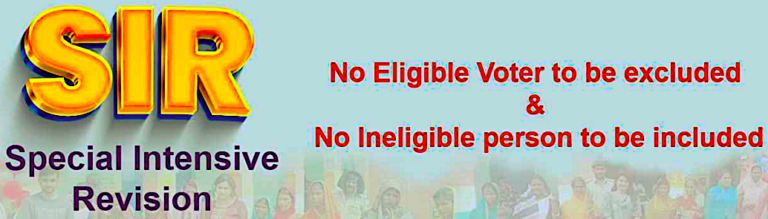
New Delhi: The Election Commission of India reported steady progress in the Special Intensive Revision of electoral rolls in Bihar, a critical effort to ensure an accurate voter list for the state assembly elections due before November 22, 2025.
The initial phase, involving the printing and distribution of enumeration forms, is nearly complete, with 93.57% of forms—7.39 crore—distributed to Bihar’s 7.90 crore registered electors as of June 24, 2025.
As of 6:00 PM on July 6, 1.69 crore forms, or 21.46% of the total, have been collected, including 65.32 lakh in the last 24 hours, with 7.25% uploaded to the Election Commission of India Network (ECINET) application. The Election Commission clarified that the Special Intensive Revision follows guidelines issued on June 24, 2025, refuting rumours of changes to the process.
The Special Intensive Revision (SIR), the first since 2003, addresses issues like rapid urbanisation, migration, unreported deaths, and concerns over ineligible voters, including alleged illegal immigrants. Of Bihar’s 7.90 crore electors, approximately 4.96 crore listed in the 2003 rolls are presumed eligible and need only submit enumeration forms, while 2.94 crore added post-2003 must provide additional documentation. Voters born before July 1, 1987, need proof of their date and place of birth; those born between July 1, 1987, and December 2, 2004, require similar proof for themselves and one parent; and those born after December 2, 2004, must provide documents for themselves and both parents. Acceptable documents include birth certificates, passports, educational certificates, caste certificates, or an extract from the 2003 electoral roll, which suffices as proof of eligibility.
Also read: Bihar’s Voter List Storm: ECI Under Opposition Siege?
The process involves 77,895 Booth Level Officers conducting house-to-house verification, with 20,603 more being appointed to ensure timely completion. Nearly 4 lakh volunteers, including government officials, National Cadet Corps cadets, and National Service Scheme members, assist the elderly, differently-abled, and vulnerable populations. Additionally, 1.54 lakh Booth Level Agents from political parties—52,689 from the Bharatiya Janata Party, 47,504 from the Rashtriya Janata Dal, 34,669 from the Janata Dal (United), and 16,500 from the Indian National Congress—support the effort. Electors can submit forms until July 25, 2025, via the Election Commission of India’s voter portal (https://voters.eci.gov.in) or ECINET app, with draft rolls due on August 1, 2025, followed by a claims and objections period from August 2 to address deficiencies.
Opposition parties, particularly the Indian National Developmental Inclusive Alliance, including the Rashtriya Janata Dal, Indian National Congress, Communist Party of India (Marxist), and Communist Party of India (Marxist-Leninist) Liberation, have criticized the Special Intensive Revision, alleging it risks disenfranchising millions, especially poor, rural, migrant, and minority communities. Rashtriya Janata Dal leader Tejashwi Yadav called it a “conspiracy” to suppress votes, claiming only 2-3% of voters possess the required documents, as common identifiers like Aadhaar, voter ID, or ration cards are not accepted. Indian National Congress leader K.C. Venugopal labelled it a “devious” move, risking “wilful exclusion” via state machinery, while Abhishek Manu Singhvi questioned its timing and unprecedented document demands. Communist Party of India (Marxist-Leninist) Liberation’s Dipankar Bhattacharya called the process “arbitrary and ill-planned,” arguing it shifts the burden of proving citizenship onto voters, contrary to established norms. All India Trinamool Congress leader Mamata Banerjee termed it a “backdoor National Register of Citizens,” raising fears of targeted exclusion. Asaduddin Owaisi of All India Majlis-e-Ittehad Muslimeen echoed concerns, calling it legally questionable and likely to silence genuine voters.
The opposition highlights practical challenges: Bihar’s low birth registration rates (only 7.13 lakh births registered in 2007, when 2025’s new voters were born) and limited access to documents like passports (held by 2.4% of the population) or permanent residence certificates. Migrant workers, estimated at 20-29% of Bihar’s population, face difficulties providing parental records while away, and illiterate voters struggle with complex forms. The tight timeline—90 days from June 25 to September 30, 2025—exacerbates concerns, with critics like Yogendra Yadav and the Association for Democratic Reforms arguing it violates constitutional rights and risks arbitrary exclusions, prompting Supreme Court petitions by Rashtriya Janata Dal MP Manoj Jha, Mahua Moitra, and others.
On July 6, the Election Commission of India responded, clarifying that voters unable to provide documents by July 25 can submit enumeration forms and provide documents later, with Electoral Registration Officers conducting local investigations to verify eligibility. Chief Election Commissioner Gyanesh Kumar defended the Special Intensive Revision as a legal necessity under Article 326 and the Representation of the People Act, 1950, citing past complaints from all parties about inaccurate rolls. He emphasized transparency, noting consultations with 11 political parties on July 2 and measures to prevent exclusion, such as using the 2003 roll as proof and allowing post-submission document verification. Despite these assurances, confusion persists among voters, with reports of illiterate electors unable to fill forms and Booth Level Officers facing questions about deceased parents or unavailable documents.
With 19 days left for form submission, the Special Intensive Revision, overseen by 239 Electoral Registration Officers, 963 Assistant Electoral Registration Officers, 38 District Election Officers, and the Chief Electoral Officer of Bihar, remains a contentious issue. Its outcome will likely shape trust in the electoral process and the fairness of Bihar’s 2025 elections.
– global bihari bureau