Bihar Polls: Murder, Muscle, and Money
Seizures surpass Rs. 100 crores
Patna: A 75-year-old man lies crushed under an SUV, a convicted strongman sits in jail, and ₹42 crore in illicit liquor floods a state that outlawed alcohol nine years ago. This is not chaos. This is Bihar’s political economy in action: prohibition breeds mafia, mafia breeds muscle, muscle breeds votes, and votes breed impunity.
Bihar is once again witnessing an election defined by violence, entrenched criminality, and the failure of prohibition enforcement. The October 30, 2025, murder of Jan Suraaj supporter Dularchand Yadav in Mokama lays bare the deep integration of muscle power and political survival—a grim reminder that in this state, democracy often bends to the barrel of a gun and the lure of illicit cash. The Criminal Investigation Department (CID) took over the probe today, after over 80 arrests and a Patna court remanded Janata Dal (United) (JD(U)) candidate Anant Singh and two aides to 14-day judicial custody. The Election Commission of India (ECI) transferred Patna Rural Superintendent of Police (SP) Vikram Sihag and disciplined three senior officers on November 1, 2025, as inducements worth ₹108.19 crore—including ₹42.14 crore in liquor—were seized since the Model Code of Conduct (MCC) took effect on October 6, 2025. These events reveal a state where prohibition sustains illicit networks, criminal histories shape electoral outcomes, and institutional responses struggle to disrupt entrenched patterns.
The murder was not a clash. It was a public execution. On October 30, 2025, in Taratar village, Mokama, Singh’s 50-vehicle convoy—his rolling fortress of feudal power—barreled through. Supporters of Jan Suraaj candidate Piyush Priyadarshi, Yadav’s nephew, stood in defiance. What followed was methodical: Yadav, 75, a former strongman turned foot soldier, was shot in the ankle, beaten with an iron rod, and crushed beneath an SUV. The postmortem, released November 1, 2025, told the clinical truth—death by cardiorespiratory failure from blunt force trauma: heart and lungs pulverized, ribs shattered, lung ruptured. The bullet was a footnote. The message was not. Four First Information Reports (FIRs) charged murder, illegal arms, and rioting. Yadav’s grandson named Singh as the triggerman. Counter-FIRs targeted Priyadarshi’s camp. By November 2, 2025, Director General of Police (DGP) Vinay Kumar confirmed over 80 arrests. That night, 150 police stormed Singh’s Barh fortress. He was dragged out—handcuffed, defiant. A Patna court locked him and aides Manikant Thakur and Ranjeet Ram in judicial custody on November 3, 2025. JD(U) had issued a feeble ultimatum. Now it watched its own candidate jailed.
According to police and forensic statements, the incident in Taratar village, Mokama, on October 30 involved a violent confrontation in which Dularchand Yadav sustained multiple injuries and subsequently died at the scene. The post-mortem report, as cited by senior officials on November 1, attributed death to cardiorespiratory failure following blunt-force trauma, recording multiple rib fractures and a ruptured lung; a gunshot wound to the ankle was also noted but was not identified by the examining doctors as the proximate cause of death. Police have registered multiple FIRs, including charges of murder, illegal arms possession and rioting; Yadav’s family members have alleged involvement by named suspects, while those accused have denied the allegations. Senior officers reported that more than 80 persons had been detained in connection with the incident, and that raids were conducted at locations linked to the accused. On the night of November 2, law-enforcement teams arrested Anant Singh and others; a Patna court remanded Singh and two aides to fourteen days’ judicial custody on November 3, 2025. The JD(U) acknowledged the arrest and said it would await the course of the investigation and judicial process.
Anant Singh is not an isolated figure. He embodies a recurring pattern in Bihar politics, where strongmen with long criminal records secure repeated electoral victories. Born in 1967 in Nadwan, Patna district, he emerged in the 1990s as the enforcer for his elder brother Dilip Singh, a former minister and Member of Legislative Council (MLC) known as “Bade Sarkar,” who was assassinated in 2003 amid land and caste disputes. Anant inherited influence in the Bhumihar-dominated Mokama-Barh area, facing over 50 criminal cases since 1979, including 7 murders, 11 attempted murders, 4 kidnappings, extortion, and arms violations as detailed in his 2020 and 2025 election affidavits. A 2022 conviction under the Arms Act for an AK-47 and grenades recovered from his home resulted in a 10-year sentence and Member of Legislative Assembly (MLA) disqualification, but the Patna High Court acquitted him in 2024, citing insufficient evidence. Singh secured Mokama five times from 2005 to 2020 on JD(U), Independent, and Rashtriya Janata Dal (RJD) tickets, defecting as alliances shifted. His declared assets in 2025 total ₹37.88 crore, with wife Neelam Devi at ₹62.72 crore. Political patronage, including Chief Minister Nitish Kumar’s tolerance despite Kumar’s governance agenda, has sustained his viability; his 2024 return to JD(U) followed Neelam’s bypoll victory. The current arrest, while disrupting his campaign, positions his wife as a potential substitute, preserving family control in a constituency shaped by caste loyalties and intimidation.
The ECI’s actions reflect reactive enforcement under pressure. On November 1, 2025, it ordered the transfer of SP Vikram Sihag, disciplinary measures against Sub-Divisional Officer (SDO) Chandan Kumar and Sub-Divisional Police Officers (SDPOs) Rakesh Kumar and Abhishek Singh (with Abhishek suspended immediately), and suspensions of Station House Officers (SHOs) Madhusudan Kumar of Ghoswari and Ravi Ranjan of Bhadaur. Replacements were appointed, with Traffic SP Aparajit Lohan assuming interim charge by November 3, 2025. The Commission required compliance by November 2 and mandated surrender of licensed firearms and the externment of known offenders. Chief Election Commissioner Gyanesh Kumar emphasised “zero tolerance” on November 2, 2025, with enhanced Central Armed Police Forces (CAPF) deployment. Tensions escalated further on October 31, 2025, when Yadav’s supporters stoned RJD candidate Veena Devi’s vehicle near Pandarak, leading to additional clashes involving gunfire and vandalism. Mokama, contesting Singh’s proxy against Veena Devi—wife of rival Surajbhan Singh—remains a focal point of caste-driven rivalry.
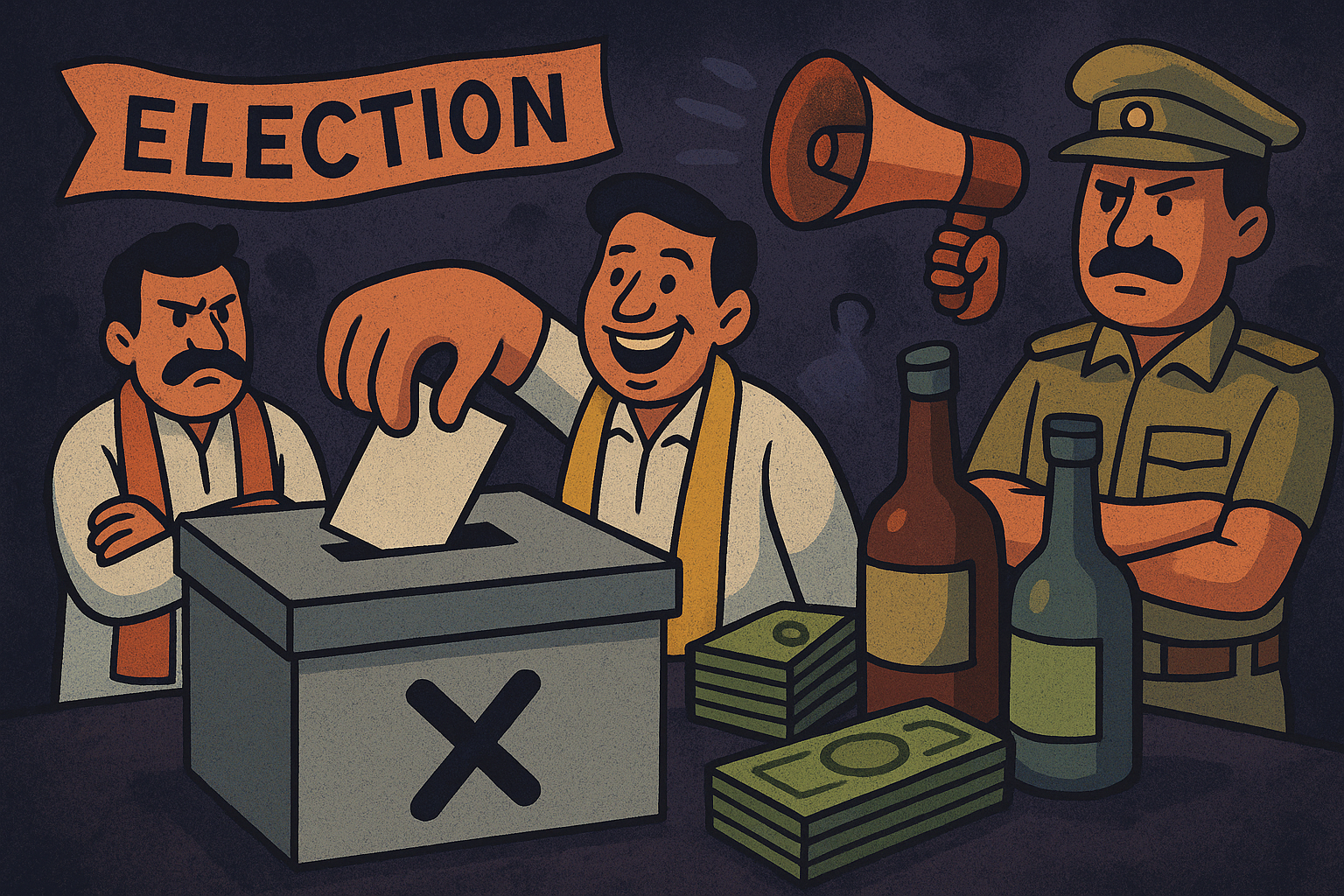
Prohibition enforcement compounds the crisis, a policy enacted on April 5, 2016, through the Bihar Prohibition and Excise Act as Nitish Kumar’s moral flagship to curb domestic violence, empower women via Jeevika self-help groups, and reduce alcohol-linked poverty in a state where pre-ban excise fetched ₹4,000 crore annually. Early gains included a 12% drop in domestic violence from 2015–16 to 2019–20, fewer hospital admissions, and 2.4 million fewer frequent male drinkers per National Family Health Survey (NFHS) data, but the draconian framework—non-bailable offences, family liability, village fines—has backfired catastrophically. By March 31, 2025, 936,000 cases yielded 1.43 million arrests, filling 20–25% of prisons with petty offenders; the Patna High Court in November 2024 condemned it as an “extortion racket” where police collude with kingpins. Over 280 hooch deaths since 2016—70 in Saran 2022 alone—have poisoned marginalised communities with methanol-laced brews, while a ₹30,000 crore revenue void over nine years could have funded education or healthcare in a 61.8% literate state. Smuggling via trains, ambulances, coffins, and diara river routes from 23 wet states and Nepal evades 180 task forces, drones, and 1,036 checkposts. Since the MCC activation on October 6, 2025, 824 flying squads responding via the Citizen Vigilance (C-VIGIL) app within 100 minutes and the 24-hour Call Centre number 1950 have facilitated seizures totaling ₹108.19 crore: ₹42.14 crore in liquor (9.6 lakh litres), ₹24.61 crore in drugs, ₹9.62 crore in cash, ₹5.8 crore in precious metals, and over ₹26 crore in freebies. Liquor recoveries have doubled from the 2020 election’s early phase, with the narcotics influx signalling addiction diversification. The shadow economy sustains political funding and voter inducement, inverting women’s empowerment as they brew secretly or face arrest.
Five years ago, in the 2020 assembly elections held amid the COVID-19 pandemic across three phases from October 28 to November 7, Bihar saw a narrow National Democratic Alliance (NDA) victory of 125 seats against the Mahagathbandhan (Grand Alliance)’s 110, decided by just 11,150 votes statewide—with over 10 seats by margins under 1,000 and 20% of constituencies under 2.5% of votes polled. Turnout was 57.05% (up 0.39% from 2015), with women at 59.69% versus men’s 54.45%, bolstering Kumar via prohibition’s rural appeal despite hooch deaths like Gopalganj’s 36 in 2016. Seizures hit ₹76 crore early on, violence was limited to 42 incidents under pandemic curbs, and the voter roll stood at 7.29 crore.
In contrast, 2025’s two-phase polls (November 6 and 11, counting November 14) operate on a 7.42 crore roll—shrunken 4.88% by the ECI’s Special Intensive Revision (SIR) purging 68.5 lakh names while adding 21.5 lakh—potentially flipping over 100 seats (31 with 2020 margins averaging 11.74% seeing >7.27% deletions, hitting Seemanchal and Bhojpur). Turnout is projected at 57–60%, aided by 17 ECI reforms (100% webcasting, Artificial Intelligence (AI) monitoring, Quick Response (QR) slips, senior/disabled facilities), but shadowed by SIR bias claims. Seizures surged 42% to ₹108.19 crore in one month, liquor doubled, and narcotics at ₹24.61 crore. Violence has erupted from 2020’s 42 incidents to Mokama’s killing, 80+ arrests, ECI sackings (November 1), and Chief Election Commissioner (CEC)’s “zero tolerance” (November 2), signalling bahubali (strongman) resurgence amid Prashant Kishor’s Jan Suraaj challenge. Women’s 2020 turnout strength faces SIR erosion; phases compressed from three to two strain security. Ultimately, 2020 consolidated NDA power quietly; 2025 reckons with SIR deletions (flipping ~107 seats), liquor-led seizures, and overt violence testing Kumar’s legacy against repeal vows.
Political responses highlight partisan calculations. Prashant Kishor termed the killing a “desperate attempt to silence change” on October 31, 2025. Rashtriya Janata Dal leader Tejashwi Yadav and Congress’s Sachin Pilot criticised NDA governance failures on November 1, 2025. Aam Aadmi Party (AAP)’s Sanjay Singh questioned arms circulation on the same day. BJP’s Dilip Jaiswal affirmed legal action on November 2, 2025. Singh, from custody, posted “Satyamev Jayate” on November 2, 2025, alleging opposition orchestration. RJD’s Misa Bharti labelled the arrest “opposition pressure,” while JD(U)’s Rajeev Ranjan called it a “befitting reply.”
Bihar exemplifies a cycle where prohibition generates illicit revenue streams that finance criminal-political networks, enabling bahubalis to maintain influence through caste mobilisation and intimidation. The ECI’s measures, including videographed operations, border patrols, and social-media monitoring, address symptoms. With Phase 2 scheduled for November 11, 2025, the persistence of violence, inducements, and proxy candidacies indicates that institutional interventions remain insufficient against entrenched systems. The Mokama case, prohibition seizures, and Singh’s history collectively demonstrate how policy distortions and criminal impunity reinforce each other, undermining democratic processes in the state.
– global bihari bureau