ECI Sets Stage for High-Stakes Battle: Counting on December 3
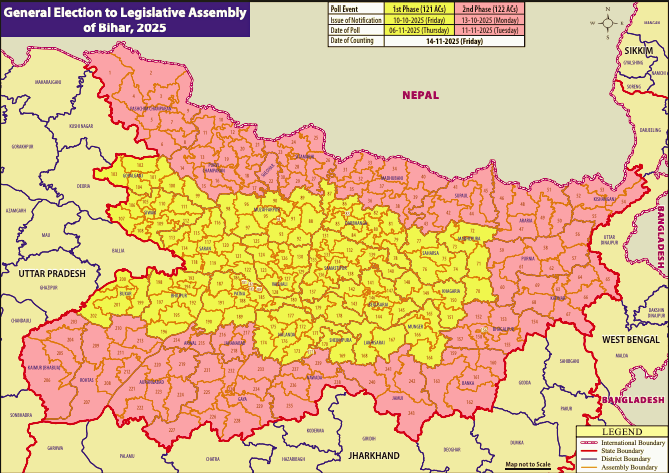
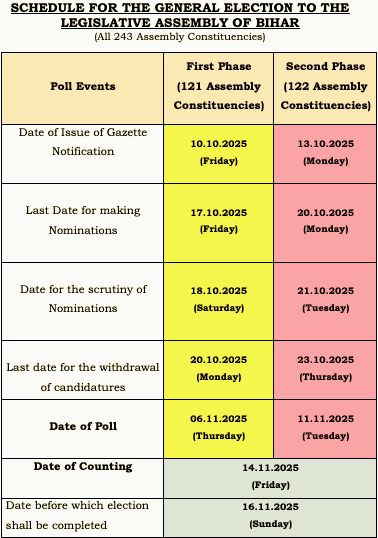
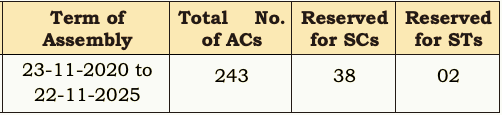
New Delhi: The Election Commission of India today announced that polling for the Bihar Legislative Assembly will take place in five phases between November 11 and 28, with counting scheduled for December 3, 2025. The current Assembly’s term ends on November 22. Bihar has 243 constituencies, including 38 reserved for Scheduled Castes and two for Scheduled Tribes.
The Model Code of Conduct came into force with the poll announcement. Loudspeakers are banned between 10 p.m. and 6 a.m. and within 48 hours of polling. The EC said all critical events—nominations, scrutiny, storage of EVMs, polling, and counting—will be videographed, and webcasting will cover sensitive locations.
Chief Election Commissioner Rajiv Kumar, flanked by Election Commissioners Gyanesh Kumar and Sukhbir Singh Sandhu, said the Commission had completed wide-ranging consultations with political parties, administrative and police officials, and Central Armed Police Forces to ensure smooth and secure elections. Security deployment will be guided by vulnerability mapping and real-time coordination between state and central agencies.
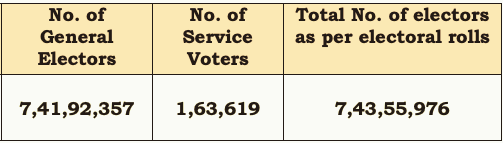
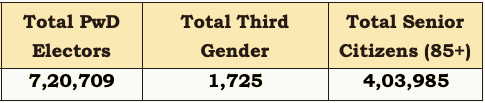
The State’s final electoral roll, published on September 30 after a special intensive revision with July 1 as the qualifying date, lists 7.43 crore voters—including 14.01 lakh first-time voters aged 18–19, 7.2 lakh persons with disabilities, and 4.03 lakh voters above 85 years. Another 1,725 electors are listed under the third gender category.
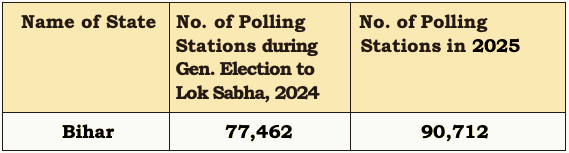

To enhance accessibility, the Commission has capped each polling station at 1,200 electors and directed that all facilities—from ramps and toilets to drinking water and lighting—be made permanent where feasible. Separate entry and exit points will be mandatory at congested polling premises.
For persons with disabilities and senior citizens, the EC has ordered ground-floor polling locations, wheelchair access, preferential queues, and transport arrangements. Braille-enabled EVMs and dummy ballots will aid visually impaired voters. Those eligible for postal ballots—service voters, PwDs, senior citizens above 85, and absentee voters in essential services—must apply through Form 12D.
Voter information slips carrying polling details and QR codes will be distributed five days before polling, while voter guides in multiple languages will explain key procedures. Booth-level officers have completed verification of “absent, shifted, and deceased” voters to prevent impersonation. Voters can identify themselves using the EPIC or one of 12 approved documents such as Aadhaar, passport, or PAN card.
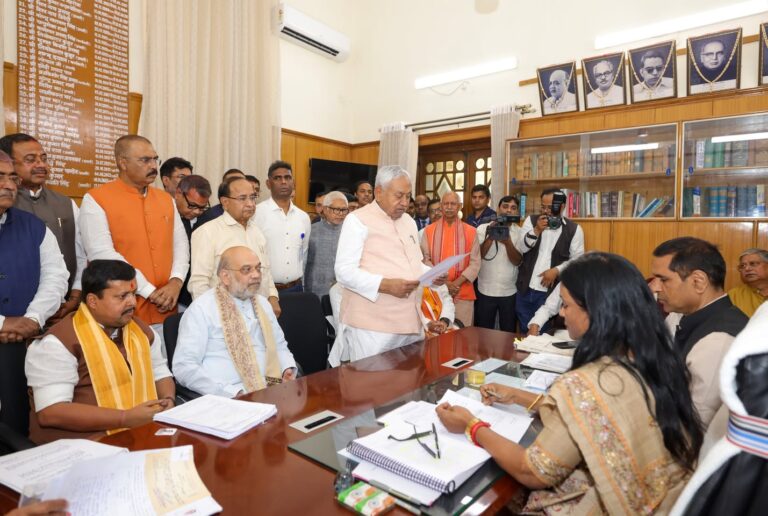
Nomination procedures have gone digital. Candidates can now file papers, affidavits, and deposits online via the Suvidha portal. They must also submit “No Dues Certificates” if they occupied government accommodation in the past decade. Incomplete affidavits will attract scrutiny and possible rejection.
Candidates facing criminal cases must publish details of their pending cases thrice during campaigning, while parties fielding them must justify their choice and display it publicly.
Expenditure monitoring has been strengthened with flying squads, static surveillance teams, and digital tracking through the Integrated Expenditure Monitoring Software. All transactions above ₹10,000 must be digital or through a cheque.
Technology will be at the core of election management. The EC’s digital ecosystem, ECINET, integrates more than 40 modules—from permissions to results—while Know Your Candidate and Suvidha 2.0 portals will give voters real-time access to affidavits and campaign permissions. Counting trends will be displayed constituency-wise every two hours on the results portal.
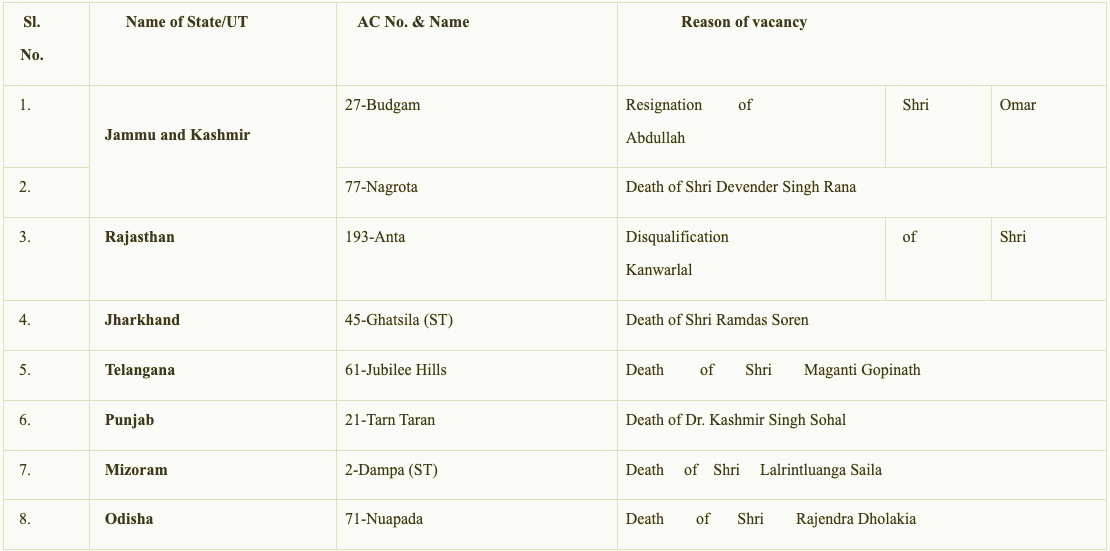
In addition to Bihar, the Commission announced bye-elections to eight Assembly constituencies across Jammu & Kashmir, Rajasthan, Jharkhand, Telangana, Punjab, Mizoram, and Odisha. Nominations open on October 13, close on October 20, polling is on November 11, and counting will be held on November 14, 2025.
As the political heat rises in Bihar, the focus will now shift to alliances, candidate selections, and campaign strategies under a stricter and more transparent election regime. For voters, the coming weeks promise a decisive test of both governance and grassroots sentiment across one of India’s most politically vibrant states.
– global bihari bureau