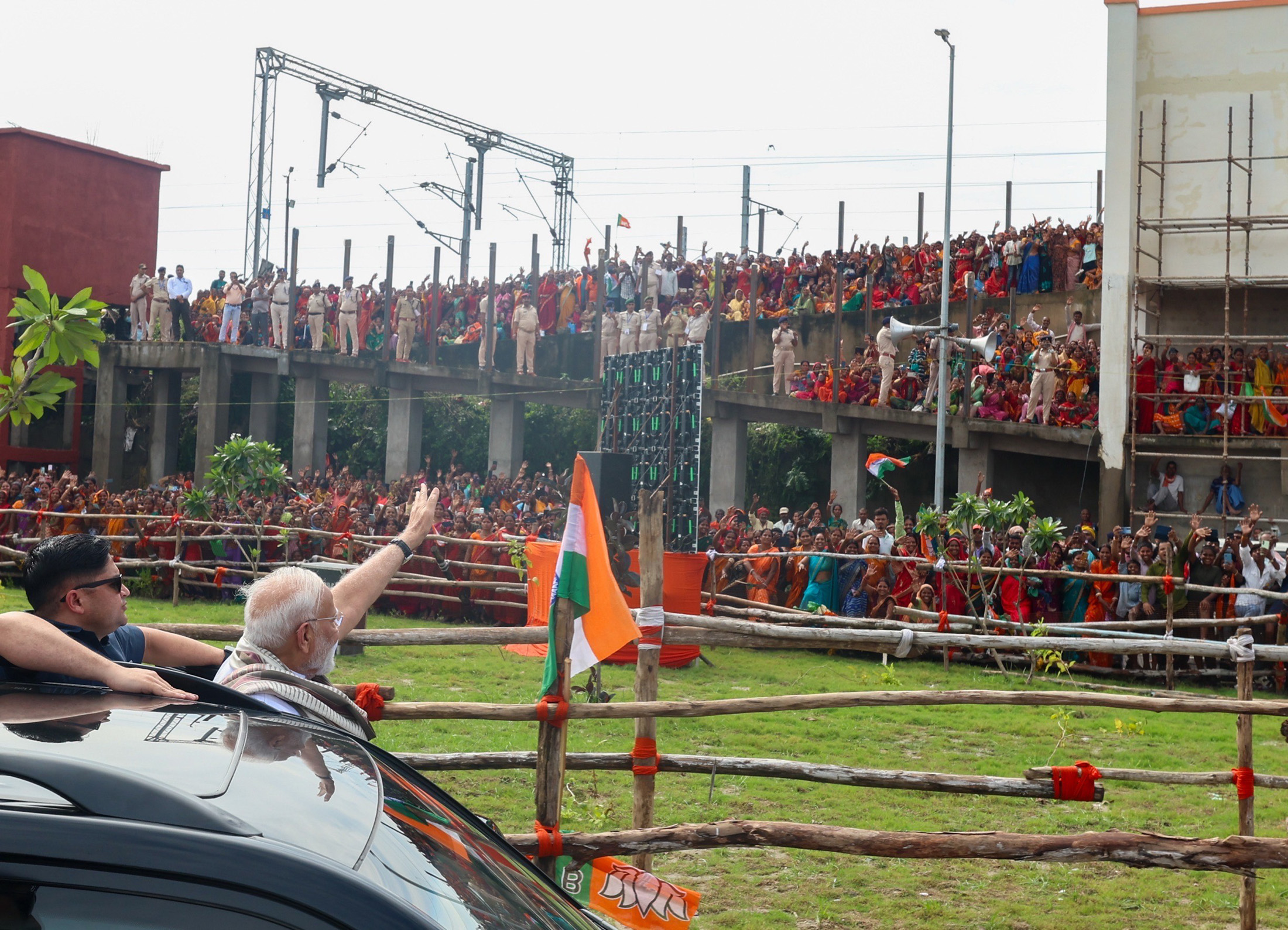
Prime Minister Narendra Modi in Simariya, Bihar, on August 22, 2025.
Gaya’s Growth Gospel Faces Gandhi’s SIR Snub
Gaya: Bihar’s electoral cauldron, simmering with caste rivalries, minority marginalisation, and migration woes, boils over as Prime Minister Narendra Modi’s Rs 12,000 crore development blitz today from Gaya’s Vishnupad Temple weaves economic promise with Hindutva’s cultural pull, proclaiming “a sacred city of knowledge and liberation” to rally Hindu voters.
This audacious pitch slams into the Supreme Court’s August 22 mandate for transparency in the Special Intensive Revision (SIR) of voter rolls—potentially sidelining 65 lakh voters—and Rahul Gandhi’s ‘Voter Adhikar Yatra’, storming through Munger on August 23, decrying SIR as “vote theft” aimed at minorities.
The Supreme Court’s SIR hearing today, led by Justice Surya Kant, pressed the Election Commission of India (ECI) to ensure transparency in the June 24, 2025, process to remove untraceable, deceased, shifted, or duplicate voters (January 1, 2024, qualifying date). It reviewed compliance with orders to publish deletion lists, allow re-inclusions via Aadhaar or 11 documents, and involve booth-level agents, addressing risks to 65 lakh voters, notably in Kishanganj (15% deletions). The ECI defended SIR as crucial for clean rolls, but petitioners, including Congress and RJD MPs, alleged bias against Muslims and Other Backward Classes (OBCs). The court’s push for online filings and agent roles aims to ease disruptions, but continued scrutiny bolsters opposition claims of ECI partiality, with Congress calling the ruling a blow to a “brutal assault” on democracy.
With 243 seats up for grabs in the October-November 2025 assembly polls, this face-off between the National Democratic Alliance (NDA)’s progress mantra and the opposition’s democratic outcry, fueled by deep-seated Muslim and Buddhist grievances, promises a high-voltage clash.
Narendra Modi’s Vishnupad Temple stage, tied to Lord Vishnu’s footprints, was a calculated nod to the Bharatiya Janata Party (BJP)’s Hindutva roots. “We bow to Gaya Ji… a land of spirituality and peace,” he proclaimed, lauding the Bihar government’s “Gaya Ji” naming and linking it to Lord Buddha’s enlightenment. This Hindu-Buddhist framing targets Hindu voters (63% per 2011 Census) while leveraging the Buddhist Circuit Train from Vaishali to Koderma, a project rooted in Chief Minister Nitish Kumar’s 2006 vision to boost tourism to Bodh Gaya and Nalanda, sustained under the NDA. Yet, this risks inflaming tensions with Muslims (16%), marginalised by historical neglect—evident in 2022 Sasaram clashes over Buddhist sites—and Buddhists, frustrated by unresolved encroachments like the Sasaram cavern.
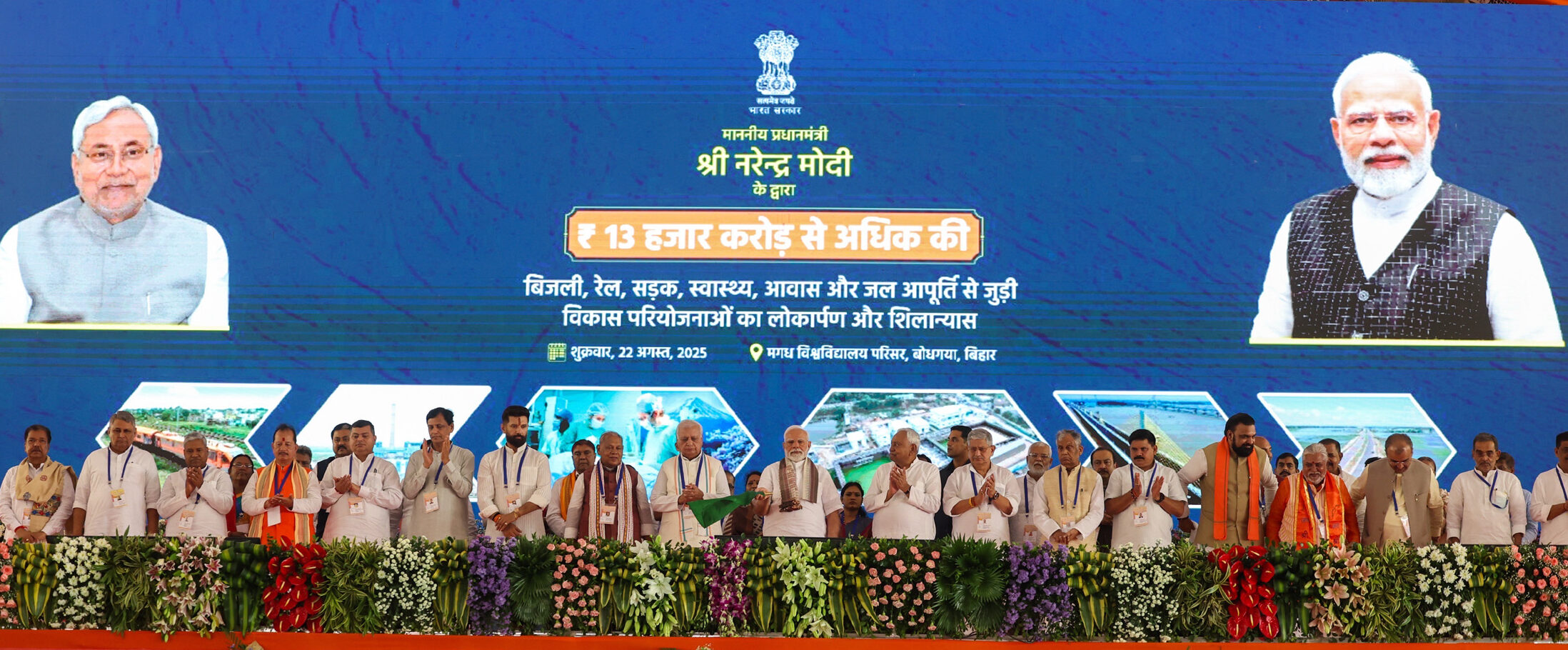
The development package featured the Buxar Thermal Power Plant (Rs 6,880 crore) to tackle energy shortages, Muzaffarpur’s Homi Bhabha Cancer Hospital and Research Centre for local oncology care, and Rs 1,260 crore in urban projects under the Atal Mission for Rejuvenation and Urban Transformation (AMRUT) 2.0, including Munger’s sewerage system for Namami Gange’s anti-pollution drive. Connectivity wins included the Aunta-Simaria bridge on National Highway 31 (NH-31) (Rs 1,870 crore), slashing detours by 100 km, and the Bakhtiyarpur-Mokama section (Rs 1,900 crore). Rail upgrades modernised Gaya station under the Amrit Bharat Station Scheme and launched the Amrit Bharat Express to Delhi.
“These will strengthen Bihar’s industries and create new employment opportunities,” Narendra Modi vowed, spotlighting Dobhi’s industrial hub, a Gaya technology centre, and new plants in Nabinagar and Pirpainti. He praised Nitish Kumar’s transparent teacher recruitments and the Pradhan Mantri Viksit Bharat Rojgar Yojana’s Rs 15,000 for first-time workers, countering migration fueled by the Rashtriya Janata Dal (RJD)’s “lantern regime,” which he blamed for “plunging Bihar into darkness” with Maoist terror and joblessness.
Security meshed with cultural and economic appeals, with Narendra Modi invoking Bihar as “a shield for the nation” under Chanakya. He touted Operation Sindoor—“Our missiles will bury [terrorists] underground”—and a Demography Mission to oust infiltrators from border districts where “demography is changing rapidly,” tacitly backing SIR as a shield for local jobs and aligning with Hindutva’s demographic fears. His anti-corruption law, mandating arrested leaders vacate posts if not bailed within 30 days, jabbed at opposition “scam leaders,” with Modi asking, “Can they run a government from jail?” He slammed RJD and the Indian National Congress (Congress) for vote-bank politics, recalling a Congress leader’s barring of Biharis, urging, “Protect Bihar from their evil eye.” (Modi was likely referring to remarks made by former Punjab Chief Minister Charanjit Singh Channi. Ahead of the 2022 Punjab Assembly elections, Channi reportedly said, “Don’t let UP, Bihar ke bhaiya enter Punjab”).
The event, with Governor Arif Mohammed Khan, Bihar Chief Minister Nitish Kumar, and Union Ministers like Rajiv Ranjan Singh (Janata Dal-United), included a Pradhan Mantri Awas Yojana (PMAY) Grih Pravesh for 16,000, with Modi noting 38 lakh Bihar homes, saying, “These are not just houses, but symbols of dignity.”
Rahul Gandhi’s Yatra, on its sixth day, rallied from Munger to Bhagalpur and Lakhisarai, with Gandhi meeting Muslim voters and blasting SIR as “stealing elections.” Joined by RJD leader Tejashwi Yadav, who dubbed it Nitish’s “last election,” and expecting Karnataka’s Chief Minister Siddaramaiah and his deputy D K Shivakumar, the 1,300 km march across 23 districts calls SIR a “conspiracy” against minorities and OBCs (38% of voters). Set to end September 1, 2025, in Patna, it could spur turnout, as in the 2015 RJD-Congress win.
Narendra Modi’s agenda, anchored by PMAY’s 38 lakh Bihar homes and 68% voter approval for central schemes, grapples with unemployment (51% voter concern) and migration (20 lakh Biharis in 2024). The NDA’s 48.9% vote share projects 130-140 seats, but Tejashwi’s 38.3% Chief Minister preference tops Nitish’s 35.6%. The Vishnupad framing and SIR’s perceived targeting deepen minority alienation, risking Muslim backlash, while the Opposition’s job and inclusion focus could flip tight seats. Prashant Kishor’s Jan Suraaj, aiming to make a dent at 8% vote share, adds volatility. Bihar’s polls teeter on a knife-edge, with Hindutva and development duelling democratic grievances.
– global bihari bureau