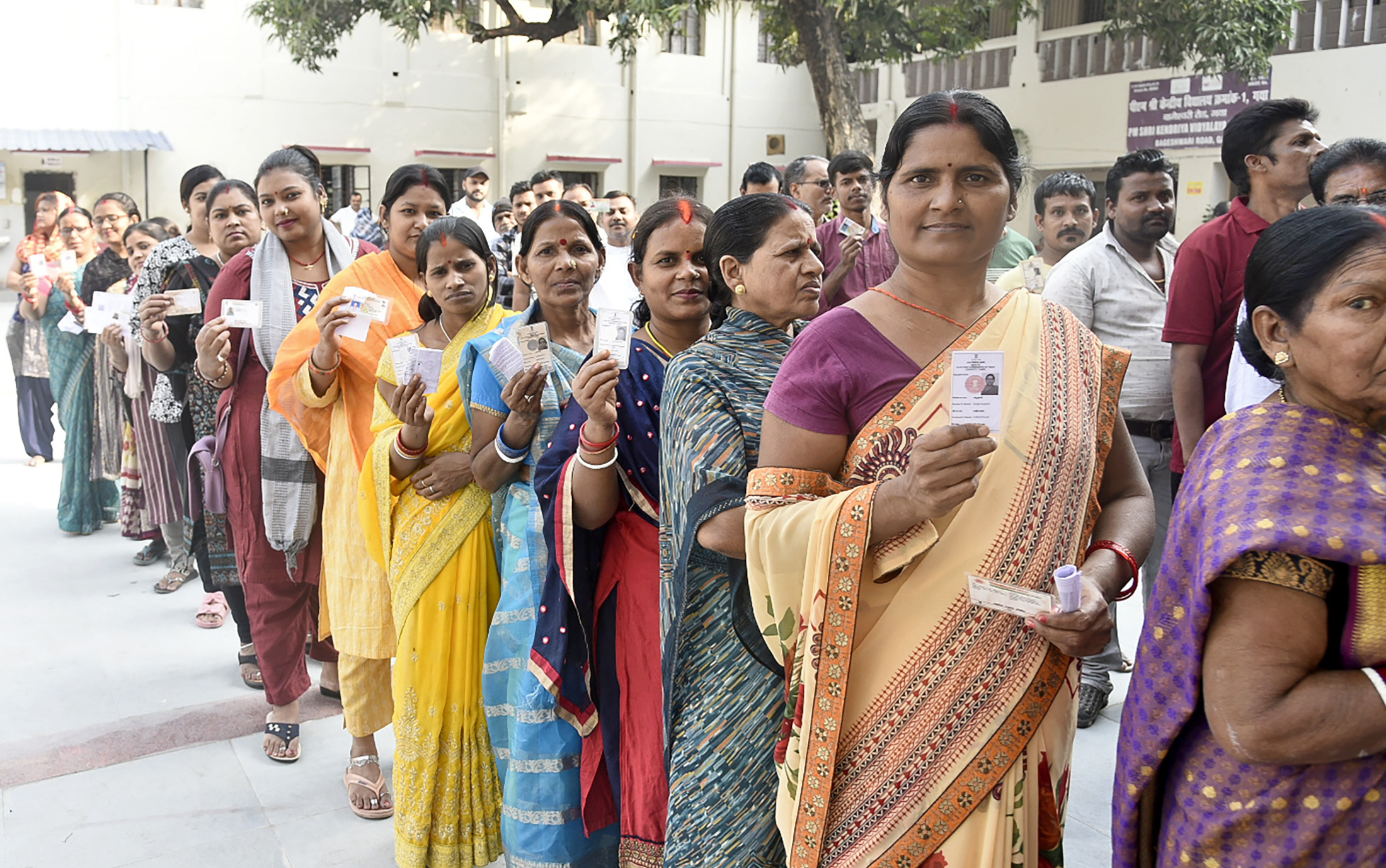
Voters displaying identity cards while standing in queue to cast their votes at a polling booth during the 2nd phase of the Bihar Assembly Election 2025 at PM Shri Kendriya Vidyalaya No.1 Gaya, in Bihar on November 11, 2025.
Turnout Triumph and Exit‑Poll Buzz in Politically Hot Bihar
66.9% Turnout; Women Outvote Men Significantly
Exit Polls Hint NDA Sweep
New Delhi/Patna: Bihar’s 2025 Legislative Assembly election has entered its final phase of suspense with voter turnout and exit‑poll projections offering a rich tableau of change, continuity and political tension. The overall turnout reached a provisional 66.91 per cent, the highest since the inaugural elections in 1951, with female voter participation soaring to 71.6 per cent—well above the 62.8 per cent male turnout – signalling an unprecedented mobilisation of women voters across the state.
These figures mark not only statistical records but also suggest a shift in civic engagement: Phase I registered 65.08 per cent overall turnout (female 69.04 per cent, male 61.56 per cent), while Phase II saw a rise to 68.76 per cent (female 74.03 per cent, male 64.1 per cent).
Comparison with previous decades shows the scale of change: Assembly election turnout in 2020 was just 57.29 per cent, in 2015 56.91 per cent, and in 1990 about 62.04 per cent. That jump to nearly 67 per cent suggests mobilised electors and particularly mobilised women voters, challenging assumptions about passivity or inertia in Bihar’s electorate. Across two phases of polling, Bihar’s 7.45 million electorate demonstrated a surge in political engagement.
Historical patterns reveal that when women turn out in larger numbers, parties with visible welfare delivery and women-centric policies, rather than purely caste or identity-based appeals, gain an edge. In past Bihar elections, notably the 2020 Assembly polls, constituencies with higher female participation often favoured the Janata Dal (United) (JD(U)) under Nitish Kumar or allied formations within the National Democratic Alliance (NDA), as women responded to policies such as the Jeevika self-help group programme, targeted entitlements, and increased representation in local governance. At that time, 167 of 243 constituencies saw women outvote men, and many of these were secured by the NDA.
Hence, the implications of the record female turnout are profound. Analyses from Brookings and Outlook India suggest that high female participation tends to reinforce parties that have delivered visible governance outcomes for women—ranging from self‑help group mobilisation, maternal and child health services, to local-level representation—rather than purely identity- or caste-based appeals. In 2025, with women casting votes at 71.6 per cent, their influence is no longer a supplementary factor but a decisive political dimension. Parties that effectively align manifestos, campaigns, and welfare delivery with women’s priorities—safety, employment, digital access, and essential services—stand to gain significantly, whereas reliance on traditional male vote banks alone may be insufficient.
The overall high turnout also signals a politically energised electorate responding to multiple vectors: local development, rural employment, migration-linked household needs, and the performance of incumbents. Analysts note that even constituencies with historically lower participation showed increased engagement, hinting at an electorate increasingly weighing governance performance over narrow partisan loyalties. Electoral officers highlighted that mobile polling units, special transport for women, and voter-awareness campaigns played a crucial role in facilitating participation, particularly in remote districts.
The exit‑poll numbers released by major national agencies—ABP News‑CVoter, India Today‑Axis My India, and News18‑Ipsos—suggest a competitive contest, projecting a narrow edge for the National Democratic Alliance (NDA), though analysts emphasised that the unprecedented female turnout and regional variations could reshape seat projections. According to Dainik Bhaskar, the NDA is projected to secure 145–160 seats, with the Mahagathbandhan (MGB) at 73–91. Matrize projected 147–167 seats for the NDA and 70–90 for the MGB. People’s Insight estimates 133–148 for the NDA, 87–102 for the MGB. Poll Diary gave the widest range for the NDA: 184–209 seats, while placing the MGB at 32–49.
All these ranges assume a 243‑seat Bihar Assembly, where the simple majority mark is 122 seats. The newly‑formed Jan Suraaj Party (JSP), though visible in campaign rhetoric, is projected at zero to five seats—a telling gauge of its limited penetration despite its founder’s profile.
These exit polls show the NDA stretching its edge. Still, whether that edge holds or fractures will depend on micro‑contests, regional battles and how well the opposition converts turnout into votes.
Party offices across Patna and district headquarters have transformed into anxious nerve‑centres. On one side, the NDA leadership is buoyed by the high participation—especially among women—and sees the exit‑poll gap as proof of public endorsement of development and stability. On the other side, opposition leaders quietly admit concern but publicly caution: “Exit polls have proven wrong in the past,” they say, urging vigilance on the day of counting.
On the ground, the mood was electric, though measured. In districts stretching from Seemanchal to the Gangetic plain, long queues formed early in the morning—women walking resolutely in groups, youth asking about digital platforms and connectivity rather than caste allegiances, return‑migrant men turning up after pre‑poll travels. At one polling station, a presiding officer fainted midday under the strain of sustained work—symbolic of the pressure and the human investment this democratic exercise entailed. Political agents and observers noted fierce but largely peaceful interactions: rival party workers argued at booths in Araria, but no major disruptions derailed the vote. Minor scuffles over voter identification and line-jumping were reported in Bhagalpur and Gaya. Security forces maintained a robust presence, and officials swiftly addressed complaints, including allegations of the distribution of cash and gifts in pockets of Darbhanga and Nalanda. Allegations flew—opposition parties claimed voter‑list manipulation and partisan staffing, while the ruling coalition charged rival “infiltrators” and vote‑theft attempts—yet the Election Commission of India maintained that monitoring and redressal mechanisms had been invoked across 90,740 polling stations.
The scale and efficiency of the elections were reflected in the deployment of over 850,000 polling staff and volunteers, 140,274 polling agents, and the close monitoring of the Election Commission of India (ECI) through webcasting facilities at polling stations. For the first time, 16 international delegates from six countries—South Africa, Indonesia, Thailand, the Philippines, Belgium, and Colombia—witnessed the polling, commending Bihar’s elections as transparent, participative, and meticulously organised.
Analysts point to several evolving fault‑lines: the surge in female turnout appears less as an add‑on and more as a force reshaping campaign strategy—women voters spoke about safety, social welfare and digital access rather than only caste loyalty. The youth vote too flagged issues of employment, migration and connectivity, with less attachment to traditional political identities. Yet beneath this veneer of emerging change, remain enduring realities: caste dynamics, local strongmen, and networked mobilisations continued to dominate in many rural pockets.
In this context, the high turnout becomes more than a number. It signals a hunger for participation and legitimacy, a potential challenge to stale alignments, and a test of whether mobilisation will translate into power. The exit‑poll numbers show the NDA stretching its edge, but whether that edge holds or fractures will depend on micro‑contests, regional battles and how well the opposition converts turnout into votes.
Bihar thus stands at a crossroads: will the 2025 verdict reinforce continuity under the NDA or open a new chapter of demand‑driven politics, youth and female empowerment, and governance over identity? As vote‑counting begins, the result will not only decide the next government but also map the contours of Bihar’s political future—its state of mind, its dynamics of change, and the direction in which its people choose to steer.
Counting of votes is scheduled for 15 November 2025, with results expected later the same day. Political commentators note that the high engagement of women, particularly in rural constituencies where welfare schemes such as Jeevika, health, and education programmes have tangible visibility, could tip the scales decisively.
– global bihari bureau