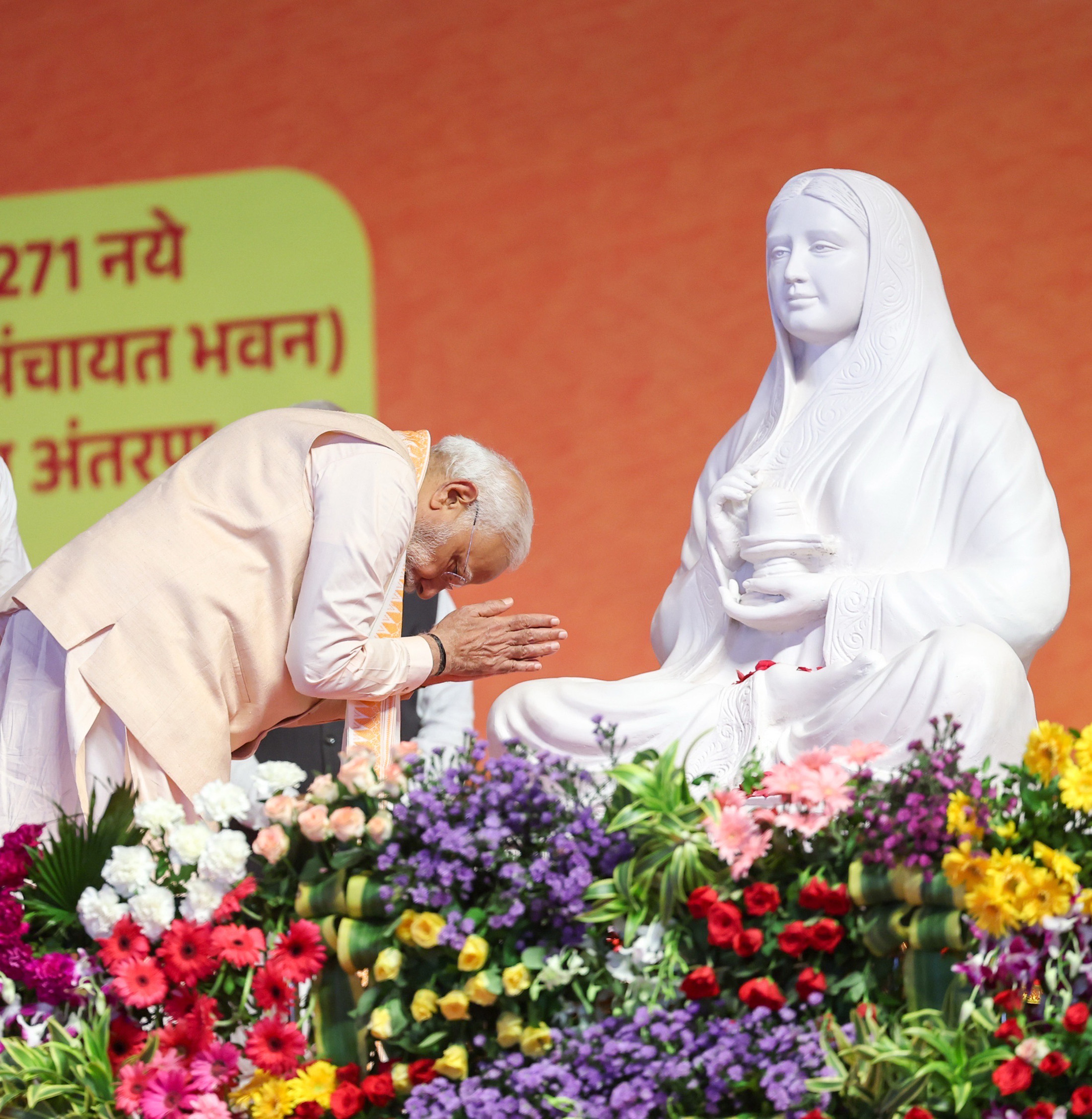
Prime Minister Narendra Modi at the Mahila Sashaktikaran Mahasammelan Programme held on the occasion of 300th birth anniversary of Lokmata Devi Ahilya Bai Holkar at Bhopal, in Madhya Pradesh on May 31, 2025.
Bhopal: A commemorative postage stamp and a Rs 300 coin featuring a portrait of Ahilyabai Holkar marked her 300th birth anniversary year, with Prime Minister Narendra Modi lauding women’s power in Bhopal’s development push, here today.
Prime Minister Narendra Modi addressed the Lokmata Devi Ahilyabai Mahila Sashaktikaran Mahasammelan in Bhopal, Madhya Pradesh. The event, attended by a large gathering, marked a tribute to the historical figure known for her contributions to governance and nation-building.
During the programme, Modi inaugurated passenger services on the Super Priority Corridor of the Yellow Line of the Indore Metro, laid the foundation stone for multiple development projects, and released. He also presented the National Devi Ahilyabai Award to a woman artist for contributions to tribal, folk, and traditional arts. The Governor of Madhya Pradesh, Mangubhai Chhaganbhai Patel, and Chief Minister Mohan Yadav were among the dignitaries present.
Paying tribute to Ahilyabai Holkar, Modi noted her role in shaping India’s heritage and governance. He stated that her name evokes reverence and that her life exemplified service to the people. Two to three centuries ago, during a period of oppression, she led the state of Malwa, navigating challenges to foster prosperity. Her governance model prioritised the welfare of the poor, with initiatives to promote agriculture, cottage industries, and handicrafts. She developed small canals and constructed ponds to enhance water conservation, encouraging cotton and spice farming to boost farmers’ income. Devi Ahilyabai invited weaving families from Junagarh, Gujarat, to establish the Maheshwari saree industry, which continues to benefit weavers. Her efforts extended to tribal communities, providing agricultural opportunities on unused land.
Modi highlighted Ahilyabai Holkar’s social reforms, including her advocacy for raising the minimum age for girls’ marriage, securing women’s property rights, and supporting widows’ remarriage. She formed a women’s unit in the Malwa army and established safety groups in villages to ensure protection. Her restoration of temples, including Kashi Vishwanath, underscored her commitment to preserving India’s cultural heritage during a time when it faced threats. Modi noted his privilege in serving Varanasi, a city where she undertook extensive development work.
The Prime Minister inaugurated Datia and Satna airports, integrating the Vindhya and Bundelkhand regions into India’s air travel network, facilitating access to sites such as Maa Pitambara and Chitrakoot Dham. He transferred the first instalment for constructing 1,271 Atal Gram Sushasan Bhawans, worth over Rs 480 crore, to provide permanent infrastructure for gram panchayats. The central government approved the expansion of the Ratlam-Nagda rail route to four lines and the Indore-Manmad rail project, enhancing connectivity and reducing congestion. Modi noted that the Indore Metro, alongside Bhopal’s ongoing metro construction, positions Madhya Pradesh as a hub of modern infrastructure.
Modi emphasised the government’s focus on women-led development, aligning with Devi Ahilyabai Holkar’s vision. Over four crore homes have been built for the underprivileged, with most registered in women’s names, marking a shift in property ownership. The Ayushman Bharat scheme provides free treatment up to £5 lakh, addressing healthcare access for women. Jan Dhan accounts have enabled direct transfers for over 30 crore women, while the Mudra Yojana has supported self-employment, with over 75% of its beneficiaries being women. Ten crore women participate in self-help groups, with 1.5 crore achieving Lakhpati Didi status. Bank Sakhis and Bima Sakhis are expanding banking and insurance services in villages.
The Namo Drone Didi initiative is enabling rural women to lead in agricultural technology, boosting their income and confidence. Women constitute nearly 45% of startup directors, and over 100 women scientists contributed to the Chandrayaan-3 mission. The Nari Shakti Vandan Adhiniyam ensures women’s reservation in Parliament, with 75 women currently serving as Members of Parliament. Modi noted the historic appointments of a woman Defence Minister and Finance Minister, reflecting increased female participation in policymaking.
Modi described Operation Sindoor, a counter-terrorism response to the Pahalgam attack, as India’s largest such operation. The Border Security Force, including a significant number of women personnel, dismantled terrorist bases, sending a message against proxy wars. Women officers demonstrated leadership in command centres and frontline positions. The government has opened Sainik Schools to girls, increased female participation in the National Cadet Corps, and welcomed the first batch of women cadets at the National Defence Academy. Women now serve in forward positions across the Army, Navy, and Air Force, with two women officers completing the 250-day Navika Sagar Parikrama, circumnavigating the globe by sailboat.
Modi connected Devi Ahilyabai’s legacy to modern India’s efforts to balance development and heritage preservation. He cited the contributions of women leaders like Rani Lakshmibai, Rani Durgavati, and Savitribai Phule, noting their role in inspiring the nation. The 300th birth anniversary of Devi Ahilyabai, he stated, serves as a moment to strengthen India’s foundations for a Sashakt Bharat. The event in Bhopal, combining infrastructure launches with tributes to women’s contributions, underscored the government’s commitment to this vision.
– global bihari bureau