IIA Shows Black Holes Shape Starless Skies
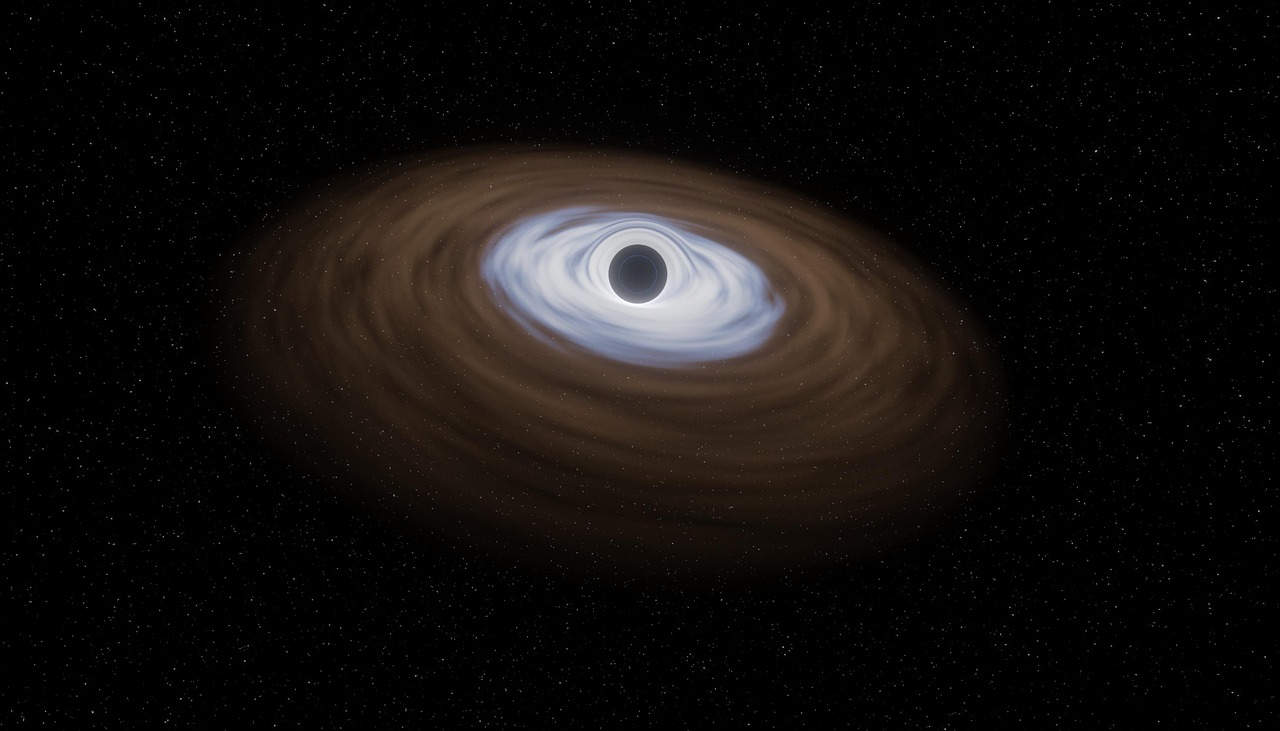
Bengaluru: Astronomers at the city-based Indian Institute of Astrophysics (IIA) have unlocked a cosmic riddle, revealing how supermassive black holes at the centres of galaxies can potentially shut down star formation in their central regions, offering vital clues to why some galaxies have very low star-formation rates. Published in The Astrophysical Journal, their study shows that intense radiation and high-speed jets from these black holes, millions of times more massive than our Sun, work together to eject gas from galactic centres through feedback mechanisms, regulating galactic growth and shaping the behaviour and evolution of their host galaxies.
The research tackles a key puzzle: the relative influence of gas outflows versus radiation from the central regions on the behaviour and evolution of the host galaxy. Supermassive black holes power active galactic nuclei (AGN)—energetic galaxy centres where matter spirals into the black hole’s accretion disc, emitting copious radiation and gas. This activity triggers AGN feedback, a process where black holes influence their host galaxies through radiative and kinetic mechanisms. Radiative feedback, or quasar-mode, involves intense radiation—light, ultraviolet, and X-rays—from the accretion disc heating and ionising gas, driving powerful winds that eject the cold molecular gas needed for star formation. Kinetic feedback, or jet-mode, involves narrow collimated beams of relativistic particles, launched near light speed from the black hole’s vicinity, amplifying gas expulsion. Negative feedback, the focus of this study, suppresses star formation by depleting gas, while positive feedback, less common, can trigger it by compressing gas clouds.
Using cutting-edge archival data from the Sloan Digital Sky Survey (SDSS) Telescope at optical wavelengths and the Very Large Array (VLA) at radio wavelengths, both located in the United States, the IIA team studied over 500 relatively nearby galaxies hosting AGN.
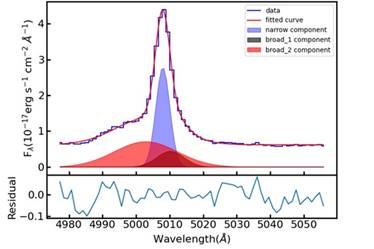
Payel Nandi, a PhD student at IIA and lead author, explains, “We found that outflows of warm ionised gas are widespread in AGN, and while radiation from the black hole is the main driver, galaxies with radio jets show significantly faster and more energetic outflows.” These high-speed streams of gas, pushed out from galactic centres at speeds up to 2,000 kilometres per second—fast enough to escape the gravitational pull of the galaxy itself—are more than twice as likely in galaxies detected at radio wavelengths (56%) compared to those without radio emission (25%).
These outflows can potentially shut down star formation in the central regions of their host galaxies through negative AGN feedback. Optical measurements of stellar populations and infrared colour diagnostics confirmed that black hole activity, not star formation, drives these winds, depleting the gas essential for new stars.
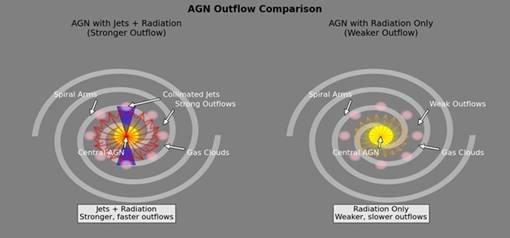
The team found a strong link between the energy of these outflows and the total luminosity or power generated by the supermassive black holes, with an even stronger connection in galaxies with radio jets. These jets act as boosters, amplifying gas ejection. C.S. Stalin, an IIA faculty member and co-author, stresses, “This study emphasises how vital it is to combine multi-wavelength data to understand the full picture of galaxy evolution.” Dhruba J. Saikia, from the Inter-University Centre for Astronomy and Astrophysics and co-author, adds, “These findings are an important step in understanding the complex inter-relationships between supermassive black holes, radio jets, star formation and evolution of their host galaxies.”
Astronomers have long studied feedback from black hole-driven gas outflows for its role in determining galactic evolution. The challenge has been discerning whether radiation from the black hole’s accretion disc or its relativistic jets dominates in shaping the host galaxy’s behaviour and evolution.
The IIA’s multi-wavelength approach clarified that radiation is the primary driver, with jets enhancing the effect, providing answers to why some galaxies exhibit very low star-formation rates. By ejecting gas, these black holes starve stellar nurseries, potentially halting star formation and regulating the growth of their host galaxies. This study deepens our understanding of how galaxies evolve and underscores the profound impact of supermassive black holes, distant yet pivotal, in crafting the cosmic tapestry we observe today.
– global bihari bureau