New Safe Aluminium Battery from Indian Labs
Bengaluru: Scientists have developed a novel battery technology that is flexible enough to fold like a piece of paper and safe to touch without risk. This development offers an alternative to lithium-ion batteries, which are commonly used in phones, laptops, electric vehicles, and wearable devices but are prone to overheating and explosion.
The battery was developed by researchers from the Centre for Nano and Soft Matter Sciences (CeNS), an autonomous institute under the Department of Science and Technology, Government of India, in collaboration with the Centre for Nano Science and Engineering at the Indian Institute of Science, both located in Bengaluru. It utilises aluminium, one of Earth’s most abundant metals, along with a water-based solution, making it safer, cheaper, and more environmentally friendly. The design aims to prevent battery explosions and environmental hazards while also reducing the power requirements of devices.
Aluminium holds potential for efficient energy storage and release, but its practical application has been hindered by complex chemistry. The researchers addressed these challenges by modifying materials at the microscopic level. They created a cathode from copper hexacyanoferrate pre-filled with aluminium ions and paired it with an anode made from molybdenum trioxide, resulting in a battery that is effective and flexible without breaking when bent.
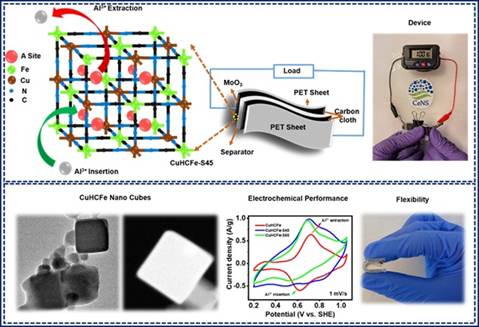
A schematic representation illustrates the battery’s composition, including the crystal structure of the electrode material, device architecture, and its flexibility with stable performance under bending conditions. The battery stores energy efficiently and reliably, retaining 96.77 per cent of its capacity after 150 charge-discharge cycles, which limits the reduction in battery life over extended use.
It remains functional even when bent or folded completely in half. To demonstrate this, the scientists powered an LCD continuously while the battery was bent at extreme angles. This feature could enable future gadgets that can be rolled up and facilitate the fabrication of wearable devices integrated into clothing.
The researchers employed advanced microscopic tools, such as electron microscopes and spectroscopic techniques, to balance the battery’s components for high performance. They conducted rigorous tests to confirm its efficiency, durability, and flexibility for real-world applications. The innovation has implications for everyday uses, including flexible smartphones, safer electric vehicles, and wearable devices in clothing. The use of abundant and environmentally friendly aluminium aligns with sustainability goals.
This development marks a stride in multivalent ion battery technology. With further improvements, such batteries could become standard in daily life and position the country to develop safe, sustainable, and next-generation energy storage solutions that support global environmental objectives.
– global bihari bureau