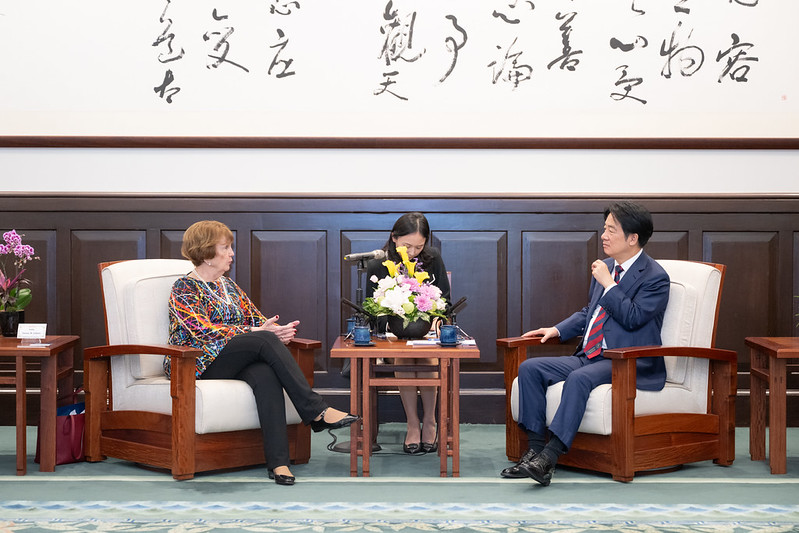
President Lai Ching-te with Ambassador Susan M. Elliott, who led a delegation from the National Committee on American Foreign Policy (NCAFP) to Taipei on December 5, 2025. Official Photo by Lin Yen Ting/ Office of the Presiden.
China Condemns $11.1B U.S. Arms Sale to Taiwan
Cross-Strait Tensions Rise After U.S. Arms Package
Beijing: China today issued a stern warning over the United States’ proposed US$11.1 billion arms sale to Taiwan, calling it a serious violation of Chinese sovereignty and a direct threat to peace and stability in the Taiwan Strait. Foreign Ministry Spokesperson Guo Jiakun, speaking at a regular press briefing, stated that the U.S. action “grossly interferes in China’s internal affairs, undermines China’s sovereignty, security and territorial integrity, disrupts peace and stability in the Taiwan Strait, and sends a seriously wrong message to ‘Taiwan independence’ separatist forces.” He emphasized that China had lodged formal protests with Washington and warned that any effort to arm Taiwan would meet “serious consequences.”
Guo framed the arms sale not merely as a military transaction but as a political signal likely to embolden Taiwan’s separatist authorities, increasing the risk of escalation. He stressed that the real threat to peace and stability in the Taiwan Strait lies in the actions of the Lai Ching-te authorities and external interference, asserting that U.S. claims of “assisting Taiwan in response to threats” would place the island on a “powder keg” and accelerate the risk of China–U.S. confrontation. He emphasised that no amount of advanced weaponry could alter what Beijing regards as the inevitability of China’s reunification, urging Washington to respect the one-China principle and the three China-U.S. joint communiqués and to halt support for Taiwan’s separatist agenda.
The U.S. government formally notified Congress on December 17, 2025, of the proposed arms package, initiating the standard 30-day review period. The package, one of the largest U.S. sales to Taiwan in decades, is designed to strengthen the island’s asymmetric defence posture, integrating advanced surveillance, precision strike, and rapid-response capabilities. The Taiwan Tactical Network (TTN) and Team Awareness Kit (TAK) aim to enhance real-time battlefield communication and situational awareness across military units, critical for coordinated defence. AH-1W helicopter spare and repair parts ensure that rotary-wing attack assets remain operational, providing mobility and rapid engagement in potential conflict scenarios. M109A7 self-propelled howitzers provide artillery support for land-based defences, while additional High Mobility Artillery Rocket Systems (HIMARS) and related equipment enable precision long-range strikes against advancing forces. Tube-launched, optically tracked, wire-guided (TOW) missiles and anti-armour UAV missile systems enhance Taiwan’s anti-armour capabilities and precision-strike options, while Javelin missile systems allow infantry units to engage armoured targets effectively. For maritime defence, Harpoon missile repair, follow-on support and related naval equipment ensure the continued operational readiness of Taiwan’s anti-ship systems. Collectively, these assets are calibrated to provide denial and deterrence capabilities, compensating for the relative imbalance in conventional forces across the Taiwan Strait.
Taiwan welcomed the announcement. On December 18, Presidential Office Spokesperson Karen Kuo expressed gratitude for the U.S. reaffirmation of commitments under the Taiwan Relations Act and the Six Assurances, framing the sale as evidence of the strong Taiwan-U.S. strategic partnership. Kuo highlighted Taiwan’s plans to raise defence spending to over three per cent of GDP next year, with a target of five per cent by 2030, alongside continued investment in asymmetric capabilities and whole-of-society resilience. She emphasised that peace and stability across the Taiwan Strait and the Indo-Pacific are vital to the security and prosperity of the international community, underlining Taiwan’s posture as both defensive and credible.
Earlier, on December 5, President Lai Ching-te met a delegation from the National Committee on American Foreign Policy (NCAFP), providing insight into Taiwan’s strategic calculations leading to the arms sale. In translated remarks, Lai described Taiwan and the U.S. as “important strategic and trade partners” sharing democratic values. He outlined Taiwan’s proposed eight-year, US$40 billion supplementary defence budget, earmarked for U.S. military procurement, indigenous defence development, and reinforcement of asymmetric capabilities. Lai emphasised Taiwan’s commitment to safeguarding peace and stability in the Indo-Pacific amid China’s use of military intimidation, grey-zone tactics, economic coercion, and diplomatic pressure. He stressed that reinforcing national defence and societal resilience is essential to uphold democratic values, maintain credible deterrence, and preserve regional stability.
Following Lai’s remarks, the leader of the NCAFP delegation, Ambassador Susan M. Elliott, thanked Taiwan for the warm reception and emphasised the delegation’s focus on regional security, prosperity, and Taiwan-U.S. cooperation. Their engagement underscored the continuity of U.S.-Taiwan strategic interaction and provided context for the composition and timing of the December 17 arms notification.
China’s warnings reflect profound strategic anxieties. Beijing perceives the U.S. sale as a deliberate escalation likely to embolden Taiwan’s separatist authorities, raise the likelihood of military confrontation, and challenge China’s core national interests. Guo Jiakun reiterated that the Taiwan question constitutes a “red line” in China-U.S. relations and warned that continued U.S. arms transfers would prompt resolute measures to safeguard sovereignty and territorial integrity. Analysts note that the scale and composition of the package signal Washington’s intent to support Taiwan’s credible self-defence while probing Beijing’s strategic responses, with potential implications for cross-Strait security and broader Indo-Pacific stability.
Placed in historical context, this sale represents the second major package under the current U.S. administration and follows decades of U.S. military support to Taipei, consistently framed within the Taiwan Relations Act and the Six Assurances. Past U.S.-Taiwan sales have focused on air defence, missile systems, and naval capabilities, reflecting a sustained objective of enabling Taiwan to maintain a credible defensive posture. The December 17 package, integrating battlefield communications, artillery, precision-strike, anti-armour, and naval systems, demonstrates the continued evolution of Taiwan’s military modernisation and the strategic significance Washington attaches to Taipei’s security, while signalling to Beijing that interference in Taiwan’s affairs carries costs.
Beyond the immediate cross-Strait dynamic, the arms sale has broader regional implications. Taiwan’s integration of advanced systems strengthens its asymmetric defence posture, providing mobility, precision, and anti-armour capability that acts as a credible deterrence against potential aggression. The sale also influences Indo-Pacific security calculations, as U.S. allies and partners observe the balance of power and assess strategic risks and opportunities in the Taiwan Strait. By connecting Taiwan’s defense modernization, U.S. support, and China’s objections, the sale illustrates the delicate interplay of deterrence, diplomacy, and strategic signalling in one of the most sensitive geopolitical flashpoints globally.
– global bihari bureau