 By Rahul Laxman Patil*
Dhaka-14 Emerges as Bellwether in Bangladesh Polls
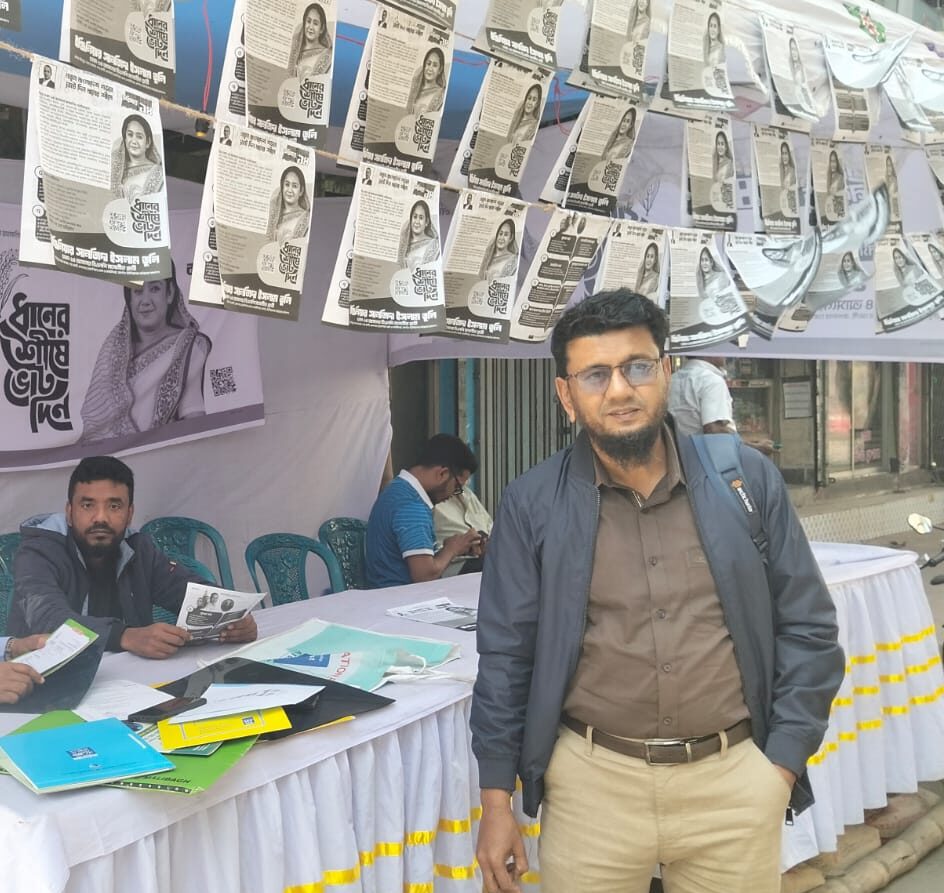
Dhaka: As Bangladesh approaches its 13th National Parliamentary Elections, the Dhaka-14 constituency has assumed heightened importance, both as a fiercely contested urban seat and as a broader indicator of changing political behaviour in the capital. The constituency, encompassing Mirpur, Shah Ali and Darus Salam, is among the most densely populated in Dhaka, marked by commercial hubs, industrial pockets, major sports facilities and cultural centres. Its electorate is young, socially diverse and highly exposed to digital communication, making it particularly sensitive to issues of governance delivery, employment and public services.
Beyond its immediate electoral contest, Dhaka-14 holds wider political significance in Bangladesh’s parliamentary landscape. As a densely populated urban constituency within the capital, it is often treated by major parties as a bellwether for middle- and lower-middle-class urban sentiment in Dhaka. In the last general election cycle (January 2024), Dhaka-14 was won by Awami League’s Mainul Hossain Khan (boat symbol) with an independent runner-up.
Historically, outcomes in constituencies like Dhaka-14 have been closely watched to assess public confidence in party organisation, urban governance delivery and leadership credibility, particularly among youth and first-time voters. The seat’s demographic mix—combining working-class neighbourhoods, students, minority communities and informal-sector workers—makes it a testing ground for political narratives on employment, civic services and inclusion. Performance here is frequently used by parties to evaluate the effectiveness of ground-level mobilisation in urban Dhaka, where voter behaviour is less rigidly aligned to party loyalty and more responsive to personal credibility and service delivery. As such, Dhaka-14 is not merely a local contest but an indicator of how national parties are adapting to evolving urban political expectations ahead of broader electoral battles in the capital.
Also read: Bangladesh Poll 2026: Minority Vote Key in BNP–Jamaat Fight
These dynamics are clearly reflected in the current campaign. Independent candidate Syed Abu Bakar Siddique, popularly known as Saju, is widely viewed on the ground as holding an edge. His standing is rooted in strong local connections, sustained visibility across neighbourhoods and goodwill generated through social initiatives undertaken during the COVID-19 pandemic. Youth voters and minority communities, in particular, appear receptive to his direct engagement and accessibility, traits that resonate strongly in an urban constituency where voters increasingly expect personal accountability from their representatives.
Local voices underline this sentiment. Mohammad Rahim, a community leader from Shah Ali, said Saju is “always visible in our neighbourhood and listens to our problems”. From Darus Salam, trader Hasan Chowdhury remarked that “focusing on local issues is decisive”. Among students, expectations are similarly clear. Ayesha Kabir, a student from Mirpur, said young voters want representatives who engage with them directly and “not just rely on party campaigns”.
However, Saju’s campaign is not without constraints. As an independent candidate, he lacks the organisational depth and financial resources that established parties typically command, a factor that could become significant during the final stages of mobilisation and polling-day logistics.
Challenging him are candidates backed by major political formations. Sanjida Islam Tuli of the Bangladesh Nationalist Party and Mir Ahmed Bin Kasem Arman of the Jamaat-led 10-party coalition both bring educational credentials and access to party or alliance networks. Yet, their appeal within Dhaka-14’s urban electorate appears limited at present. Ground assessments point to lower personal visibility, weaker neighbourhood-level engagement and the circulation of minor negative reports and rumours, which may be affecting voter confidence.
In an urban constituency such as Dhaka-14, where electoral margins can be narrow, these perceptions matter. Kamal Uddin, a community leader in Mirpur, observed that “just having a name doesn’t work here; personal connection and trust decide the outcome”. This reflects a broader shift among urban voters, especially the young, who increasingly evaluate candidates on accessibility and responsiveness rather than party affiliation alone.
Demographically, the constituency underscores why engagement is critical. Voters aged 18 to 35 are estimated to constitute between 30 and 40 per cent of the electorate, with students accounting for roughly 15 to 20 per cent. Minority communities, though forming about three per cent of the population, including Hindu and Buddhist voters, are seen as potentially decisive in closely fought contests. Ananda Ghosh, a minority elder from Mirpur, noted that even a small vote share can influence results if candidates maintain regular contact and inclusion.
Campaign strategy in Dhaka-14 has therefore centred on direct outreach to youth, students, traders and minority communities, alongside careful management of alliance dynamics to avoid vote fragmentation. Participation in local social and cultural programmes, consistent presence in neighbourhoods and effective use of digital platforms are increasingly viewed as essential. For party-backed candidates in particular, countering negative narratives through visible local engagement has become a priority.
As campaigning intensifies, Dhaka-14 continues to highlight a defining trend in Bangladesh’s urban politics: personal credibility and local problem-solving often carry greater weight than party branding. While Syed Abu Bakar Siddique currently appears to be ahead due to his grassroots connect, the final outcome will depend on turnout, alliance calculations and last-mile voter mobilisation.
Ultimately, the Dhaka-14 race is likely to favour the candidate who can combine organisational discipline with sustained community engagement, address everyday urban concerns and maintain continuous dialogue with youth and minority voters. In this constituency, trust built on the ground may once again prove more decisive than national slogans or party labels.
*Political and Strategic Analyst