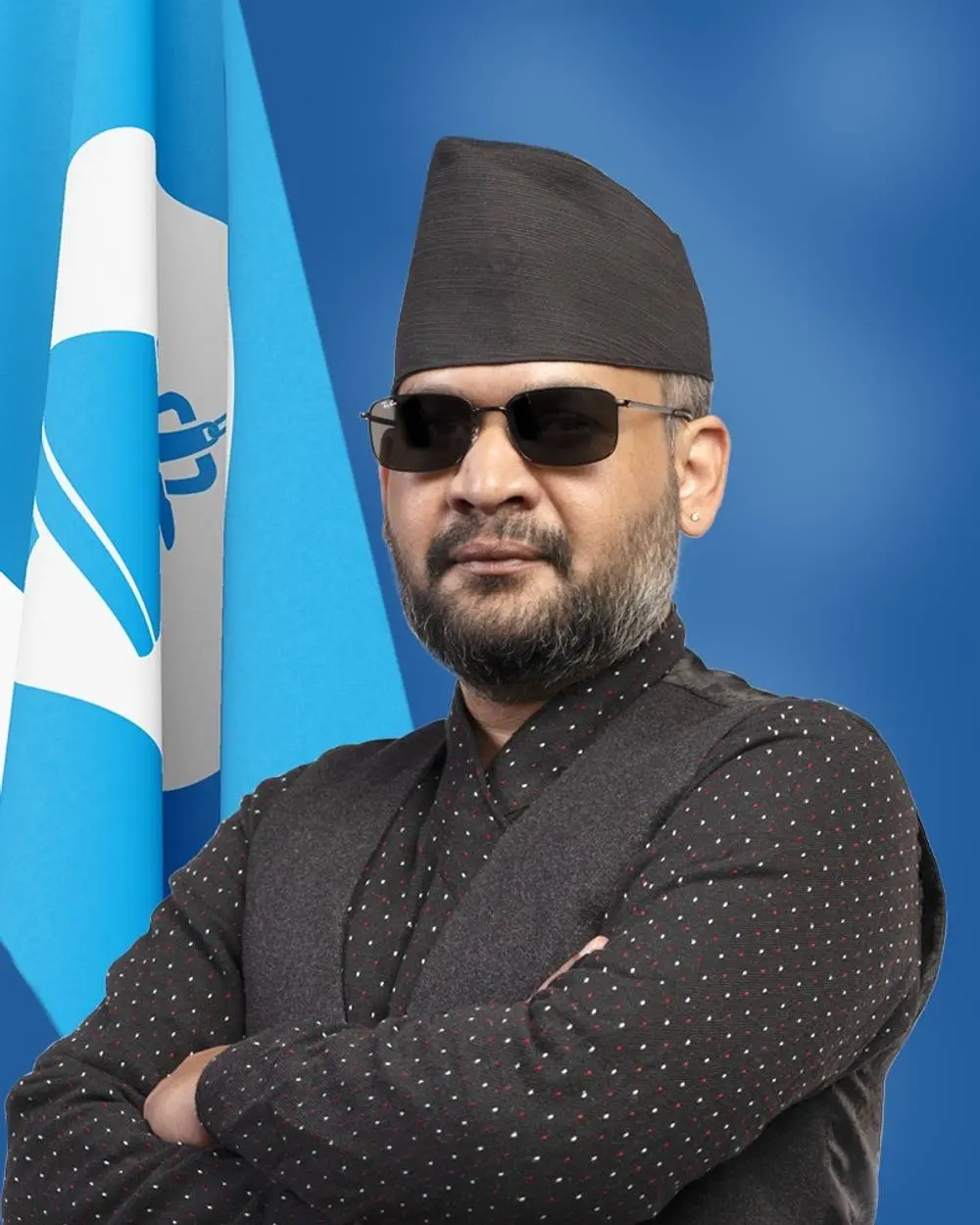
Balendra Shah
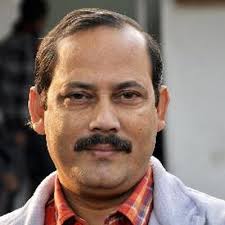 By Nava Thakuria*
Nepal Poll Results Signal Major Political Shift
Nepal’s parliamentary elections have delivered a decisive victory for the Rastriya Swatantra Party (RSP) led by Balendra Shah, placing the former Kathmandu mayor in a strong position to form the next government in the Himalayan republic. Official tallies indicated that the RSP secured more than 115 seats in the 275-member House of Representatives and was leading in several others, placing it well ahead of Nepal’s traditional political parties.
The outcome establishes the Rastriya Swatantra Party as the largest political force in the new Parliament and places Shah at the forefront of government formation once the constitutional process is completed. With the allocation of proportional representation seats underway, the party is expected to emerge with a commanding presence in the federal legislature. If appointed, the 35-year-old leader would become one of the youngest prime ministers in Nepal’s history.
One of the most closely watched contests unfolded in the Jhapa-5 constituency of eastern Nepal, located near the strategic Siliguri corridor connecting mainland India with its northeastern states. In that constituency, Balendra Shah defeated former prime minister K. P. Sharma Oli of the Communist Party of Nepal (Unified Marxist–Leninist) by a wide margin, securing 68,348 votes against Oli’s 18,734. The result strengthened Shah’s position as the leading contender to form the next government in Kathmandu.
The election results also reflect substantial setbacks for long-established political parties that have dominated Nepal’s political landscape for decades. The Nepali Congress, the country’s oldest political organisation, secured around 17 seats, while the Communist Party of Nepal (Unified Marxist–Leninist) won seven seats and was leading in a few others during the counting process. Other communist factions associated with Pushpa Kamal Dahal, widely known as Prachanda, registered only a limited presence in the new Parliament. Smaller parties including the Rastriya Prajatantra Party and the Shrama Shakti Party secured or led in a handful of constituencies.
According to the Election Commission of Nepal, more than 60 percent of registered voters participated in the polling process, which remained largely peaceful across the country. Once the final certification of results and allocation of proportional representation seats are completed, Nepal’s president Ram Chandra Poudel is expected to invite the leader commanding a majority in the House of Representatives to form the new government. With his party’s commanding position in Parliament, Balendra Shah has emerged as the frontrunner to assume the office of prime minister.
Prime Minister Narendra Modi congratulated the Nepali people and the interim authorities for the successful conduct of the election. In a message posted on social media, he said it was heartening to see Nepali citizens exercising their democratic rights and reiterated that India remained committed to working closely with the people of Nepal and the incoming government to strengthen cooperation, peace and prosperity.
The election was conducted while the country was under an interim administration headed by former chief justice Sushila Karki. She had assumed responsibility in September last year following a wave of anti-corruption protests led largely by Nepali youth that resulted in the fall of the government led by K. P. Sharma Oli. Ahead of the polling day, Karki had addressed the nation urging citizens to participate peacefully and assuring that the authorities were committed to conducting a free, fair and fearless election.
Political debate during the campaign also included calls from the Rastriya Prajatantra Party for restoring Nepal’s constitutional monarchy and declaring the country once again a Hindu state. The party organised rallies in several regions supporting the former king Gyanendra Bir Bikram Shah Dev, who has lived as a private citizen in Kathmandu since the monarchy was abolished nearly two decades ago. Sections of supporters have periodically demanded the restoration of the monarchy even in a ceremonial capacity.
Nearly 19 million Nepali citizens were eligible to vote in the election to the 275-member House of Representatives. Polling began at 7 am Nepal time, which is 15 minutes ahead of Indian Standard Time, and continued until 5 pm across 23,112 polling centres under 10,963 polling stations in all 77 districts of the country. The exercise was conducted with the deployment of 341,113 security personnel, including nearly 149,000 temporary election police personnel.
The Election Commission had reported that 18,903,689 electors, including more than eight lakh newly registered voters, were eligible to participate in the democratic exercise. Nepal follows a mixed electoral system in which voters cast two ballots, one for an individual candidate under the first-past-the-post system and another for a political party under proportional representation. A total of 3,406 candidates representing more than 65 political parties, along with 1,143 independent contestants, competed for the 165 constituency seats, while another 3,135 candidates contested the remaining 110 seats under proportional representation.
Balendra Shah, a structural engineer by training who gained national prominence as Kathmandu’s mayor before entering national politics, had earlier been known for his career in music before transitioning into public life. His political rise coincided with a broader youth-driven movement demanding governance reforms and greater accountability in public institutions.
The election outcome is being closely watched across South Asia because of Nepal’s strategic location between India and China and its role in regional connectivity and economic cooperation. The new government expected to take office in Kathmandu will inherit the task of addressing domestic economic challenges while managing relations with its neighbours and responding to expectations of political stability following the political upheavals of the past year.
*Senior journalist