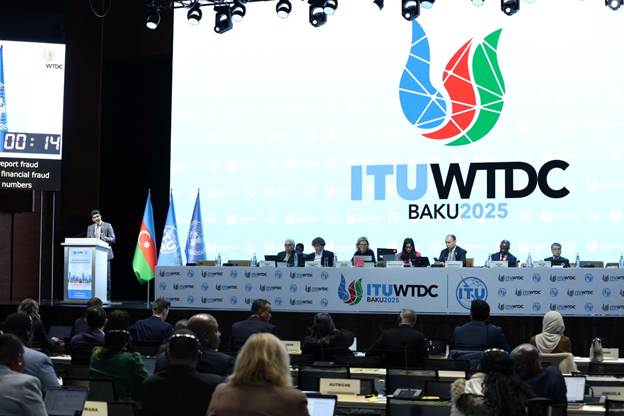
India Sets Pace for Global Digital Norms at WTDC-25
Can India Turn WTDC Vision into Real Digital Access?
Baku: The adoption of 19 Asia-Pacific Telecommunity (APT) Common Proposals, in which India served as lead or assisting lead, had the stamp of New Delhi’s unmistakable, if predictable, presence that shaped the outcome of the World Telecommunication Development Conference 2025 (WTDC-25) in Baku today. The voting pattern and floor negotiations suggested broad regional alignment behind India’s telecom and Information and Communication Technology (ICT) positions, though several delegations privately acknowledged that the real measure of impact will come only when implementation begins at the domestic level.
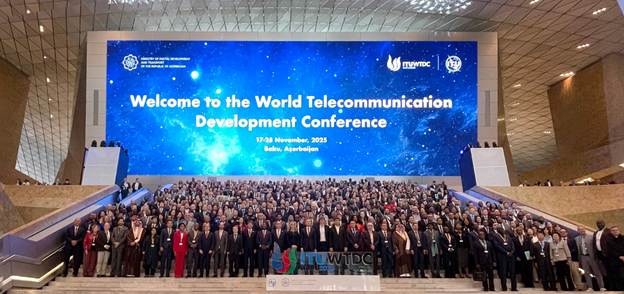
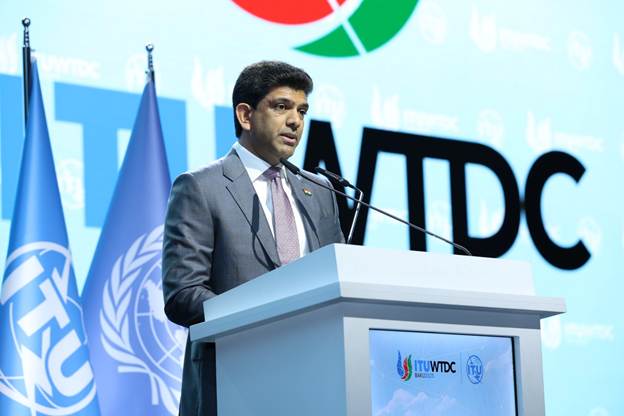
The conference — attended by nearly 2,300 delegates, including more than 65 ministers and heads of agencies — sets the global development agenda for telecommunications every four years. India arrived with extensive diplomatic preparation: leadership positions, coordinated APT backing, and a delegation headed by Minister of State for Communications and Rural Development Dr Pemmasani Chandra Sekhar, who delivered India’s high-level policy statement invoking “Vasudhaiva Kutumbakam — Driving global Digital Transformation with ancient wisdom and modern commitment.” His intervention framed India’s approach as centred on universal and meaningful connectivity, digital inclusion, and leveraging emerging technologies for development.
A transitional theme quickly emerged across the negotiation rooms: India’s resolutions largely avoided abstract principles and instead sought operational clarity — linking digital transformation with measurable requirements such as interoperable standards, public–private partnerships, capacity-building, early warning systems, cybersecurity safeguards for small and medium enterprises (SMEs), electromagnetic field (EMF) risk communication, and circular-economy practices in ICT hardware. The APT group’s coordinated support was decisive in securing consensus wording across multiple negotiating clusters, particularly where diverging regulatory baselines exist between high-income and low-income nations.
The most strategically watched cluster was Digital Transformation and Innovation, with India leading or shaping Resolutions 85, 89 and 90. These extend the Smart Sustainable Cities and Communities (SSC&C) framework to also cover smart villages — a notable expansion for countries where digital inequity tracks rural–urban lines. The resolutions encourage Internet of Things (IoT)-driven local planning models, innovation alliances to nurture domestic entrepreneurs, and the use of regional International Telecommunication Union (ITU) offices to support low-resource innovators. Delegates from Africa and Southeast Asia described this as a “relevance shift,” bringing the conversation closer to real deployment environments outside capital cities.
On cybersecurity and consumer protection, India guided the strengthening of Resolutions 45 and 84, emphasising safeguards against misuse of telecom services, caller ID manipulation, and tools to support SME cyber resilience. Mobile handset theft and illegal device tampering — issues that disproportionately affect developing markets — were recognised through enhanced provisions on global best practice exchange.
Regulatory and spectrum policy negotiations saw India push for flexibility rather than uniformity. Resolution 09 now includes references to regulatory sandboxes, experimental spectrum licensing, International Mobile Telecommunications 2030 (IMT-2030 / 6G) testbeds, and unmanned aerial vehicle (UAV)/drone communication frameworks, along with guidance for valuing, charging, and allocating spectrum. Some smaller economies, while supporting the final text, noted in corridor conversations that the shift to valuation-based spectrum approaches will require support mechanisms if it is not to widen the disparity between resource-rich and resource-poor regulators. India also contributed to changes in Resolution 62, calling for expanded public awareness on electromagnetic field (EMF) exposure and updated ITU guides to cover new wireless equipment.
In emergency telecommunications, India strengthened Resolution 34 to support cell-broadcast-based multilingual early warnings, geographic information system (GIS)-based telecom infrastructure mapping, and cross-border disaster information exchange — additions described by Pacific Island delegates as “urgent rather than aspirational,” given climate-linked vulnerabilities.
Environmental concerns were addressed through India’s role in reinforcing Resolution 66, which promotes strategies to reduce ICT carbon footprints, expand circular-economy practices, and raise awareness of e-waste management. Delegations repeatedly pointed out that climate-linked ICT burden is rising fastest in low-income nations where end-of-life hardware accumulates without recycling frameworks.
Throughout the week, India’s negotiating influence was amplified by its institutional footprint. Avinash Agarwal (Deputy Director-General – International Relations, DDG-IR) served simultaneously as Conference Vice-Chair, APT-WTDC-25 Coordination Chair, and Chair of the Ad Hoc Group on Digital Transformation & Innovation. India also secured two Vice-Chair positions in the incoming International Telecommunication Union – Development Sector (ITU-D) Study Groups (2026–29) — Sunil Kumar Singhal and Sandeep Kumar Gupta — extending India’s agenda-setting capacity beyond Baku and into the technical study cycle that will shape project design and funding priorities for the next four years.
Alongside negotiations, India used the conference to introduce M. Revathi as the country’s candidate for Director of the Radiocommunication Bureau (BR) and to highlight its candidature for the ITU Council (2027–2030). A networking reception and a Centre for Development of Telematics (C-DOT) technology pavilion — showcasing indigenous platforms that attracted interest from multiple African and Asian delegations — formed part of India’s broader diplomatic strategy.
Still, amid the high-visibility announcements, a quieter thread of doubt emerged across delegations from resource-constrained regions. Several negotiators, speaking outside formal sessions, cautioned that global ICT development frameworks often struggle not in design but in execution — citing uneven financing access, regulatory gaps, and limited ground-level capacity.
The consensus in Baku demonstrated directional alignment; whether the 19 adopted APT proposals translate into practical change in rural networks, cybersecurity ecosystems, EMF awareness, spectrum policy, climate-responsible telecom infrastructure, and disaster-communications systems will depend on national commitments in the years ahead. This concern was not aimed at India specifically but at the global system’s history of under-implementation.
At the closing ceremony, ITU Secretary-General Doreen Bogdan-Martin described India as “a valuable partner in ITU, having served as a Council Member since 1952” — a reminder of India’s long-standing presence in telecom diplomacy. In Baku, that presence was visible not through rhetoric alone but in procedural weight: coordinated APT backing, leadership of negotiating groups, and consensus-building across regions that do not always align.
The operational lifetime of the Baku resolutions now shifts to capitals, regulators, operators, innovators, and funding agencies. For the moment, the record shows that India arrived with proposals, secured support, and prevailed in the diplomatic arena. What that will mean on the ground — for universal affordability, rural reach, cyber resilience, and sustainable ICT adoption — is a story that will not be written in conference halls but in implementation.
– global bihari bureau