At Hamilton Airport, Rubio Redraws U.S. Priorities
Hamilton, Ontario — The airfield press area at Hamilton International Airport felt more like the antechamber of a war room than the fringe of a diplomatic summit. The G7 foreign ministers had dispersed, but the urgency had not. When U.S. Secretary of State Marco Rubio stepped up to the microphones, he opened not with pleasantries but with the arithmetic of attrition: Russia, he said, was losing “7,000 soldiers every week” while still insisting it must take “the rest of Donetsk” before any negotiation with Ukraine could be entertained. In Washington’s view, that single demand had effectively collapsed any pathway to meaningful talks.
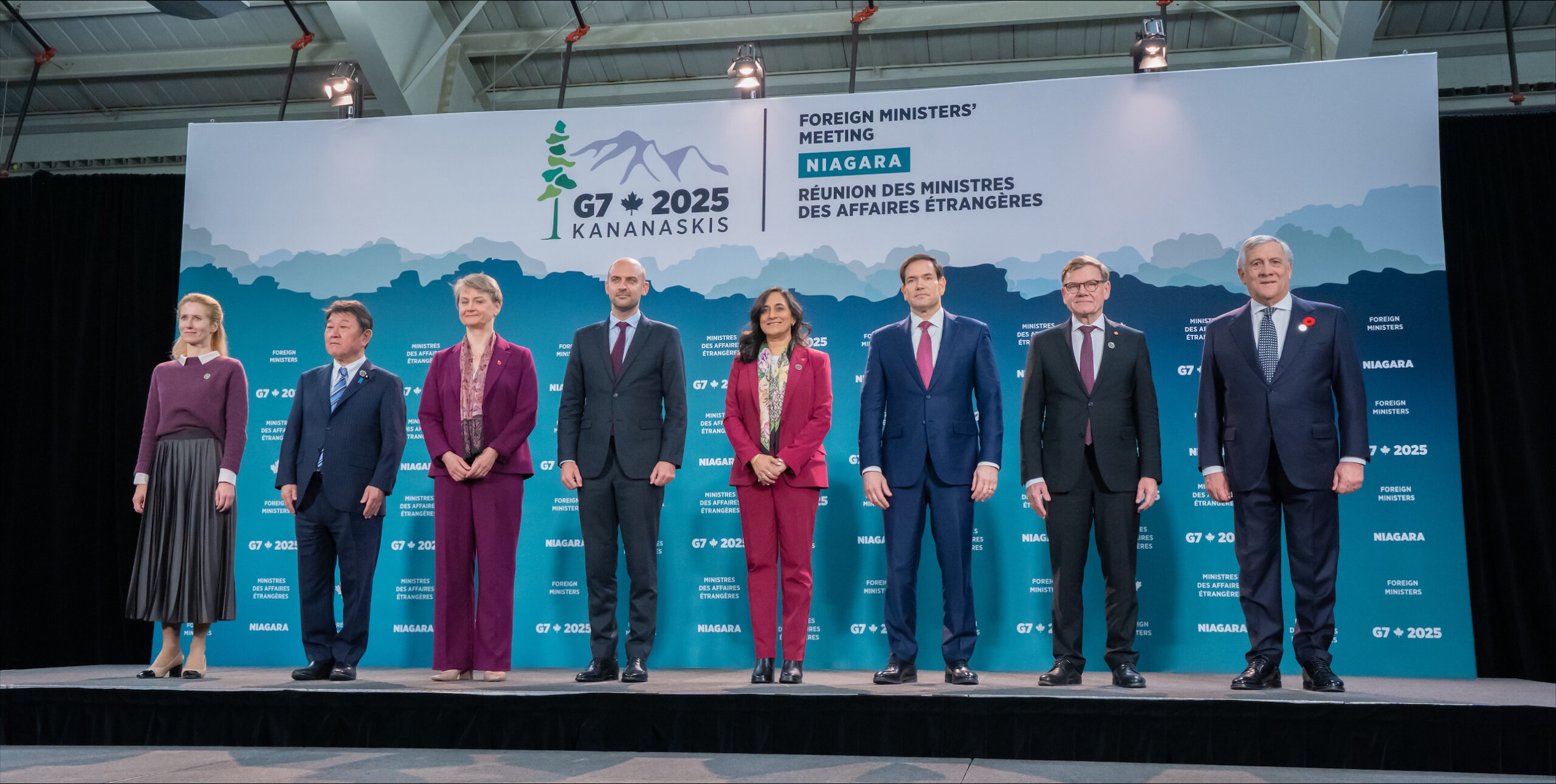
The Secretary of State had travelled to the Niagara Region in Ontario, Canada, from November 11 to 12, 2025, to attend the G7 Foreign Ministers’ Meeting. His brief was defined: To advance U.S. interests in peace and security, strategic cooperation, and global stability.
At the press briefing, Rubio sketched a battlefield where front lines were now measured less in kilometres than in kilowatts. Russia’s air campaign, he said, was systematically dismantling Ukraine’s electrical grid — a strategy designed to make cities unlivable and governance unworkable. “Fifty to sixty per cent” of Kyiv’s population lacked power for large portions of the day, he said, and even the most modern air-defence systems could be destroyed within a week of installation. The United States was engaged in technical discussions with Ukraine on how to protect critical infrastructure, but he warned that the pace of Russian strikes often outstripped the pace of repairs.
From there, the conversation widened into a tour of global crises, but with the same through-line: fractures in security were beginning to influence one another. Rubio rejected speculation that the U.S. had arrived at the G7 “empty-handed” on Ukraine. Washington had delivered what Kyiv specifically requested, he said — a tranche of sanctions — and continued supplying military and energy-sector support already in place. More would come, but only as systems proved deployable and survivable under bombardment.
A brief detour into South Asia underscored the caution in his tone. Asked about the deadly explosion near the India-Pakistan border, Rubio said early indications pointed to an “accidental explosion of a truck moving munitions,” adding that no evidence yet suggested terrorism or cross-border escalation. “Could that change? Of course,” he said, but nothing at present indicated a wider conflict.
Tensions flickered again when a journalist asked about Venezuela’s reported military activation in response to U.S. maritime interdictions. Rubio dismissed the statements, saying he would not engage with declarations issued by what he repeatedly described as a “narco-trafficking organisation.” The U.S. operations in question, he stressed, targeted “criminal drug-running vessels” operating from Venezuelan waters, and were not strikes on Venezuelan territory.
European discomfort over those interdictions surfaced unmistakably. Rubio said one unnamed European official had publicly questioned the legality of U.S. actions at sea. His response was sharp: the U.S., he said, would not allow “anyone in the European Union” to interpret international law on its behalf. He noted an inconsistency in the criticism — some of the same governments expressing concern in the Caribbean context were simultaneously asking Washington to deploy nuclear-capable systems to Europe for deterrence. He rejected as “a fake story” suggestions that either Canada or the United Kingdom had distanced itself from U.S. targeting processes. Intelligence-sharing remained intact, he said, and the operation would “end tomorrow” if drug-running vessels stopped departing Venezuela.
When the briefing turned to Sudan, Rubio’s tone darkened further. The humanitarian catastrophe in El Fasher, he said, had “dominated” ministerial discussions. Reports pointed to starvation, sexual violence, mass killings, and the disappearance of civilians who, under normal patterns, would have fled across borders as refugees. Their absence, he suggested, indicated either mass casualties or an environment so hostile that escape itself had become impossible. The RSF had violated every commitment it made to the Quad — the U.S., Egypt, Saudi Arabia, and the UAE — and was being strengthened by arms flows that Washington was now trying to cut off “at the highest levels.”
Rubio’s bilateral with Saudi Arabia’s foreign minister included preparations for Crown Prince Mohammed bin Salman’s expected visit to Washington, as well as regional security issues linked to Yemen and energy stability. He offered no details but indicated several agreements were moving toward completion.
The questions returned to Ukraine when a reporter asked about rumours of a sanctions waiver for Hungary. Rubio clarified that what was being discussed was not a waiver but a narrow “grace period” connected to the delivery of equipment to a Rosatom-related nuclear plant in Hungary. He emphasised that any dispensation would apply only to material required for domestic civilian power generation, not to broader commercial exemptions. Energy exemptions, he said, already existed under the price-cap regime, and this discussion was separate from that framework.
On the Middle East, Rubio separated two threads sharply. He acknowledged that the U.S. had not reopened its embassy in Syria and had no plans to. Reports suggesting a shift in American posture there, he said, were inaccurate. As for Israel, he repeated that Washington defended Israel’s right to respond to attacks but said he was unfamiliar with any statement instructing Israel not to prepare retaliatory measures against Iran.
From there, the conversation moved to Asia, where Rubio sketched the scale of China’s rapid nuclear expansion. Beijing, he said, had built “several hundred” new silos in a short span, altering the strategic landscape. He did not dwell on it, but framed it as part of a wider global environment in which major powers were modernising or enlarging their arsenals.
The Pacific returned in a discussion of maritime trafficking. The U.S. Coast Guard remained effective, he said, but interdictions alone had diminishing impact. Vessel losses had become a cost of doing business for traffickers. Real leverage lies upstream: on land, in precursor chemicals, and in cooperation with source and transit countries. Mexico, he said, had undertaken “severe actions” against fentanyl production, and China had agreed to schedule thirteen precursor chemicals under an understanding reached in South Korea. If enforced, that decision could significantly undermine the chemical supply chain.
Finally, Rubio addressed a sensitive but persistent theme: the use of U.S. systems by allied forces. Asked if Canada, the UK, or others had declined to participate in specific targeting activities that required American consent, Rubio said there had been no intelligence gaps and no procedural rupture. On whether the U.S. was encouraging allies to purchase Tomahawk missiles, he said only that partner militaries remained sovereign: “Countries act in their best interest,” he noted, and buy systems aligned with their operational needs. He called the speculation about targeting constraints “100 per cent false.”
Across subjects, Rubio’s message converged on a unifying logic: crises that once seemed regionally bounded were now interacting, and the U.S. viewed the intersections — drugs, energy, nuclear programmes, migration, proxy warfare, sanctions evasion, illicit financing — as the real terrain on which 21st-century threats developed. What emerged at Hamilton was less the unveiling of a doctrine than the articulation of a worldview in which American security was shaped by disruptions that moved across continents at the speed of weapons, supply chains, and political breakdowns.
For America’s partners, Rubio’s framing has direct implications. His emphasis on aligning policy responses to concrete threat vectors — rather than broad ideological categories — signals a sharper expectation that allies contribute visibly where U.S. intelligence or strategic interests are directly engaged. Some governments will interpret this as clarity; others may read it as pressure. But in either case, the margin for ambiguity appears to be narrowing.
Domestically, Rubio’s formulation sketches the emerging contours of the foreign-policy debate under the Trump administration. By grounding decisions not in broad interventionist or isolationist labels but in specific intersections between overseas instability and American security, he offers the administration a pragmatically framed narrative: deterrence where necessary, targeted force where unavoidable, and partnerships recalibrated around tangible payoffs. Whether this approach satisfies Congress — or provokes new arguments about burden-sharing, risk tolerance, and strategic bandwidth — will shape the battles ahead in Washington. But Hamilton made one fact unmistakable: the administration intends to tie global engagement tightly to U.S. security consequences, and expects allies to read that signal plainly.
– global bihari bureau