Union Minister Ashwini Vaishnav in Davos
At WEF, India Outlines Pragmatic AI and Renewable Pathways
Davos: India articulated a clear and deliberately differentiated position on both artificial intelligence and the clean energy transition at the World Economic Forum (WEF) Annual Meeting 2026 today, signalling that its strategy is anchored not in technological showmanship but in scale, affordability and real economic outcomes.
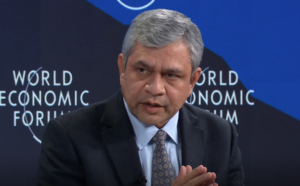
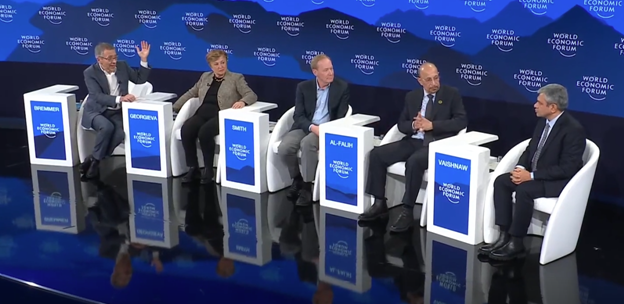
Union Minister for Electronics and Information Technology Ashwini Vaishnaw, speaking at the panel discussion titled “AI Power Play, No Referees”, said India firmly belongs to the first group of AI nations, but cautioned against equating global AI leadership with ownership of very large models. The discussion was moderated by Ian Bremmer, President and Founder of Eurasia Group, and featured global voices including Brad Smith, Vice-Chair and President of Microsoft, Kristalina Georgieva, Managing Director of the International Monetary Fund, and Khalid Al-Falih, Minister of Investment of Saudi Arabia, situating India’s intervention squarely within the highest levels of global policy and corporate debate.
Vaishnaw underlined that the real power of artificial intelligence lies in economics and deployment rather than sheer model size. He explained that AI architecture rests on five layers — applications, models, chips, infrastructure and energy — and said India is actively working across all of them. At the application layer, he noted, India is poised to be among the world’s largest suppliers of AI-enabled services, reinforcing its long-standing strength in technology-led service delivery.
The Minister pointed out that nearly 95 per cent of real-world AI use cases can be addressed using models in the 20–50 billion parameter range, many of which are already being deployed across sectors in India. He argued that return on investment in AI flows from enterprise-level adoption and productivity gains, not from building massive models that are expensive to train and maintain. In a geopolitical context, he warned against equating AI dominance with scale alone, noting that very large models can be switched off and may even impose financial stress on their developers.
Drawing parallels with India’s digital public infrastructure experience, Vaishnaw said the government’s focus is on systematic AI diffusion across the economy. Identifying access to compute as a key constraint, he said India has adopted a public–private partnership model to empanel around 38,000 GPUs as a shared national computing facility. This government-enabled and subsidised infrastructure is providing affordable AI compute to students, researchers, start-ups and innovators at nearly one-third of prevailing global costs.
He outlined four pillars of India’s AI strategy: a common national computing facility, a free bouquet of AI models catering to most practical needs, large-scale skilling initiatives aimed at training 10 million people in AI, and enabling India’s information technology industry to pivot towards AI-driven productivity and efficiency for domestic and global enterprises.
On regulation, Vaishnaw emphasised a techno-legal approach to AI governance, arguing that laws alone are insufficient to address emerging risks. He said regulation must be backed by technical tools to tackle harms such as bias and deepfakes, stressing that detection systems must be accurate enough to withstand judicial scrutiny. India, he said, is developing technologies for deepfake detection, bias mitigation and responsible model unlearning before enterprise deployment.
Alongside AI, India’s clean energy transition featured prominently at Davos. Union Minister for New and Renewable Energy Pralhad Joshi, through a series of high-level engagements, highlighted India’s approach to a just, affordable and inclusive energy transition. In discussions with WEF President and CEO Børge Brende and other global stakeholders, Joshi emphasised the importance of multilateral platforms in building consensus around sustainable growth and energy security.
Addressing roundtables and thematic sessions, Joshi highlighted India’s success in scaling decentralised renewable energy solutions, including rooftop solar, agricultural solarisation and mini-grids. He said these models are particularly relevant for the Global South, as they improve energy access, enhance resilience in weak-grid areas and reduce costs for households and farmers. Flagship initiatives such as PM Surya Ghar Muft Bijli Yojana and PM-KUSUM, he noted, demonstrate how decentralised systems can expand clean energy adoption while easing subsidy burdens.
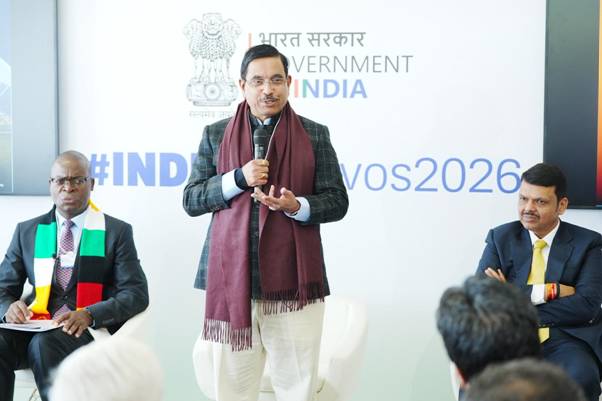
Joshi stressed that India’s energy transition is being driven not only at the national level but also by reform-oriented states translating policy into tangible outcomes. Citing examples such as Madhya Pradesh and Maharashtra, he said India today stands in the global spotlight for renewable energy execution. He pointed out that solar tariffs in India have declined by nearly 80 per cent, renewable energy coupled with storage has become cost-competitive, and green hydrogen and green ammonia prices discovered in India are among the most competitive globally. He added that domestic renewable energy manufacturing capacity has expanded to 144 GW, positioning India as both a major clean energy market and a reliable global manufacturing hub.
On the sidelines of WEF, Joshi also held discussions with global investors, including senior leadership of Mercuria Group, focusing on market-based mechanisms for scaling renewables, strengthening carbon markets and climate finance, and advancing green hydrogen, biofuels and energy storage. He welcomed the company’s stated intent to significantly expand investments in green energy and its interest in India’s clean energy ecosystem.

India’s clean energy narrative was reinforced by Indian Renewable Energy Development Agency (IREDA) Chairman and Managing Director Pradip Kumar Das, who participated in a WEF panel on scaling decentralised solar for the Global South. Das said decentralised renewable energy can reduce aggregate technical and commercial losses, lower subsidies and improve affordability. He noted that despite financing renewable projects worth around ₹1.81 lakh crore over nearly four decades, IREDA’s cumulative write-offs remain exceptionally low, reflecting robust project appraisal and risk management.
Joshi also linked India’s energy transition with digital innovation, delivering a keynote on the role of artificial intelligence in the energy sector. He said AI can improve forecasting, reduce losses, lower costs and strengthen grid reliability, highlighting India’s shift from pilot-based interventions to platform-based deployment through digital public infrastructure for energy.
Taken together, India’s interventions at Davos reflected a consistent theme across sectors: a preference for deployment over demonstration, diffusion over dominance, and execution over ambition. Whether in artificial intelligence or clean energy, India positioned itself not as a technology maximalist, but as a system builder focused on scalable, economically grounded solutions aligned with its development priorities and global responsibilities.
– global bihari bureau