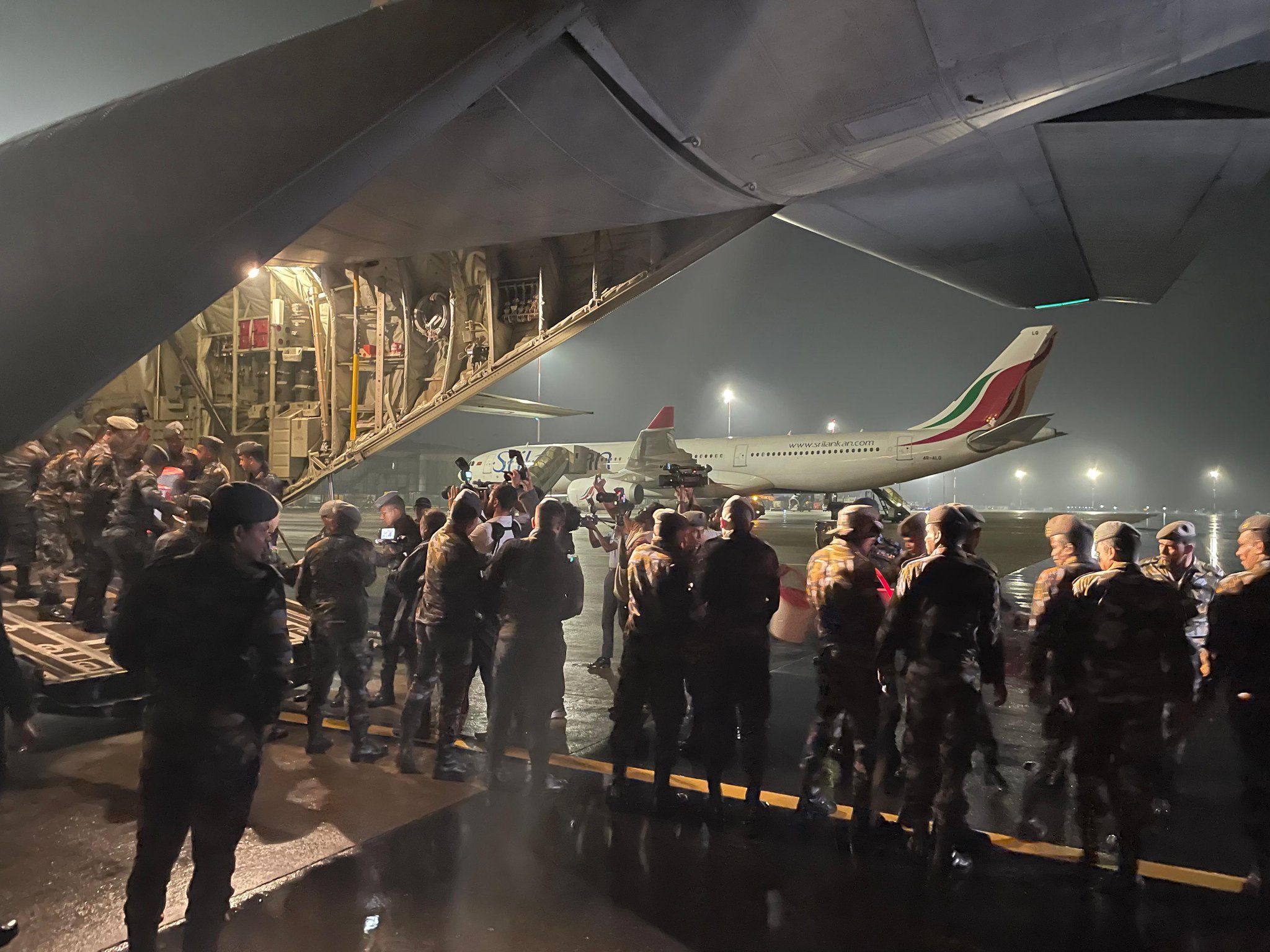
In the wake of the devastation caused by Cyclone Ditwah across Sri Lanka, India swiftly launched Operation Sagar Bandhu to bolster relief efforts. The Indian Air Force promptly deployed one C-130 and one IL-76 from Hindan Air Base on the night of 28/29 Nov 2025, airlifting 21 tonnes of relief material along with over 80 NDRF personnel and 8 Tonnes of equipment to Colombo. Essential rations and critical supplies have been delivered to support affected communities.
Storms Without Recovery Time: UN Warns of Cascading Climate Emergencies
Warmer Planet Driving Back-to-Back Cyclone Floods Across Asia
Geneva: Warmer global temperatures are enabling the atmosphere to hold more moisture, dramatically increasing the likelihood of extreme rainfall — “that’s the law of physics,” warned World Meteorological Organization (WMO) spokesperson Clare Nullis. Across Southeast Asia, from the Indian Ocean rim to the Bay of Bengal, this principle is unfolding in relentless succession: storms and floods that once would have been separated by seasons now arrive like a chain reaction. Coastal communities stagger to their feet only to be hit again before recovery can begin, while relief workers ricochet between emergencies that never fully subside.
In Indonesia, the first shock came with Cyclone Senyar, a rare tropical storm forming near the equator in the Strait of Malacca. Nullis highlighted the unusual formation, noting that local communities, unfamiliar with such storms, faced magnified impacts. Verified figures from the Indonesian National Disaster Management Authority report 604 deaths, 464 missing, 2,600 injured, and approximately 1.5 million people affected, with over 570,000 displaced. Northern Sumatra and the Malay Peninsula experienced heavy rainfall, landslides, and severe flooding that cut off transport and isolated neighbourhoods. Families moved to upper floors and rooftops as waters rose, improvising shelters in spaces unaccustomed to sustained inundation.
Meanwhile, in Vietnam, weeks of torrential rains battered the central provinces. A meteorological station in central Vietnam recorded a staggering 1,739 millimetres of rainfall in 24 hours, potentially the second-highest global single-day total, pending formal verification by WMO’s extremes committee. Historic citadels, tourist resorts, and farmlands were submerged. Tens of thousands were displaced as rivers overflowed, landslides buried roads, and reservoirs strained to contain the deluge. Government warnings continued as further rainfall threatened to prolong the crisis, keeping communities on high alert and relief agencies scrambling to provide aid.
In Sri Lanka, Cyclone Ditwah made landfall along the eastern coast in late November, carving a path of destruction across coastal towns and highlands. UNICEF spokesperson Ricardo Pires described a “fast-moving humanitarian emergency,” with 1.4 million people affected, including 275,000 children. Blocked roads and downed communications hindered the tally of affected individuals, while families crowded into makeshift shelters. Children, displaced or separated from caregivers after schools turned into dormitories, faced heightened risk of disease and psychological trauma. Medical staff, constrained by damaged infrastructure, improvised clinics outdoors, working tirelessly to meet urgent health needs.
The repeated flooding left profound human consequences. In neighbourhoods already soaked from prior storms, families had no time to recover. Ground floors were abandoned in favour of upper stories, roofs, and eventually boats. Rice sacks salvaged from initial floods spoiled during subsequent rains; retail stocks were washed away repeatedly. In provinces along the Bay of Bengal and Southeast Asia, floodwaters sometimes never receded fully between events. Relief networks depended on improvised radio systems as phone towers failed, and emergency coordinators moved from district to district, mapping fresh evacuation routes in areas they had already served.
Nullis explained that the cumulative nature of these events — not just peak intensity — drives much of the damage. Communities endure the grinding persistence of floods, which erodes resilience faster than any single catastrophic peak. Psychosocial stress among children and adults rises sharply, and health systems, even when well-prepared, strain under repeated exposure, displacement, and disease.
Also read: 5 Million Affected as Climate Shocks Reveal Systemic Risks
The Caribbean, still bearing scars from earlier hurricane landfalls, has experienced the same warming-driven rainfall principle without corresponding cyclonic winds. Coastal neighbourhoods, hardened against high winds, were ill-prepared for prolonged downpours. Streets became rivers, inland runoff overwhelmed drainage systems, and communities faced the same psychological and logistical stresses seen in Asia.
Across all affected regions, a common thread emerges: the storms are different not because of a single dramatic peak, but because they do not allow time for recovery. The repeated deluges overwhelm livelihoods, erode agricultural and commercial stocks, and strain health and shelter systems. Families contend with repeated displacement, children lose schooling continuity, and psychological burdens deepen with each wave of water.
Yet the global agencies framing these events emphasise preparedness rather than inevitability. Early-warning systems, climate-resilient infrastructure, and targeted humanitarian support are no longer abstract ambitions — they are the first line of defence against a warming world where extreme rainfall will only grow in frequency and intensity. Governments that fail to adapt now will confront spiralling social, economic, and human losses.
The human stories remain vivid. A child completes homework by torchlight in a crowded shelter. A farmer watches his field drown a second time in weeks. A nurse treats feverish children while floodwater laps at the clinic door. Families navigate rooftops and makeshift boats, carrying salvaged belongings, while entire communities wait for relief that struggles to reach them. These stories, repeated across Indonesia, Vietnam, Sri Lanka, Thailand, Malaysia, and beyond, are the human face of structural climate change, already here, accelerating, and reshaping the way life is lived in flood-prone regions.
The relentless floods and cyclones of late 2025 are a reminder that climate science is no longer abstract. Rising temperatures mean more moisture in the atmosphere, heavier rainfall, and repeated events that stress human, economic, and ecological systems alike. For those in the path, the challenge is immediate and relentless: rebuilding, protecting, and adapting while the skies continue to test the limits of resilience.
– Global Bihari Bureau