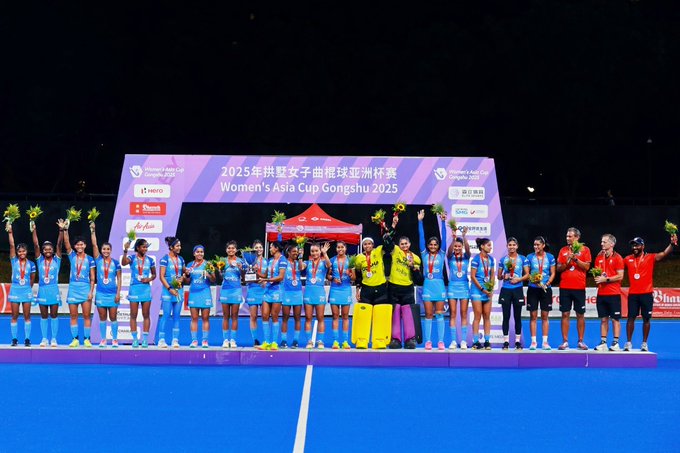
Hangzhou: It was the final—a match delayed 25 minutes by rain—that captivated all, as China’s relentless precision overcame India’s spirited challenge in a 4-1 victory at the Women’s Asia Cup 2025.
It began with a spark of hope for India, ranked ninth globally. Just one minute in, Navneet Kaur rifled a penalty corner shot into the net, handing India a 1-0 lead. Their aggressive opening, marked by swift attacks and high pressing, had China on the back foot, keeping the contest tight through the first quarter. The crowd, though modest, roared with energy, amplifying the stakes of World Cup qualification.
Yet China, the world No. 4, responded with composure, levelling the score soon after, likely before the second quarter ended. Their momentum surged in the third and fourth quarters, with Chen Yang, Tan Jinzhuang, and Zou Meirong exploiting India’s defensive mistakes to net three more goals. The 4-1 scoreline, while reflecting China’s dominance in the second half, masked India’s early tenacity.
India’s defensive struggles mirrored their earlier 4-1 Super 4s loss to China, where Chen Yang’s opportunistic field goal and Tan Jinzhuang’s penalty corner strike highlighted similar errors. In the final, China’s sharp finishing and ironclad defence—conceding just three goals across seven matches—stifled India’s attempts to sustain their early momentum. The 25-minute weather delay may have disrupted India’s rhythm, but China’s flawless tournament record (seven wins, 28 goals scored, three conceded) underscored their supremacy.
India’s journey to the final was electrifying. In Pool B, they crushed Thailand 11-0, drew 2-2 with defending champions Japan, and thrashed Singapore 12-0, with Navneet Kaur and Mumtaz Khan each scoring hat-tricks. Topping their pool, India entered the Super 4s, defeating South Korea 4-2 in a rain-delayed match with goals from Vaishnavi Vitthal Phalke (2’), Sangita Kumari (33’), Lalremsiami (40’), and Rutuja Dadaso Pisal (59’). After their loss to China, a 1-1 draw with Japan—Beauty Dung Dung’s 7th-minute goal matched by Shiho Kobayakawa’s 58th-minute strike—secured India’s final berth, aided by China’s 1-0 win over South Korea.
China’s campaign was a masterclass. In Pool A, they routed Malaysia 5-0, edged South Korea 2-1, and overwhelmed Chinese Taipei 7-0. The Super 4s saw them blank Japan 3-0 and dominate India, their defence a fortress. In the final, their ability to shift gears after India’s early goal showcased their Olympic silver-medalist pedigree, earning them the Asia Cup crown and World Cup qualification.
India’s silver medal, though tinged with disappointment, sparked national pride. At 9:21 PM IST, Prime Minister Narendra Modi posted on X, “Our Indian Women’s Hockey Team has made the nation proud by winning the Silver Medal in the Women’s Asia Cup 2025. Congratulations to them. Their determination and team spirit are simply outstanding. Wishing them the very best for the times to come.” Fans, watching via the Watch.Hockey app due to no live TV coverage, hailed India’s fight, with X posts describing the final as a “gritty battle.” Scoring 30 goals across seven matches, India—led by Navneet Kaur’s flair and Mumtaz Khan’s dynamism—showed attacking brilliance, though their 13 goals conceded revealed defensive frailties.
The 11th edition of the Asian Hockey Federation’s flagship women’s tournament, held from September 5 to 14, featured eight teams—India, China, Japan, South Korea, Malaysia, Singapore, Thailand, and Chinese Taipei—competing for the title and a direct spot in the 2026 FIH Women’s Hockey World Cup. With 138 goals across 20 matches, averaging 6.9 per game, the tournament showcased Asia’s attacking flair.
As China celebrated their title, India left Hangzhou with a silver that promises future glory. Japan claimed bronze, and the tournament’s 138 goals highlighted Asia’s hockey ascent. In a vibrant, rain-soaked final, India’s early fire met China’s unyielding resolve, leaving fans hopeful for 2026.
– global bihari bureau