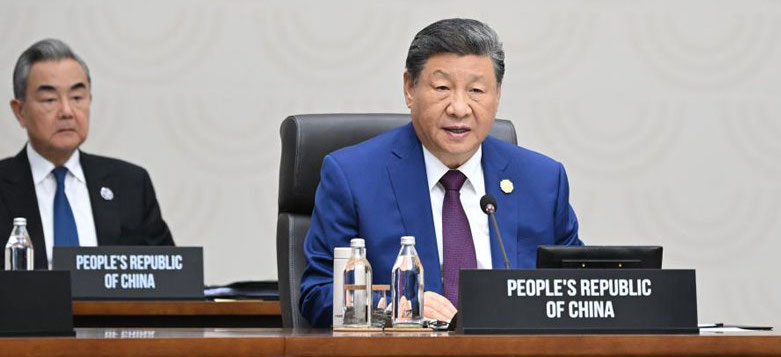
Chinese President Xi Jinping with his Foreign Minister Wang Yi.
 By Deepak Parvatiyar*
China’s White Paper: Reassurance or Strategic Spin?
Dragon Calls Out Arms Blocs While Modernising at Home
China has escalated the global argument on arms control. In the middle of a moment when the world’s traditional disarmament architecture is collapsing — with treaties dying, deterrence logic shifting, and new military technologies entering competition without rules — Beijing has issued its most comprehensive white paper on arms control, disarmament and non-proliferation in two decades – China’s Arms Control, Disarmament, and Nonproliferation in the New Era, released today by the State Council Information Office of the People’s Republic of China.
The significance is not that a report has been published, but that China is positioning itself not as a latecomer to the global security order, but as the power qualified to reshape it.
What stands out is the political character of the document. The last time Beijing issued a full-blown arms-control white paper was in 2005; before that, in 1995. In other words, at a time when the global arms-control architecture is clearly unravelling — with old treaties expiring, multilateral trust eroding, and emerging technologies (cyber, space, AI) complicating everything — China has chosen now to insert its own vision publicly into the debate. That timing alone is news. It is not merely a restatement of policy: it is a signal to world capitals, to international institutions, and to publics that China intends to shape the next phase of arms-control discourse.
The white paper is not written in the neutral voice of a technocratic arms-control brief. It is a manifesto of a one-party state seeking to drive norms rather than merely adopt them. The argument is laid with ideological precision: the Communist Party of China is cast as the guarantor of responsible global security stewardship, and Beijing as the capital committed to peace, stability and equity in international security. The West is cast, without ever being named, as the destabiliser — driven, according to the document, by bloc politics, power domination, export coercion and militarisation of science.
The finger-pointing remains anonymous, but unmistakable. The “certain country” that allegedly destroys arms-control architecture, militarises alliances and obstructs disarmament is clearly the United States. The white paper describes “unilateral coercive measures”, “exclusive military blocs”, and “Cold War mentality” as the primary catalysts of the current escalation cycle. The omission of the name is not a sign of restraint; it is a framing device. China wants to indict Washington in principle, not person. Naming the United States would reduce a global critique to a bilateral quarrel — and the document seeks something bigger than that.
The defence of China’s own conduct is strategically selective. The white paper highlights China’s long-declared nuclear policies — no first use, no targeting of non-nuclear weapon states, and maintenance of what it calls a minimalist deterrence posture. These claims are long-standing and verifiable in China’s doctrinal statements. The unstated element is the scale of China’s ongoing modernisation, including the expansion of its missile silos and sea-based deterrence platforms. The narrative architecture is clear: China places its doctrine on the table, not its capabilities.
The report’s calls for universal disarmament are anchored in conditions that ensure Beijing retains maximum flexibility. It demands that all nuclear-armed states adopt no-first-use and renounce the threat or use of nuclear weapons, but it does not present timelines, ceilings or verification mechanisms. It promotes moral equivalence — but avoids verifiable symmetry.
When the report turns to emerging technologies, its political intent deepens rather than softens. It lists artificial-intelligence weapons, autonomous attack systems, anti-satellite tools, hypersonic delivery systems, and outer-space military assets as destabilising arenas lacking regulation. It demands urgent norms. But it does not pledge even temporary restraint in China’s own research, development and deployment. The message is unambiguous: the rules must be written immediately, and China must be involved in writing them — but not constrained while doing so.
The white paper identifies export control regimes as a central threat to global security. Western restrictions on high-technology transfers, including dual-use items and semiconductor equipment, are characterised not as non-proliferation safeguards but as economic and geopolitical weapons. Beijing argues that these measures fragment global supply chains and push neutral states into coerced strategic dependency. That is not simply a critique of economic sanctions; it is a challenge to the Western claim to moral leadership in global arms governance.
The ideological consistency is unmistakable. The white paper seeks to redefine the problem: proliferation is not caused by new entrants or irresponsible actors, China says, but by “technological containment” imposed by existing powers. It reads as an attempt to weaponise the grievances of the Global South — not implausibly. Many emerging economies do fear that export controls prevent industrial development under the banner of non-proliferation.
Equally notable is the geopolitical arena China wants. Beijing does not call for arms control to be structured through defence alliances, strategic partnerships or minilateral technology blocs — all of which favour the West. It insists on the United Nations and associated multilateral mechanisms, where the Communist Party leadership knows it enjoys procedural advantage, numerical alliances and diplomatic reach. The West wants security through partnerships; China wants security through forums. The difference is not academic — it determines who writes the rules.
The document’s length, density and policy architecture are not bureaucratic excess. They communicate something: China wants to be seen not as a late learner of arms-control norms, but as the custodian and reformer of them. It is not asking for admission into a Western-designed order — it is attempting to define the next one.
This raises the central strategic question: is China offering a pathway to stability, or offering itself the authority to decide what stability means? The white paper does not hide the answer. China declares that true peace depends on “mutual respect” and “equal security.” It proposes “equal and undivided security” where “the security of one state must not undermine that of another.” The phrasing sounds consensual, but the interpretation is political. The meaning hinges on who defines respect and who decides equality. In practice, it could mean that alliances capable of military advantage are illegitimate. It could mean that deterrence architecture centred on the United States is incompatible with the future order. And it could mean that arms control becomes the instrument through which military influence is redistributed.
If the world adopts China’s definitions, Beijing becomes central to global strategic decision-making. If the world rejects them, the arms race will continue under somebody else’s terms.
This is the real stakes of the report. It is not a technical contribution to arms governance. It is a plan for a world in which decisions about nuclear restraint, military technology and defence cooperation cannot be made without China at the table — and preferably with China at the centre.
The white paper leaves the world with two choices. Accept China’s definitions of fairness, and the reinvention of global arms control happens in a format where Beijing possesses a disproportionate voice. Reject them, and the arms race continues without even the semblance of a regulating mechanism.
Either outcome confirms an uncomfortable truth: China has placed itself not outside the debate on global security, but at its throat.