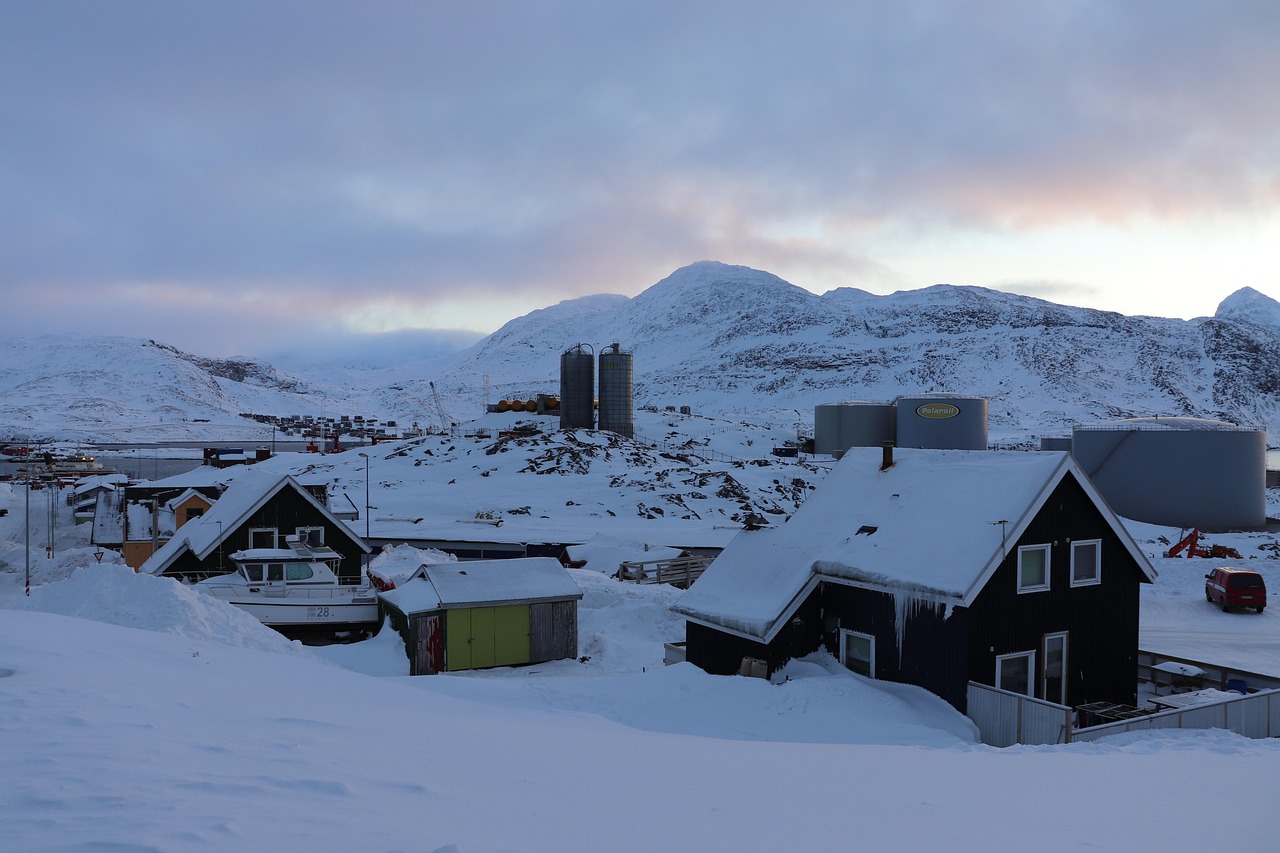
Nuuk, Greenland
Greenland Becomes Strategic Battleground in the Melting Arctic
NATO Strains Rise as U.S. Eyes Greenland Control
U.S. Push for Greenland Sparks Russia Warning
Denmark Defends Greenland Amid U.S., Russia Tensions
Washington/Copenhagen/Nuuk/Moscow: In the frozen expanse of the Arctic, where melting ice caps are opening new trade routes and exposing vast mineral deposits, Greenland has become the epicentre of a high-stakes geopolitical standoff. This self-governing Danish territory—home to just over 56,000 people on an island three times the size of Texas—now sits at the convergence of sovereignty disputes, strategic military interests, and competition for resources critical to defense and clean-energy technologies, while Russia and China figure prominently in United States arguments for deeper involvement and Denmark holds firm amid strains that expose latent tensions in the North Atlantic Treaty Organization (NATO).
The sequence opened on January 14, 2026, in Washington, where Danish Foreign Minister Lars Løkke Rasmussen and Greenlandic Foreign Minister Vivian Motzfeldt met Vice President J.D. Vance and Secretary of State Marco Rubio at the White House. United States officials stressed Greenland’s importance for missile defence, radar coverage, early-warning systems, and control of emerging northern sea lanes, as well as its large reserves of rare earth elements, uranium, graphite, copper, nickel, zinc, gold, and other metals vital for military hardware and renewable infrastructure. President Trump, speaking to reporters afterwards, said the United States “needs” Greenland for national security and to prevent rivals from gaining a foothold, adding a dismissive remark that Danish and Greenlandic defences amount to “two dog sleds.”
Danish and Greenlandic officials characterised the talks as frank but constructive, while underscoring a core disagreement over any notion of United States ownership or unilateral control. They insisted that all cooperation must have explicit consent under Greenland’s self-rule law and announced the formation of a high-level technical working group to address American security concerns within Denmark’s clear red lines: no transfer of sovereignty, no unilateral steps, and full respect for Greenlandic self-determination. Rasmussen indicated the group would convene soon in hopes of de-escalating and finding common ground.
On January 15, Russian Foreign Ministry spokesperson Maria Zakharova addressed the matter in Moscow, naming Greenland directly. She warned that any disregard for Russian security interests in the Arctic would have far-reaching consequences and described NATO’s growing regional footprint—including talk of new missions—as provocative militarisation. Zakharova dismissed Western assertions that Russian or Chinese activity constituted a threat, called such claims factually unfounded, and cited perceived double standards in the rules-based order. She noted that neither Moscow nor Beijing had declared aggressive intentions toward Greenland, insisted disputes should be settled under international law with regard for local residents’ interests, and aligned Russia’s stance with China’s position that references to their activities cannot serve as pretexts for escalation. She presented Russia as a responsible Arctic stakeholder invested in infrastructure, environmental protection, indigenous rights, and its robust military posture, including the world’s largest icebreaker fleet and revived Soviet-era facilities.
China’s role remains a key element in the United States case. Beijing identifies as a near-Arctic state and has pursued sustainable development, scientific research, and economic projects in the region, including earlier mining proposals in Greenland that Copenhagen rejected on security grounds. Joint Russian-Chinese patrols and mutual emphasis on peaceful Arctic cooperation have drawn attention, feeding Washington’s concern that rivals could secure influence over strategic resources and routes as the ice retreats.
Denmark, which exercises sovereignty over Greenland, has reiterated that the island is not for sale and that its future belongs to its inhabitants under self-rule within the Kingdom of Denmark. Prime Minister Mette Frederiksen and colleagues have cautioned that any forcible United States move would activate Article 5 of the North Atlantic Treaty—constituting an armed attack on an ally—and carry grave implications for the alliance and the broader transatlantic security order. In response, Copenhagen has deepened coordination with European NATO allies, expanding its footprint through Operation Arctic Endurance, a Danish-led exercise that includes reconnaissance, patrols, intelligence sharing, maritime surveillance, and infrastructure checks in extreme conditions. Small contingents—typically in the low dozens—from Germany (≈13 reconnaissance personnel), France (≈15 mountain infantry), Sweden, Norway, the United Kingdom, the Netherlands, and others began arriving January 15. Officials describe the activity as preparatory training rather than combat deployment, intended to affirm that Arctic security is a collective NATO task, not a unilateral prerogative.
Greenland’s geoeconomic weight underpins the urgency. Tanbreez and Kvanefjeld hold some of the planet’s largest untapped rare-earth deposits, rich in elements essential for permanent magnets, electric motors, wind turbines, and defence systems—offering a potential path to diversify supply chains away from concentrated producers. Tanbreez has progressed with environmental permits for certain blocks under United States-linked ownership, while Kvanefjeld is stalled by the 2021 uranium-mining ban, which reflects environmental, regulatory, and community concerns. Other deposits contain graphite for batteries and various base and precious metals, though Arctic weather, remoteness, strict rules, and high costs continue to constrain development. Accelerating ice melt only heightens the strategic premium on these assets and the passages they border.
The January 14–15 developments reveal a multifaceted multipolar contest: American efforts to secure strategic advantage through diplomacy, Danish defence of sovereignty paired with alliance solidarity, Greenlandic insistence on consent and self-rule, Russian delineation of security red lines alongside appeals to international law, and European NATO partners projecting shared capability via modest, visible deployments. With working-group talks forthcoming, personnel on the ground, and public statements ongoing, Greenland remains the live arena where sovereignty, resource access, and security collide—exposing NATO’s internal frictions, testing Arctic governance norms, and raising questions about future supply-chain resilience and high-latitude stability. The broader Arctic governance context has been complicated since Russia’s 2022 invasion of Ukraine, which led the other seven Arctic Council members to pause participation in council activities with Russia, effectively halting much multilateral cooperation on non-military issues and leaving the forum in a state of prolonged dysfunction.
Meanwhile, within Greenland, indigenous-led politics show divisions among major parties—such as the pro-independence Inuit Ataqatigiit (left-leaning, focused on environmental safeguards and full sovereignty) and the more gradualist Siumut (social democratic, emphasising self-determination while preserving strong Danish ties)—though a recent cross-party joint statement reaffirmed unified opposition to external coercion and commitment to Greenlandic decision-making on resources and future status. Risks to alliance cohesion, including hypothetical Article 5 scenarios, have surfaced in commentary, but remain speculative rather than inevitable; diplomacy is still the primary channel for navigating the differences. How these tensions resolve—or persist—will shape transatlantic trust, regional power balances, and the international framework for an increasingly accessible Arctic for years to come.
– global bihari bureau