Hyderabad: Jet engines roaring in aircraft, nuclear reactors driving power plants, and space vehicles soaring beyond Earth rely on super-tough metals like Inconel 625 (IN625), which are notoriously hard to shape. A newly developed technology called Laser-Assisted Turning (LAT), created by the city-based International Advanced Research Centre for Powder Metallurgy and New Materials (ARCI), an autonomous institution under the Department of Science and Technology (DST) of the Ministry of Science and Technology, is changing that. This hybrid method blends localised laser heating with mechanical cutting to transform how superalloys, used in aerospace, chemical industries, nuclear systems, and power production components like boilers, heat exchanger tubes, and steam turbines, are processed, enabling lighter, stronger, and more efficient turbine blades, surgical tools, and high-performance automotive parts.
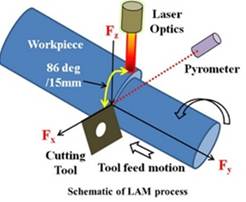
Superalloys like IN625 are renowned for exceptional mechanical strength, corrosion resistance, and ability to endure extreme temperatures, making them ideal for harsh environments but challenging to machine, causing excessive tool wear, high cutting forces, and poor surface finish with traditional turning techniques. Under DST’s Clean Coal Research Initiative, ARCI researchers developed LAT, using a high-power diode laser (up to 2500 W) to precisely heat the workpiece just ahead of the cutting tool, inducing thermal softening in the material. This significantly reduces cutting resistance, improves chip formation, and enhances tool life and machining quality.
The study evaluated turning IN625 with uncoated tungsten carbide tools and CrAlSiN (a quaternary system composed of chromium nitride (CrN), aluminium nitride (AlN), and silicon nitride (SiNx), often with a nanolayered structure), and nanocomposite-coated tools, known for superior hardness, thermal stability, and oxidation resistance.
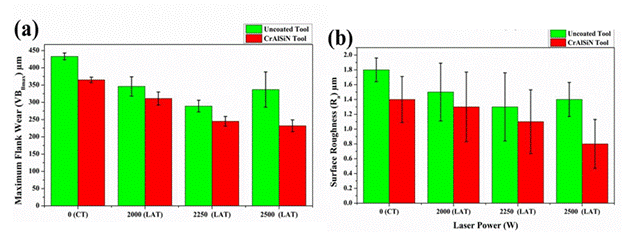
When paired with LAT, these coated tools delivered outstanding performance: a 69% reduction in cutting force, 46% lower tool wear, and 56% improvement in surface finish compared to conventional methods. The team also investigated wear mechanisms of tungsten carbide cutting tools during IN625 machining, revealing a transition from fatigue and abrasion at room temperature to oxidation and adhesion-dominated behaviour at higher temperatures.
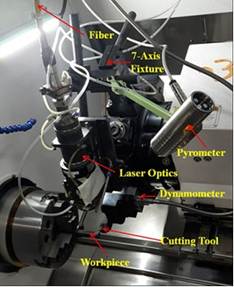
ARCI’s setup integrates a Computer Numerical Control (CNC) turn-mill centre with a fibre-coupled diode laser, custom-designed adapters, and real-time monitoring tools. The novelty of the approach lies in the synergistic use of LAT with advanced tool coatings, a combination not widely explored earlier. The CrAlSiN-coated tools demonstrated excellent resistance to wear mechanisms like abrasion and oxidation while maintaining cutting-edge sharpness and dimensional accuracy under high temperatures. These insights could help in understanding tool failure modes and estimating the thermal stability and service life of the cutting tool.
This breakthrough offers a scalable, high-precision solution for industries requiring machining of difficult-to-machine materials, particularly in aerospace, power generation, and marine sectors.
Published in the Journal of Process Mechanical Engineering and Materials Letters, this technological advancement aligns with India’s strategic goals of boosting domestic manufacturing, improving energy efficiency, and adopting cleaner industrial technologies, the Ministry of Science and Technology stated today.
– global bihari bureau