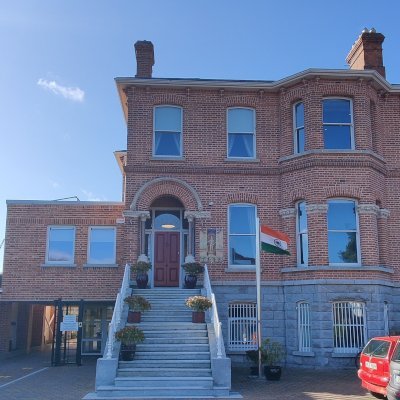
The Indian Embassy in Dublin, Ireland.
Indian Community Protests as Racial Attacks Persist in Ireland
Dublin: Approximately 300 Indian and migrant community members protested outside the Department of the Taoiseach in Dublin today, delivering a petition with over 15,000 signatures demanding justice and stronger measures against a surge in racially motivated attacks targeting Ireland’s 80,000-strong Indian community, the largest non-European Union (EU) immigrant group. The Ireland India Council reported at least two hate incidents daily, with 60 hate crime cases unresolved as of August 2025, fueling persistent fear as the violence shows no signs of abating. Driven by anti-immigrant sentiment, economic scapegoating, online misinformation, and weak enforcement, the attacks have prompted calls for a national anti-racism strategy.
The protest, supported by groups like the African Solidarity Centre Ireland, highlighted ongoing fear, with community members like tech worker Abin, a two-year resident, planning to leave Ireland due to “subtle racism and direct attacks.” Lassane Ouedraogo, a 20-year resident, reported five personal attacks with no prosecutions, while Green Party Councillor Feljin Jose noted that Indian healthcare workers face daily abuse and fear for their safety. The demonstration followed a series of violent incidents in Dublin and Waterford since early 2025, often involving teenage gangs using racial slurs.
Notable attacks include: On July 19 in Tallaght, Dublin, a 40-year-old Indian Amazon employee, newly arrived on a critical skills visa, was beaten, stabbed in the face, and partially stripped by a teenage gang, rescued by a passerby after false online accusations of misconduct. On July 27 in Clondalkin, Dr. Santosh Yadav, a 32-year-old data scientist, suffered a fractured cheekbone after an assault by six teenagers shouting racial insults. On August 4 in Waterford City, six-year-old Nia Naveen was punched, had her hair pulled, and was hit with a bicycle by children aged 12 to 14, who yelled “dirty Indian” and “go back to India.” On August 10 in Fairview Park, Dublin, a 34-year-old Indian man was attacked with a metal water bottle, requiring eight stitches for an eye injury. In early August, taxi driver Lakhvir Singh, 46, was hospitalised after an attack with a broken bottle in Ballymun, Dublin, accompanied by slurs like “go back to your country.”
The Ireland India Council’s report of two daily hate incidents—ranging from physical assaults on taxi drivers to racial abuse and harassment—underscores the ongoing pattern, with families avoiding public spaces after dark. The Gardaí (Irish police) have 60 open hate crime cases, with 24 logged from January 2023 to January 2025 (11 classified as hate crimes, 13 as hate incidents). Despite CCTV and eyewitness evidence, few arrests have been made, with victims like Dr. Yadav citing delays and inadequate responses due to outdated police systems. The Immigrant Council of Ireland notes insufficient training, discouraging reporting, and, despite 2024 hate crime law updates, enforcement remains inconsistent, leaving the 60 cases largely unresolved.
The attacks stem from rising anti-immigrant sentiment, exacerbated by Ireland’s housing crisis, with a 250,000-home shortage and 10% annual rent increases. The Central Statistics Office reported 150,000 immigrants in 2023–2024, with Indians holding 13,500 skilled work permits, contributing 52% of new nurses and significant information technology (IT) expertise. Some locals wrongly blame migrants for economic woes like homelessness, fueled by online misinformation, such as false claims in the Tallaght attack spread by an account with 300,000 followers.
The Indian Embassy, responding on August 1, 2025, is coordinating with the Gardaí, providing emergency contacts (phone: 08994 23734, email: cons.dublin@mea.gov.in) and urging incident reporting. In an advisory, the Embassy noted an increase in the instances of physical attacks reported against Indian citizens in Ireland recently. It stated that the Embassy was in touch with the relevant authorities in Ireland regarding this matter. “At the same time, all Indian citizens in Ireland are advised to take reasonable precautions for their personal security and avoid deserted areas, especially in odd hours. Following is the Emergency Contact numbers of the Embassy of India, Dublin: 08994 23734 (Mobile),” it stated.
Ireland’s President Michael D. Higgins, on August 12, condemned the attacks as “despicable,” praising Indian contributions to healthcare, culture, and business. Minister of State for Migration Colm Brophy urged the incoming Garda Commissioner to prioritise hate crimes, noting their rise despite lower overall crime. Tánaiste Simon Harris, meeting Indian representatives on August 11, denounced the attacks and criticised social media’s role in amplifying hate. India’s Ministry of External Affairs noted a global rise in attacks on Indians, from 4 in 2022 to 40 in 2024, with rare fatalities in Ireland. Ambassador Akhilesh Mishra emphasised protecting the community to maintain India-Ireland ties.
Community fear has led to the cancellation of India Day, a cultural event since 2015, planned for August 17 at Farmleigh House, with a smaller event set for Merrion Square by the Federation of Indian Communities in Ireland. The Ireland India Council, backed by the Irish Network Against Racism (INAR), demands a cross-departmental task force, stronger hate crime laws, and parental accountability for minor offenders. Archbishop Dermot Farrell called the attacks “truly shocking.” With 60 unresolved cases and daily incidents, advocacy groups push for better police training, victim support, and a national anti-racism plan to address root causes—misinformation, economic scapegoating, and enforcement gaps.
– global bihari bureau