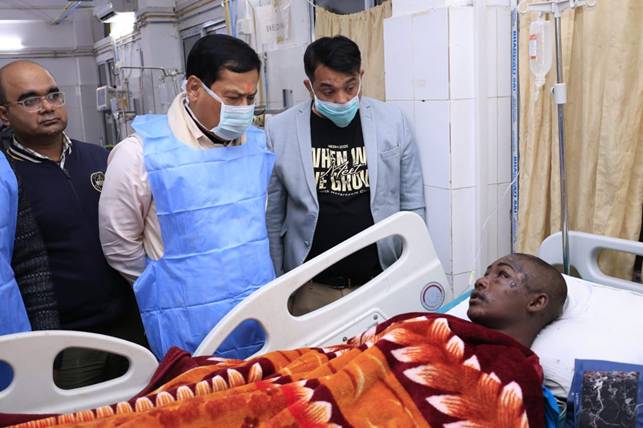
Union Minister Sarbananda Sonowal visits the injured from the Anjaw district (of Arunachal Pradesh) tragedy to review their condition and take stock of their medical care, on December 12, 2025.
Workers and Pilgrims Die in Two Fatal Hill Road Accidents
Survivor Leads Teams to 22 Bodies After Anjaw Tragedy
Rescue Teams Battle Terrain
Anjaw/Tinsukia/Visakhapatnam: Two fatal accidents in India’s hill corridors, separated by almost three thousand kilometres and barely a day apart, have left authorities confronting the limits of infrastructure under extreme weather and fragile terrain.
The first occurred in Arunachal Pradesh’s Anjaw district, where a truck carrying daily-wage labourers from Assam plunged into a deep gorge, killing at least 21 people.
The second struck Andhra Pradesh’s Alluri Sitharama Raju district just over 24 hours later, where a private bus carrying pilgrims plunged into a ravine on a fog-choked ghat road, leaving nine dead and more than twenty injured, on December 12. The private bus carrying approximately 35–37 passengers, many on a pilgrimage, lost control on the Chinturu–Maredumilli ghat road near Rajugarimetta amid dense fog and poor visibility. The vehicle plunged into a ravine. Nine passengers died, while 20–23 were injured, several critically. Rescue teams and local residents pulled survivors from the wreckage before emergency services arrived. Authorities have temporarily banned night-time travel for heavy vehicles on ghat roads until conditions improve. Investigations into vehicle condition, driver actions, and road safety are ongoing.
Together, the incidents underscore the persistent risks of travel and work in remote, mountainous regions.
In Anjaw, the truck had departed from Assam’s Tinsukia district, carrying labourers to a road construction site near the India–China border, when it veered off the Hayuliang–Chaglagam Road late on December 8. The steep terrain and absence of mobile connectivity meant the incident went unnoticed for nearly two days. Only when the lone badly injured survivor, 23-year-old Budheswar Deep, managed to pull himself up part of the slope and crawled several kilometres to reach a Border Roads Task Force (BRTF) camp did authorities learn of the scale of the disaster. His account was the first lead for police and district officials, who began tracing the route and scanning the cliffside until the wreckage was spotted far below. Rescue teams from the Indian Army, National Disaster Response Force (NDRF), Border Roads Organisation (BRO) and local police began recovering bodies from the gorge under extremely difficult conditions of steep slopes, loose rocks and dense vegetation.
Since then, rescue teams from the National Disaster Response Force, the Army, the state police and local volunteers have been working with ropes and harnesses to reach the bodies scattered along the incline. The terrain is unforgiving—loose soil, sharp rocks, no footholds—and even experienced personnel have struggled to get down without slipping. As of the latest count, authorities have confirmed the presence of at least eighteen bodies, with more feared to be buried under vegetation or lodged in inaccessible ledges. Identification has been slow but steady, with many victims confirmed to be from tea garden settlements around Gelapukhuri. Seventeen bodies have been recovered, and four remain missing.
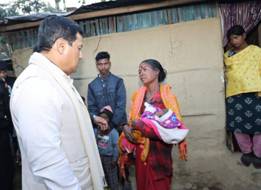 In Tinsukia, the news travelled from house to house, sometimes arriving before officials could reach the families. On December 12, Union Minister Sarbananda Sonowal walked through those lanes, meeting parents, siblings and spouses who had been waiting for official word. According to the government’s own briefing, he told relatives that he had been tracking the situation closely and had asked Assam’s Chief Secretary to stay in constant touch with Arunachal Pradesh to keep the rescue moving. The Minister assured families that agencies from both states were coordinating on recovery, transport and paperwork. His remarks, delivered in small courtyards and sitting rooms, repeated a single message: that assistance would continue and that every department had been asked to work in step.
The official statement also noted that Prime Minister Narendra Modi approved an ex gratia amount of two lakh rupees for each deceased worker’s next of kin from the Prime Minister’s National Relief Fund, while the Assam government announced additional support for families. Assam ministers, including Bimal Borah, coordinated support for families, assisted in the transport of bodies, and facilitated documentation for compensation. Officials emphasised that all necessary assistance, including medical support and counselling, is being provided. The PM also expressed grief for the Andhra Pradesh accident, confirming ex gratia payments identical to those in Arunachal, while President Droupadi Murmu conveyed her condolences. Local hospitals continue to care for the injured, and authorities are monitoring recovery and investigation efforts closely.
Back at the site in Anjaw, investigators are still examining the road stretch where the vehicle left the path. Locals familiar with the route say the bend has long been considered risky because of its narrow width and the absence of guardrails. The truck was travelling after dark, and officials are looking at the condition of the vehicle as well as the circumstances under which the labourers were being transported.
Names of identified victims include Rahul Kumar, Samir Deep, Pankaj Manki, Ajay Manki, Bijay Kumar, Abhay Bhumij, Rohit Manki, Birendra Kumar, Agar Tanti, Dhiren Chetia, Rajani Naag, Deep Gowala, Ramchabak Sonar, Sonatan Naag, Sanjay Kumar, Karan Kumar and Jonas Munda. A few more are in the process of verification. For now, bodies recovered from the gorge are being brought up slowly—sometimes one in half a day—before being taken to the nearest road point and onward to Assam.
Both incidents illustrate a recurring pattern in India’s hill states: steep terrain, unpredictable weather, and limited infrastructure make even routine travel or work journeys highly vulnerable. Families in Assam and Andhra Pradesh have faced days of anxiety, fragmented updates, and slow recovery of their loved ones. Rescue operations in both regions have been arduous, but officials underscore that all possible measures are being taken to recover the victims and support their families.
– global bihari bureau