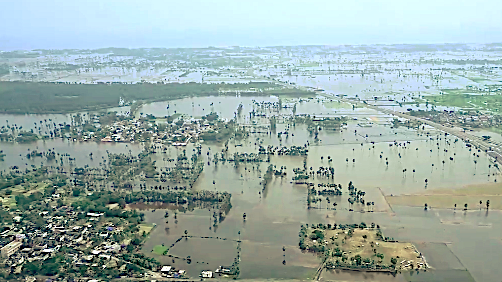
Cyclone Montha Weakens Over Chhattisgarh After Andhra Landfall
Heavy Rains Lash East India
Visakhapatnam: Severe Cyclonic Storm Montha has weakened into a depression over south Chhattisgarh following its landfall on the Andhra Pradesh coast near Kakinada around midnight on October 28–29, claiming at least two lives and submerging crops across 87,000 hectares in a severe setback to the region’s agrarian economy.
The storm, which sprouted as a deep depression on October 27, traversed the Andhra Pradesh-Yanam shoreline between Machilipatnam and Kalingapatnam with winds of 90–110 kilometres per hour gusting higher, spawning waves up to 4.9 metres and torrential downpours that crippled roads and ignited landslides.
According to the India Meteorological Department’s bulletin issued at 5:30 PM Indian Standard Time on October 29, the system – then centred near 17.3°N and 81.2°E – was moving north-northwest at 17 kilometres per hour, likely to dissipate into a well-marked low-pressure area over the next 12 hours while delivering isolated heavy rainfall to north coastal Andhra Pradesh, Odisha, Telangana, Jharkhand, Bihar, and West Bengal through October 31. Evacuation drives persist, with over 87,000 people shifted to safety and National Disaster Response Force contingents mobilised, as officials flag flash flood perils in 14 Telangana districts until 5:30 PM on October 30.
The cyclone’s coastal incursion played out with stark inevitability commencing around 11:30 PM on October 28 – a three-to-four-hour gauntlet that scourged seaside settlements with gale blasts and cloudbursts, toppling 506 trees, fracturing 446 electric poles, and demolishing 30 transformers in Krishna district alone, as detailed by the State Disaster Management Authority. The vortex lingered over Konaseema’s lowlands like Sooradapeta, where tidal incursions razed 98 houses and inundated paddies, while Vijayawada stirred on October 29 to flooded thoroughfares and dislodged fronds beneath 52.2 millimetres of precipitation in Visakhapatnam. Chief Minister Nara Chandrababu Naidu ignited Operation Sahayam from Vijayawada, inaugurating 3,174 relief camps that harboured more than 76,000 evacuees across 403 mandals in 22 districts, per the Chief Minister’s Office. Crimson alerts resounded for Kakinada, Konaseema, and Eluru, with a nocturnal vehicle ban from 8:30 PM on October 28 to 6:00 AM on October 29 in seven districts – Krishna, Eluru, East Godavari, West Godavari, Kakinada, Dr B R Ambedkar Konaseema, and segments of Alluri Sitarama Raju – greenlighting solely emergency medical passage. “Our farmlands are submerged, yet our determination holds,” Naidu proclaimed in a strategy session, unveiling ex gratia disbursements of 5 lakh rupees to the families of the departed: a woman felled by a tumbling palmyra in Makanagudem village and another ensnared in the tempest’s maelstrom. Provisional relief protocols, encompassing federal assistance, are under finalisation, with Prime Minister Narendra Modi pledging support in a late-night dialogue.
Andhra Pradesh, Montha’s focal fury, confronts an agricultural apocalypse: the state calamity bureau catalogued sweeping crop ravages spanning tens of thousands of hectares, with amalgamated data revealing 38,000 hectares of farmland and 1.38 lakh hectares of horticulture devastated, according to the Chief Minister’s Office – elevating the aggregate paddy and ancillary impairment to 87,000 hectares in initial reckonings. Exceeding 380 kilometres of roadways were scarred, 14 bridges and culverts sundered, and 600 fishing vessels marshalled to sanctuary amid sonic advisories dispatched to 26 seaside hamlets that forestalled amplified human anguish. Gannavaram Aerodrome idled 30 flights, whereas South Central Railway voided 61 trains through 30 October, marooning wayfarers and vendors; in Telangana, 35 flights fell at Shamshabad Aerodrome linking Hyderabad to Andhra outposts like Vijayawada, Visakhapatnam, and Rajahmundry, as carriers and rail handlers halted services on beleaguered lines, engendering pervasive postponements for voyagers. The Union Health Ministry’s liaison with Andhra, Odisha, and Tamil Nadu fortified medicinal reserves and itinerant health outposts, while naturalists bewail the attrition of mangroves that heretofore cushioned such onslaughts.
Montha’s fringes frayed afar Andhra, drenching Odisha’s austral precincts where avalanches in Gajapati and Ganjam sepulchred thoroughfares, derailing routines in 15 domains from Malkangiri to Nabarangpur. Chief Minister Mohan Charan Majhi barricaded academies, colleges, and anganwadi hubs in nine meridional districts – encompassing Gajapati – pending 30 October, relocating 11,396 souls to 2,048 refuges as Chilika Lagoon seethed with lofty breakers and Gopalpur Strand wailed beneath 90-kilometre-per-hour zephyrs. “We have evaded the gravest, though alertness lingers,” Majhi reflected from the Special Relief Commissioner’s nerve centre in Bhubaneswar, where Revenue and Disaster Management Minister Suresh Pujari orchestrated allotments. Erstwhile Chief Minister Naveen Patnaik exhorted synergy with salvage squads in a vidcast, as profuse rain – sporadic pinnacles surpassing 20 centimetres – scourged Malkangiri, Koraput, Rayagada, Kalahandi, and Nabarangpur under scarlet edicts, with amber cautions for four supplementary districts.
Telangana quaked from the northerly surge, with Hyderabad’s lanes deluged on 29 October and Chief Minister A Revanth Reddy consigning eight districts to scarlet vigilance amid subdued-to-moderate deluge hazards in 14 sectors until 5:30 PM, pursuant to India National Centre for Ocean Information Services admonitions. The statewide apparatus stayed on exalted sentry, with Doppler arrays lauded for incisive prognostications that mitigated the gale’s clout via terrestrial friction. Lingering menaces endured on late night October 29: Jharkhand’s Ranchi, Gumla, Simdega, Khunti, Ramgarh, Hazaribag, Palamu, Lohardaga, and Latehar girded for copious showers till October 31, with tumbles already chronicled; Bihar and east Madhya Pradesh cowered beneath amber edicts through October 30; Gangetic West Bengal, Sub-Himalayan swaths, and Sikkim arrayed for sporadic spouts until November 1, as mild-to-moderate rain with sporadic heavies swept north coastal Andhra Pradesh.
The India Meteorological Department extolled its lattice for scalpel-like foresight, observing Montha’s nadir pressure of 1000 hectopascals at shorefall and a 1-degree Celsius Bay of Bengal uptick that escalated potencies by 10 per cent, as per Indian Institute of Tropical Meteorology dissections. Andhra’s 83,000 beleaguered husbandmen – oft petiteholders teetering on bare sustenance – await indemnity remittances, whilst the National Disaster Response Force’s 25 antecedent squads across coastal Andhra, Odisha, Tamil Nadu, Chhattisgarh, and Puducherry, augmented by 20 reinforcements, illuminate pre-emptive stratagems that spared augmented calamity. Transcontinental confederates like the World Bank contemplate grit endowments, but utterances from Kakinada’s piscator enclaves peal lucid: “Cyclones surge and subside, yet bereft of sturdy levees and prompt portents, exposure abides.” On October 30, as daylight cleaves Hyderabad’s shroud, Montha’s endurers inaugurate restitution – not exclusively in rupees, but in the indomitable throb of an eastern littoral eternally reforged.
– global bihari bureau