Photo source: @ZiplineGhana|X
US invests $150mn in African drone health deliveries
Zipline to reach 130 million Africans with US funding
Washington: The United States Department of State has committed up to 150 million dollars to expand Zipline’s autonomous drone delivery network across five African nations, marking the first major investment under the recently launched America First Global Health Strategy.
Speaking at a digital press briefing organised by the Africa Regional Media Hub today, Senior Bureau Official and Acting Global AIDS Coordinator Jeffrey Graham described the partnership as a flagship example of the new strategy, which prioritises greater return on American taxpayer money, eliminates long-term dependency in foreign aid, and aligns health assistance directly with United States foreign policy objectives.
Graham emphasised that the approach represents a deliberate shift from decades-long aid programmes with no clear exit to targeted, time-bound investments that leave behind self-sustaining, country-owned systems. “With a modest upfront capital investment from the United States, these countries will become more responsible for maintaining and continuing to invest in their own health systems,” he said.
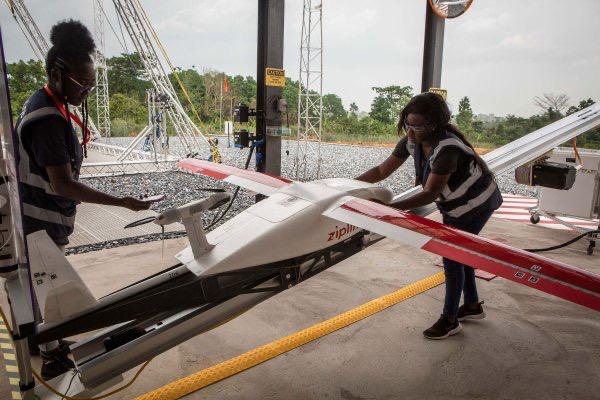
The five countries chosen for immediate nationwide scale-up are Côte d’Ivoire, Ghana, Kenya, Nigeria, and Rwanda, all of which already host Zipline operations and have been paying for the service from their national budgets for several years. At full deployment, the expanded network will serve up to 15,000 health facilities and reach approximately 130 million people.
Caitlin Burton, Chief Executive Officer of Zipline Africa, opened her remarks with the story of a pregnant woman in Rwanda’s Nyagatare district who suffered premature labour and placental abruption on October 30, 2025. The local hospital lacked sufficient blood of her type, and road delivery would have taken six hours. A Zipline drone delivered nearly seven pounds of blood in just 40 minutes, saving the mother’s life and allowing her to raise her newborn twins. Burton noted that maternal mortality has fallen by 56 per cent at facilities served by Zipline in Rwanda, with similar reductions recorded in other partner countries.
She highlighted additional measurable outcomes: a 42 per cent drop in zero-dose vaccination prevalence within a single year, and a 66 per cent reduction in missed opportunities to treat severe malaria. Burton said the system, which operates 24 hours a day, seven days a week in all weather conditions, replaces outdated, wasteful supply chains with a centralised, on-demand model that guarantees delivery and focuses on health outcomes rather than mere inputs.
The partnership will create roughly 1,000 direct jobs in Africa and is projected to generate an estimated one billion dollars in annual economic activity across the five countries. Burton stressed that African governments themselves selected Zipline, often choosing to pay for it despite receiving traditional supply-chain support for free elsewhere, because the data proved it to be both the least expensive and most effective option.
On community acceptance, Burton explained that drone hubs frequently become local gathering points. Children visit to watch launches, schools conduct robotics workshops, and governments use the sites for blood donation drives and health awareness campaigns. “After a few months of operation, almost everyone in the community knows someone whose life was saved by a Zipline delivery,” she said.
In response to questions about long-term sustainability, both speakers underlined that the model is designed from the outset to be locally financed and locally run. African governments cover all operating costs from day one, with payments flowing back into the local economy through salaries, taxes, utilities, and service providers. The United States contribution is strictly front-loaded capital to accelerate nationwide coverage that would otherwise take a decade or more to achieve through self-financing alone.
Graham described the initiative as classic “commercial diplomacy”: American innovation and manufacturing create jobs at home while rapidly transferring technology, entrepreneurship, and economic growth to willing partner nations. He confirmed that the funding is not divided equally but tailored to each country’s population size, geography, and priority health burdens.
In Nigeria, for instance, the immediate focus will be integration with the Basic Health Care Provision Fund (BHCPF) network, which aims to establish one well-equipped, reliably supplied primary-care facility in every ward across the country.
Burton thanked several long-standing philanthropic partners, corporate, and multilateral supporters, including the Elton John AIDS Foundation, Bill & Melinda Gates Foundation, Gavi the Vaccine Alliance, Pfizer Foundation, and UPS Foundation, for earlier backing that helped generate the evidence base now attracting public investment.
Concluding the briefing, Graham expressed enthusiasm for future investments under the America First Global Health Strategy, describing Zipline as “one of our big kick-off projects” that demonstrates how cutting-edge American technology can deliver dramatic health gains while strengthening resilient, independent health systems abroad.
– global bihari bureau