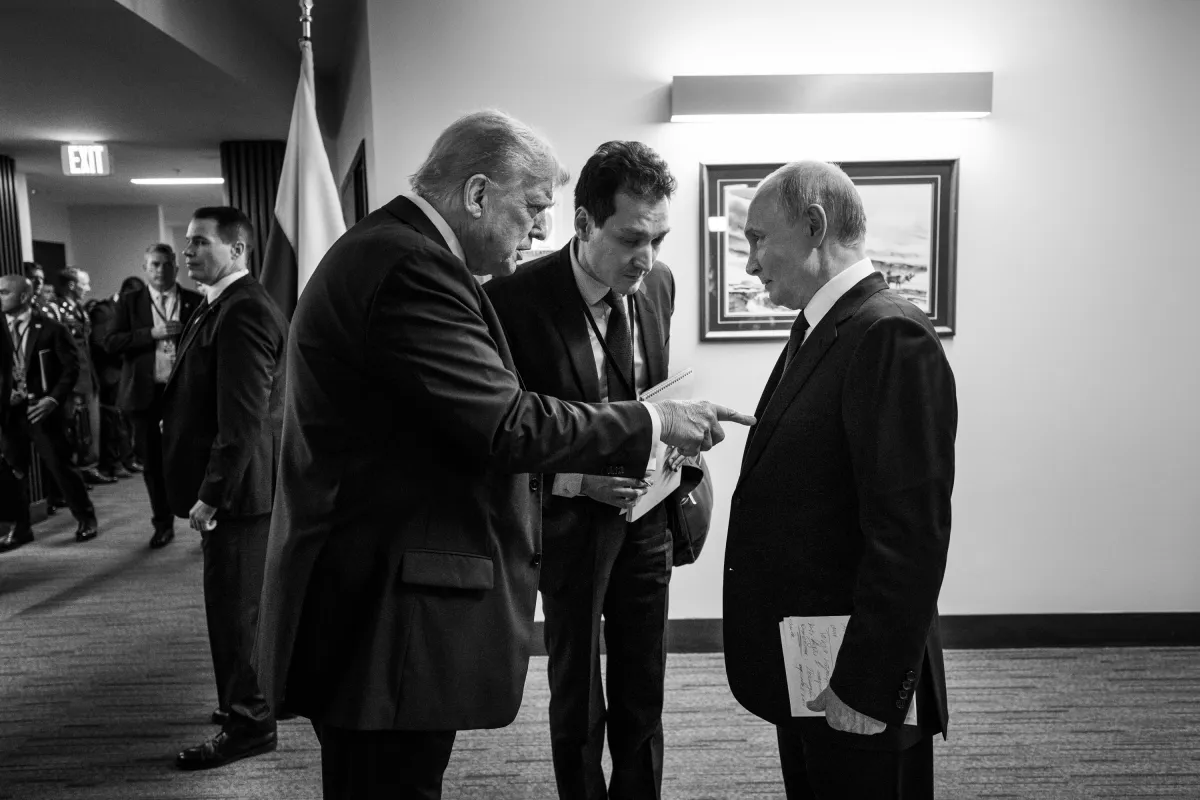
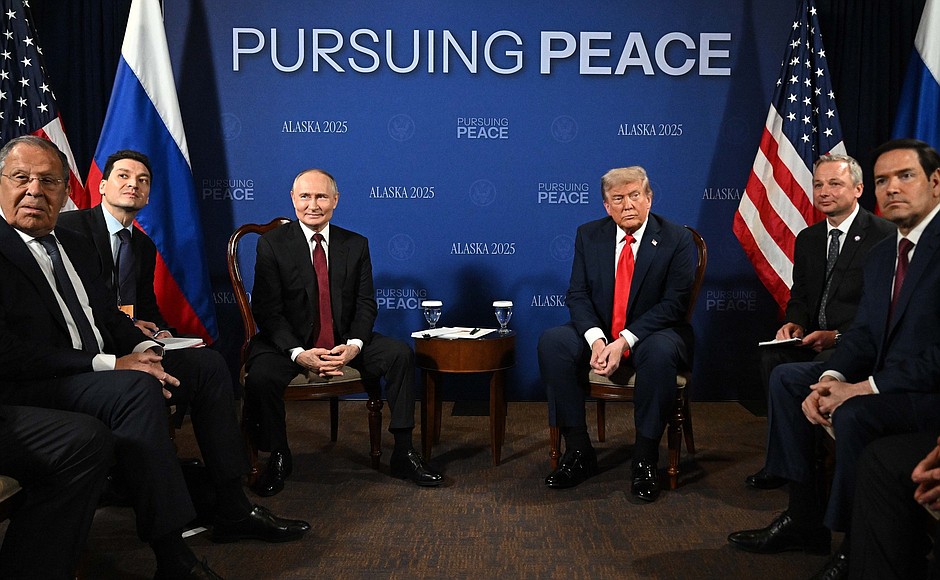
Presidents Donald Trump and Vladimir Putin in Alaska. Photo source: White House
 By Deepak Parvatiyar*
No Ceasefire, But U.S. Clings to ‘Secret’ Progress
The recent summit between United States President Donald Trump and Russian President Vladimir Putin in Anchorage, Alaska, has sparked intense scrutiny over its outcomes and the United States’ evolving stance on the ongoing war in Ukraine. Drawing from Secretary of State Marco Rubio’s appearances on major news programmes, including ABC’s This Week with Martha Raddatz, CBS’s Face the Nation with Margaret Brennan, and Fox Business’s Sunday Morning Futures with Maria Bartiromo, the U.S. official narrative emphasises incremental progress toward peace despite the absence of an immediate ceasefire, underscoring the complexity of negotiations in a conflict now stretching into its fourth year. Rubio consistently portrayed the meeting as a constructive step in a broader diplomatic push, insisting that true resolution requires involvement from all parties, particularly Ukraine, which was notably absent from the Alaska talks.
Central to the U.S. interpretation is the assertion that the Alaska summit advanced discussions on potential areas of agreement, though specifics remain shrouded in secrecy to preserve negotiation integrity. “We made progress in the sense that we identified potential areas of agreement, but there remain some big areas of disagreement,” Rubio explained on ABC, highlighting the need for private deliberations to avoid derailing fragile talks. He told Raddatz, “These peace deals… don’t work when they’re conducted in the media, either through leaks or through lies,” noting that even “totalitarian governments have constituencies they have to respond to.”
This opacity raises probing questions: If progress was indeed made, why withhold details that could build public confidence in the process? Critics might argue that such discretion masks a lack of substantive gains, especially given Trump’s pre-summit rhetoric promising “very severe consequences” if no ceasefire materialised. Yet Rubio countered on CBS that imposing penalties prematurely could sabotage diplomacy, noting, “The minute you levy additional sanctions, strong additional sanctions, the talking stops. And at that point, the war just continues.”
A recurring theme across the interviews was the failure to secure a ceasefire, a point of common interest that interviewers pressed Rubio on repeatedly. Trump had entered the summit vowing not to leave without some form of halt to the fighting, telling reporters, “I won’t be happy if I walk away without some form of a ceasefire.”
Yet hostilities persist unabated, with Russian strikes intensifying, as Brennan noted. Rubio maintained that Trump’s position remains unchanged, framing the Alaska meeting as a preliminary engagement rather than a decisive endpoint. “You’re not going to reach a ceasefire or a peace agreement in a meeting in which only one side is represented,” he argued on ABC, pointing to the immediate follow-up call Trump placed to Ukrainian President Volodymyr Zelenskyy within an hour of boarding the plane and the scheduled Washington meetings on August 18 with Zelenskyy and European leaders, including North Atlantic Treaty Organization (NATO) Secretary General Mark Rutte, as evidence of ongoing momentum.
This begs further inquiry: What tangible shifts, if any, occurred during the three-hour discussion in Alaska—despite Trump’s threat to walk out in two minutes—to justify extending the diplomatic timeline, particularly when Rubio cited 20,000 Russian deaths in July alone as evidence of the war’s escalating toll? – “The Ukrainians have inflicted a tremendous amount of damage on the Russians. I think last month alone, 20,000 Russian soldiers were killed in one month in this war. So the Ukrainians have inflicted a tremendous amount of damage on the Russians as a result of this.”
Trump’s Gamble: Peace Push or Putin’s Gain?
Rubio repeatedly stressed the necessity of mutual concessions for any viable peace deal, rejecting the notion of outright surrender by either side. “In order for there to be a peace deal… both sides are going to have to give up something in order to get to the table,” he stated on CBS, acknowledging the unpalatable reality that Ukraine may need to compromise on territorial claims while Russia accepts security guarantees for its neighbour. On territories, Rubio deferred ultimate decisions to Ukraine, saying on ABC, “When it comes to territories and territorial claims, that’s ultimately something Ukraine will have to decide.”
Putin’s demands include full control of Donetsk and Luhansk in the Donbas region, recognising Russian as an official language, and protecting Russian Orthodox churches, which Rubio linked to Putin’s “long historical complaints” about Western encroachment, though he dismissed dwelling on these “root causes” to focus on ending the fighting. This approach invites analysis on whether it risks endorsing Russia’s gains through force, a concern Brennan echoed, asking if accepting Russian-held territories sets a “dangerous precedent” that condones seizing land by force. Rubio responded that the war itself is a negative precedent, but one must probe: Does this stance inadvertently validate aggression if negotiations codify occupied lands, especially in Donetsk, where Russian control could take four more years to complete, per United Kingdom estimates?
Security guarantees emerged as a pivotal element in the U.S. vision, with Rubio outlining discussions in Alaska inspired by NATO’s Article 5 collective defence clause. “Ukraine has a right… to enter into security alliances with other countries,” he affirmed on CBS, positioning this as a reasonable demand that Russia must acknowledge. The upcoming Washington talks are poised to flesh out these constructs, potentially involving U.S. and European commitments like monitors or troops, though Rubio called U.S. participation a “huge concession” to be decided by Trump. He noted Europe’s role in reconstruction, stating on CBS, “There’s the whole issue of reconstruction and how do you rebuild the country,” suggesting allies could support Ukraine’s postwar recovery. Bartiromo pressed on whether U.S. troops would be involved, to which Rubio replied, “That’s what we’re going to be working on.”
Questions linger: How firm is U.S. willingness to commit resources or personnel, and could such guarantees evolve into a de facto NATO-like shield without formal membership, altering global alliances?
Unique interpretations of the summit surfaced subtly through the interviewers’ lenses. Raddatz viewed the event through a prism of symbolic elevation, questioning if the “pomp and circumstance, the red carpet, the warm handshake” unduly legitimised Putin on the world stage. Rubio dismissed this on ABC, arguing, “Putin is already on the world stage. He’s already on the world stage. The guy’s conducting a full-scale war in Ukraine.” Brennan highlighted humanitarian angles, raising the abduction of an estimated 30,000 Ukrainian children—Russia claims to have “rescued” 700,000—and concerns over Zelenskyy being pressured into concessions, interpreting the dynamics as potentially coercive. Rubio confirmed the U.S. has “repeatedly raised that issue on every forum possible,” citing prior Ukraine-Russia talks in Türkiye and insisting children “shouldn’t even be a bargaining chip.” Bartiromo focused on economic levers, questioning Europe’s complicity in sustaining Russia’s economy via indirect oil purchases through China and the strategic importance of Ukraine’s rare earth minerals deal. Rubio downplayed the deal’s centrality, stating on Fox, “The United States has other sources of rare earth minerals,” but noted its value for Ukraine’s reconstruction, unaffected directly by Russian bombing.
Rubio uniformly credited Trump as the singular global leader capable of brokering peace, citing his administration’s successes in Cambodia-Thailand, India-Pakistan (although denied by India), and Rwanda-Democratic Republic of the Congo, and calling Ukraine “the hardest one.” He argued on Fox, “He’s the only one in the world that has any chance of doing it,” emphasising the value of in-person meetings to gauge Russia’s stance, as “meeting in person really allows you to get a better gauge of how strongly one side feels about certain issues.” He denied Bartiromo’s query about a potential nuclear deal, stating talks were “99 per cent” about the war. Rubio rejected claims that European leaders are attending Washington to prevent Zelenskyy from being “bullied,” insisting on CBS that their presence reflects collaboration after weeks of coordination, including Trump’s call to Rutte post-summit and Rubio’s talks with European advisors. Bartiromo raised Europe’s continued purchase of Russian energy, with Rubio noting that a proposed Senate bill for 100% tariffs on China and India raised European concerns about higher energy costs, as “anyone who’s buying that oil would be paying more for it or… would have to find an alternative source.”
Probing deeper, one must ask: If Trump’s leverage stems from his rapport with Putin, as implied, why hasn’t it yielded quicker results, and what thresholds would trigger the “additional consequences” Rubio alluded to? The interviews reveal no deadlines, with Rubio emphasising on ABC “as soon as possible” while warning that sanctions could extend the war by “six, eight, nine, 12 more months.” He described Russia’s wartime economy as a “meat grinder,” noting on CBS, “They lost 20,000 Russian soldiers last month, in July, in this war,” underscoring the urgency. Bartiromo pressed on other economic levers, like designating Russia a state sponsor of terrorism, which Rubio dismissed as unlikely to change the war’s course.
The patient diplomacy contrasts with the war’s toll, prompting reflection on whether the pursuit of peace risks indefinite stalemate. Ultimately, the U.S. narrative casts the Alaska summit not as a triumph or failure, but as a bridge to inclusive talks, betting on Trump’s deal-making prowess to navigate entrenched positions. As Zelenskyy arrives in Washington, the world watches to see if these foundations yield a breakthrough or merely extend an uneasy limbo.
*Senior journalist