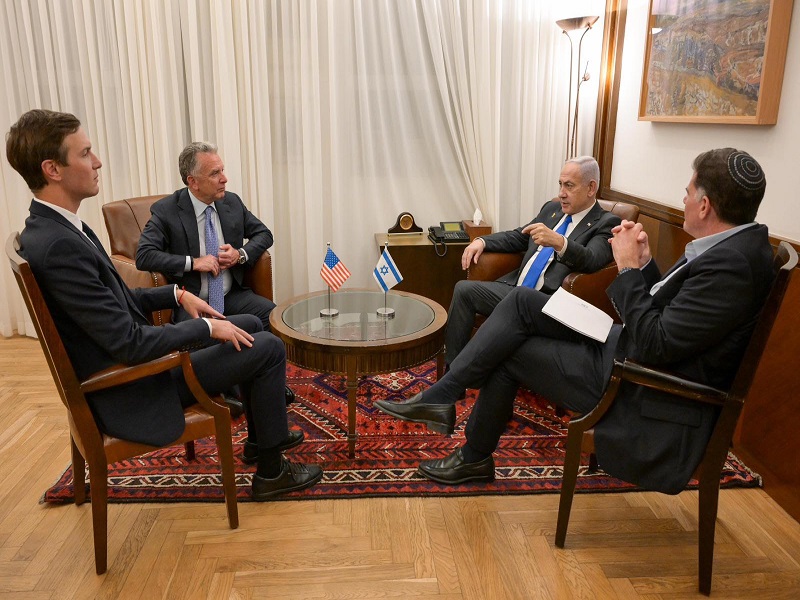
Israeli Prime Minister Benjamin Netanyahu with US President Donald Trump's Special Envoy to the Middle East, Steve Witkoff, and the President's son-in-law, Jared Kushner today.
Ceasefire Struggles as Gaza’s Needs Remain Unmet
Gaza/Jerusalem/Geneva: Airstrikes echoed across Gaza today morning, shattering hopes of an immediate truce as thousands of desperate residents clogged the enclave’s main northward route, fleeing amid unverified reports of Israeli military withdrawals.
United Nations aid teams called urgently for unfettered access to deliver 170,000 metric tons of food, medicine, and supplies to 2.1 million people, including 500,000 children in need of nutritional support. Aid teams still working in the enclave reported that the ceasefire had not come into effect today morning.
Nonetheless, vital humanitarian work continues, including one UNICEF mission to Gaza City yesterday “to rescue two babies who were in incubators and fighting for their lives”, said Ricardo Pires, spokesperson for the United Nations Children’s Fund. “Luckily, with the hard work of colleagues and health workers on the ground, they survived and they got reunited with their families today.”
The UNICEF spokesperson explained that the mission had to wait 15 hours to gain access to Gaza City because “the situation on the ground was still very, very unstable and kinetic activity was taking place, a lot of violence”.
Echoing that assessment, Juliette Touma, Director of Communications for the United Nations Relief and Works Agency for Palestine Refugees in the Near East, noted that colleagues in the enclave reported ongoing airstrikes today morning.
Against this backdrop of persistent violence, the United Nations Relief and Works Agency for Palestine Refugees in the Near East (UNRWA), the United Nations Children’s Fund (UNICEF), and the World Health Organization (WHO) issued an impassioned plea for unfettered access to deliver 170,000 metric tons of life-saving food, medicine, and supplies to 2.1 million people teetering on the brink of famine.
The urgent calls came as a United States-brokered ceasefire agreement, mediated in Egypt with Qatar and Türkiye, promised the release of all hostages—living and deceased—taken during the Hamas-led terror attacks on southern Israel on October 7, 2023.
Yet, with “kinetic activity” disrupting humanitarian missions and a lack of clarity surrounding the deal’s implementation, the chasm between diplomatic fanfare and Gaza’s harrowing reality cast doubt on the ceasefire’s ability to deliver relief. The United Nations’ demands for open crossings and transparency clashed with Israel’s insistence on maintaining military dominance, exposing a fragile truce strained by competing priorities and a humanitarian crisis on the edge of catastrophe.
Touma emphasised the critical need to open all Gaza crossings immediately to avert famine. “There is little information available on the details or how the agreement will be implemented,” she said, her restrained tone betraying frustration over the opaque mechanics of the pact. She highlighted the staggering human cost: 370 United Nations Relief and Works Agency staff have been killed since the conflict’s onset, marking the highest death toll in United Nations history. “This food from the United Nations Relief and Works Agency is critical for averting and controlling famine,” she stressed, underscoring the agency’s struggle to operate amid ongoing violence.
The United Nations’ top aid official, Tom Fletcher, mobilised the “whole United Nations humanitarian family,” emphasising the United Nations Relief and Works Agency’s “indispensable role” in distributing aid under the United States’ 20-point plan, which assigns the agency a central role in relief efforts.
Ricardo Pires painted a grim picture of 50,000 children at risk of acute malnutrition, their survival hinging on immediate access to therapeutic treatment. He recounted a United Nations Children’s Fund mission to Gaza City on Thursday, delayed 15 hours by “very unstable” conditions and “a lot of violence,” which narrowly rescued two infants from incubators. “They were fighting for their lives,” Pires said, crediting the dedication of colleagues and local health workers for reuniting the babies with their families.
The World Health Organization’s Christian Lindmeier amplified the urgency, calling for resumed medical evacuations to the West Bank, including East Jerusalem, and flexible funding to rebuild Gaza’s shattered health infrastructure, crippled by two years of conflict. “We need unimpeded aid access across all possible routes,” he insisted, pointing to the enclave’s collapsing medical system. The persistent airstrikes and “kinetic activity” reported by United Nations teams on Friday morning underscored the ceasefire’s fragility, leaving agencies grappling to translate diplomatic promises into tangible relief for 2.1 million Gazans, including 500,000 needing specialised nutritional support.
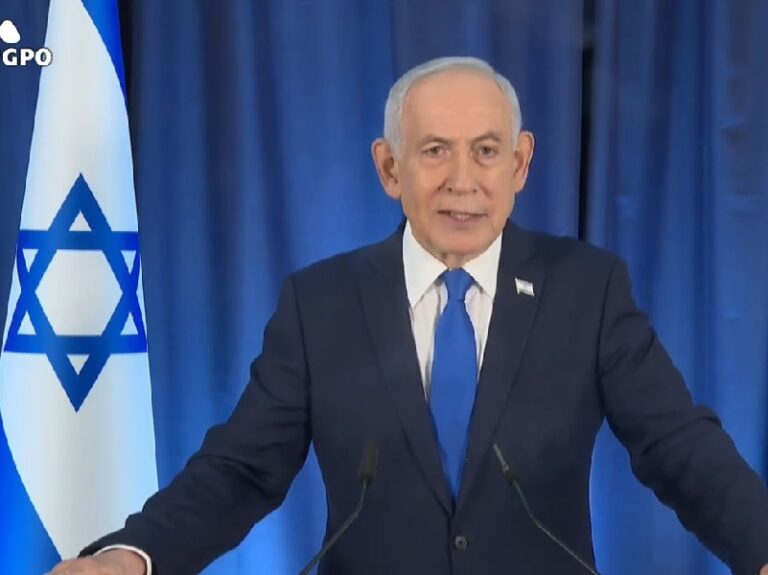
In Jerusalem, Israel’s Prime Minister Benjamin Netanyahu hailed the ceasefire as a “tremendous achievement” in what he termed the “War of Redemption,” announcing the Israeli government’s approval of a framework to return all hostages—207 already freed, including 117 living before United States’ President Donald Trump’s return to office, 49 more (including 10 via daring Israel Defense Forces operations) since, and the final 48 (20 living, 28 deceased) expected in the coming days, “God willing.” Speaking alongside Trump’s envoys, Steve Witkoff and Jared Kushner (Trump’s son, at a government meeting, Netanyahu credited the Israel Defense Forces’ “courage” and Trump’s diplomatic pressure for isolating Hamas. “We applied heavy military and diplomatic pressure,” he said, detailing operations in Rafah, the Philadelphi Corridor, and Gaza City that he claimed forced Hamas to yield. “They felt the sword on their neck,” he declared, rejecting claims that the deal was ever assured without Israel’s refusal to withdraw from strategic zones. He recounted resisting “enormous” domestic and international pressure to halt operations in Gaza, Lebanon, or against Iran’s nuclear and ballistic missile threats, arguing that acquiescing would have empowered Hamas, Hezbollah, the Assad regime, and Iran’s broader axis. “I steadfastly resisted all that pressure, because my focus was on one single consideration: Israel’s security,” he said, framing the hostage release as a step toward dismantling the “Iranian axis.”
Netanyahu’s public address, steeped in biblical resonance, framed the operation as “Returning Home,” invoking the Book of Jeremiah’s promise that “your children shall return to their own border.” He described “heart-rending” meetings with hostages’ families over the past two years, where he and his wife shed tears, pledging, “We will not give up on anyone.” He vowed the nation would embrace survivors for physical and mental rehabilitation, while the deceased would receive proper Jewish burials as a “sacred duty of communal responsibility.” Netanyahu honoured fallen Israel Defense Forces soldiers, embraced their families, and wished recovery for the wounded, both “in flesh or in spirit.” He thanked Trump for his “global leadership,” Witkoff and Kushner for their “tireless” efforts, and Israel’s negotiation team, led by Minister Ron Dermer, for their “dedicated and creative” work. “Two years ago, the holiday of Simchat Torah turned into a day of national grief,” he said. “This holiday of Simchat Torah will turn, God willing, into a day of national joy with the return of all our brothers and sisters taken hostage.”
Kushner praised the Israel Defense Forces’ broader campaign, citing its degradation of Hezbollah in Lebanon and strikes on Iranian targets as pivotal in shifting the regional balance. “Your citizen army… put your sacrifices on the line,” he told Israeli officials, noting that “probably all of you have family, friends who were in this effort.” He credited Netanyahu’s firm negotiation stance, aligned with Trump’s vision of an enduring end-state, for securing the deal. Witkoff lauded Netanyahu’s “tough choices,” admitting to personal sleepless nights and United States debates over flexibility—moments where he questioned Israel’s firmness but later saw its necessity. “The president believes Prime Minister Netanyahu made very difficult calls,” Witkoff said, noting Hamas was “backed up” by Israel’s military inroads. “They had to do this deal,” he added, emphasising the combined military and diplomatic pressure that culminated in the agreement. “The hard job was the Prime Minister’s,” Witkoff said, acknowledging the challenge of balancing national security with negotiation demands.
Netanyahu’s triumphal narrative, casting the deal as a victory that “changes the face of the Middle East,” risks overshadowing Gaza’s humanitarian abyss. His insistence on maintaining Israel Defense Forces control over Gaza’s dominating points, including the Philadelphi Corridor and Gaza City, with disarmament and demilitarisation as next steps, signals a strategy prioritising Israel’s security over immediate aid imperatives. “If this is achieved in the easy way, it’s all for the better. And if not, it will be achieved the hard way,” he warned, hinting at further military action if Hamas resists. He rejected critics who claimed the deal was always possible, insisting Hamas only relented under unprecedented diplomatic isolation via Trump’s plan and Israel’s military pressure. “Hamas has never agreed to release all of our hostages while we are inside the Gaza Strip,” he said, framing the agreement as a testament to Israel’s resolve to remain in strategic zones while securing the hostages’ return.
This stance, aligned with Trump’s 20-point framework, clashes with the United Nations’ urgent calls for open crossings, transparency, and an end to violence, exposing a fault line between Jerusalem’s victory narrative and Gaza’s desperation. The United Nations Relief and Works Agency’s Touma, UNICEF’s Pires, and WHO’s Lindmeier all underscored the lack of safe passage, with 50,000 children on the brink of starvation, 370 United Nations Relief and Works Agency workers dead, and airstrikes persisting despite the ceasefire announcement.
The United Nations’ repeated pleas for “unimpeded” access and clear implementation details highlight the disconnect between diplomatic rhetoric and the enclave’s grinding reality. Netanyahu’s vision of a disarmed, demilitarised Gaza, backed by Trump’s diplomatic heft, looms as a potential flashpoint, with Hamas’s compliance uncertain and the humanitarian toll mounting. The ceasefire’s success hinges on whether aid can flow freely and violence truly halts, a test so far unmet as Gazans flee northward and United Nations teams wait at the gates, caught between hope and peril.
– global bihari bureau