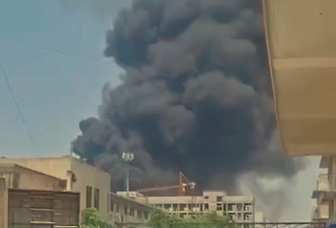
Smoke from the crashed Air India flight in Ahmedabad on June 12, 2025.
 By G. Krishna Mohan Rao*
New Delhi: The release of the preliminary enquiry report into the tragic crash of the London-bound Air India flight AI171 in Ahmedabad, minutes after taking off on June 12, 2025, turned out to be a job half done since it created more confusion and suspicion about the present situation. Theories hinting at pilot action or error for the crash have infuriated pilot associations in the country.
Reacting to the 15-page Aircraft Accident Investigation Bureau (AAIB) report, the Indian Commercial Pilots Association (ICPA) has strongly condemned it. The association, which represents the narrow-body fleet pilots at Air India, said in a statement that such a suggestion, based on incomplete and preliminary information, is not just “reckless and unfounded” but also “irresponsible” and “deeply insensitive”.
The 15-page preliminary report was expected to clarify the early findings of the crash of a Boeing 787 Dreamliner at Ahmedabad, opening a Pandora’s box of unresolved questions and incomplete disclosures. Experts said that the probe report painted a picture that is more fragmented than coherent. It may be recalled that Flight AI171 operating a schedule service from Ahmedabad to London, crashed moments after take off , killing all 260 people on board.
The pilots’ anger is said to be a reminder that dead pilots cannot defend themselves. It is being argued that we do not know the pilots’ exact words, nor who asked and who answered. We do not know what was said before and after. Just two cherry-picked sentences paraphrased in a way that they slyly implicate the two pilots, not fair. If pilot dialogue is material to the probe, so is the fact that seven years ago, the US aviation regulator found fuel control switches used in some Boeing 737s.
While the report is silent on who, or what, caused the error, the exchange between pilots paraphrased in it— one asks the other why he moved the switches; the other responds that he did not— has been seen by many as a suggestion that the pilots were at fault. The Indian aviation community has reacted in anger over what it sees as an attempt to scapegoat the pilots. This is understandable. The report provides only a paraphrased account of the cockpit exchange, capturing confusion when engines began losing power. Exact words and other sounds from the voice recorder could provide crucial context that remains hidden.
If the sole purpose of the enquiry is to meet deadlines, AAIB has done well. International rules gave it 30 days to submit a preliminary report about the June 12th crash. Many aviation experts felt that the report would be short on substance, not 15 pages. Preliminary reports cannot be conclusive, but they should begin to shed light. The findings carry global significance because this represents the first fatal accident involving Boeing’s 787 in 14 years of commercial service.
A striking feature of the 15-page report is its cautious tone. The AAIB has stated that the sole objective of the probe is “the prevention of accidents and incidents and not to apportion blame or liability “. It has also pointed to the risk of drawing erroneous interpretations from this document. No action has been recommended for operators and manufacturers of Boeing 787 jets.
Early theories speculated that the pilots hit the wrong levers during take-off. This was ruled out in the report. The report noted that the fuel supply to the two engines was cut off within a second of each other, almost immediately after takeoff. Did this happen due to electrical/ software malfunction or human error? Did the pilots misinterpret any signal, or was the failure abrupt and total? Why was the Emergency Locator Transmitter (ELT) not active? Why were crash-proof recorders (EFAR) damaged? All these critical questions are unanswered.
The most glaring absence is the comprehensive Flight Data Recorder (FDR) data. The report mentions the transition of the fuel control switches, which implies that this data exists and was retrieved. Yet, no graphical or tabular snapshot has been shared through the report. Nor is there any confirmation that 100 per cent of the FDR data was recovered. Similarly, the Cockpit Voice Recorder (CVR) is only referenced once— a vague sentence about an attempted restart. There is no transcript, no clear timeline of the cockpit conversation, and no insight into the crew’s awareness or state of mind.
Adding to the mystery is the discrepancy in the aircraft’s altitude. The Ram Air Turbine (RAT) is said to have deployed at 60 feet, as inferred from the CCTV image, which again fails to produce a timestamp, which suggests that the onboard systems had already detected a power loss almost instantly after liftoff. Yet, the report timestamps this after the fuel control switch cutoff. Which came first: the RAT deployment or the engine shutdown? Absolute clarity about the sequence is necessary.
Experts feel that technical findings remain significant and demand rigorous follow-through regardless of implications. If evidence ultimately points to pilot error, that conclusion must be accepted, however, inconvenient. If mechanical or system failures emerge, manufacturers and regulators must face accountability. In other words, the AAIB must demonstrate thoroughness and transparency. This requires releasing complete cockpit voice transcripts when appropriate, providing regular progress updates and including qualified technical expertise.
*Senior journalist