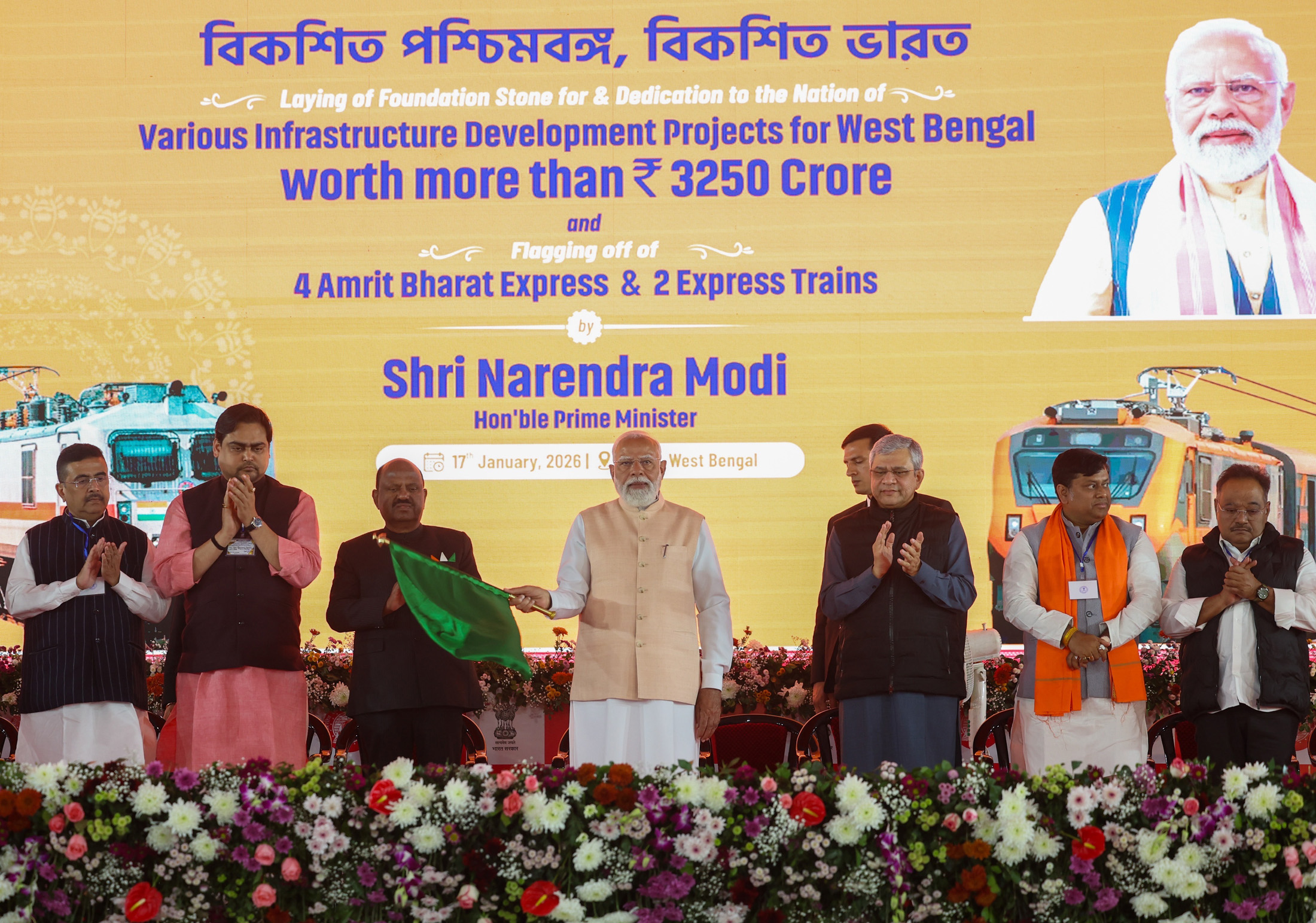
Prime Minister Narendra Modi inaugurates, lays the foundation stone and dedicates to nation various rail and road projects at Malda, in West Bengal on January 17, 2026.
New Vande Bharat Sleeper, Amrit Bharat Trains Launched in Bengal
Malda: Prime Minister Narendra Modi today inaugurated and laid the foundation stone of multiple rail and road infrastructure projects worth more than ₹3,250 crore in Malda, aimed at strengthening rail, road, freight and logistics connectivity in West Bengal and the North-Eastern region.
The inauguration and foundation-laying of the projects come in the run-up to the West Bengal Assembly elections due this year, with the current term of the state legislature ending in May.
Addressing the gathering, the Prime Minister said that from Malda, efforts to accelerate development in West Bengal had gained further momentum.“Several projects related to the development of West Bengal were either inaugurated or had their foundation stones laid. New rail services have been gifted to West Bengal. These projects will make travel easier for the people here and will also simplify trade and business,” he said, adding that newly created train maintenance facilities would generate employment opportunities for the youth of Bengal.
A key highlight of the programme was the flagging off of India’s first Vande Bharat Sleeper Train between Howrah and Guwahati (Kamakhya). The Prime Minister visited Malda Town Railway Station, interacted with passengers, and flagged off the service, while the Guwahati–Howrah Vande Bharat Sleeper Train was flagged off virtually. He described the introduction of the sleeper variant as a major step in the modernisation of Indian Railways. “What the trains of a developed India should look like is clearly visible in this Vande Bharat Sleeper train,” he said, recalling that passengers he spoke to described the experience as distinctive and comfortable.
The fully air-conditioned sleeper train, designed and built in India, is intended to offer an airline-like travel experience at economical fares. It is expected to make long-distance journeys faster, safer and more convenient, and reduce travel time on the Howrah–Guwahati route by around two and a half hours, providing a boost to tourism and religious travel. Referring to the route, the Prime Minister said the service connects West Bengal and Assam and would be expanded to other parts of the country in the coming years.
Four new Amrit Bharat Express trains were virtually flagged off during the event, linking New Jalpaiguri with Nagercoil and Tiruchirappalli, and Alipurduar with Bengaluru and Mumbai (Panvel). The Prime Minister said these services would strengthen connectivity between Bengal, particularly North Bengal, and South and Western India. He said the trains would support the travel needs of pilgrims visiting Gangasagar, Dakshineswar and Kalighat, as well as passengers travelling to Tamil Nadu and Maharashtra, while providing affordable and reliable long-distance connectivity for common citizens, students, migrant workers and traders.
In addition, two new train services equipped with LHB coaches were flagged off between Radhikapur and Bengaluru, and Balurghat and Bengaluru, aimed at improving direct, safe and comfortable rail connectivity to major employment and information technology hubs.
The Prime Minister laid the foundation stone for four major railway projects in West Bengal, including a new rail line between Balurghat and Hili, next-generation freight maintenance facilities at New Jalpaiguri, upgradation of the Siliguri Loco Shed, and modernisation of Vande Bharat train maintenance facilities in Jalpaiguri district. These projects are expected to strengthen passenger and freight operations, improve logistics efficiency in North Bengal, and generate employment opportunities in the region.
He also dedicated to the nation the electrification of the New Coochbehar–Bamanhat and New Coochbehar–Boxirhat rail sections, enabling faster, cleaner and more energy-efficient train operations. In the road sector, the Prime Minister laid the foundation stone for the rehabilitation and four-laning of the Dhupguri–Falakata section of National Highway-31D, a project aimed at improving regional road connectivity and facilitating smoother movement of passengers and goods.
The Prime Minister said Indian Railways was undergoing a phase of transformation through electrification, station modernization and the expansion of modern and high-speed train networks. “Today, more than 150 Vande Bharat trains are running across the country, including West Bengal,” he said, adding that the benefits were being felt by poor and middle-class families. He said Indian Railways was becoming modern as well as self-reliant, noting that India now manufactures more locomotives than the United States and Europe and exports passenger trains and metro coaches to several countries, contributing to economic growth and employment generation.
Governor of West Bengal C V Ananda Bose, Union Ministers Ashwini Vaishnav, Shantanu Thakur and Sukanta Majumdar, along with other dignitaries, were present at the event.
– global bihari bureau