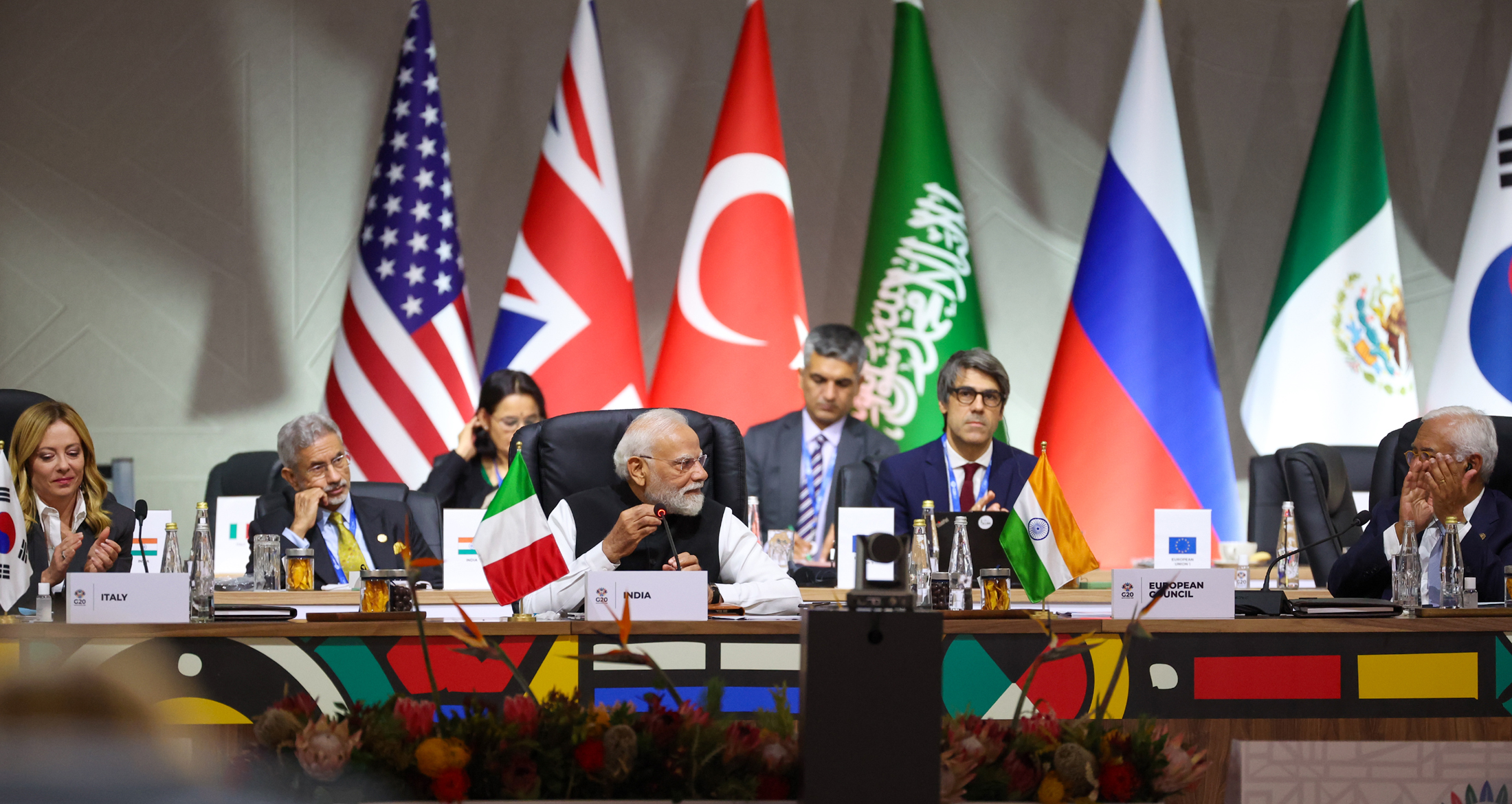
Indian Prime Minister Narendra Modi addressing at the Session-2 of the G20 Leaders Summit at Johannesburg, in South Africa on November 22, 2025.
Trump and Putin Skip Johannesburg Summit
India Proposes Knowledge and AI Initiatives, Sets Agenda on Food, Minerals, and Drug-Terror Nexus
Modi Highlights Integral Humanism and Global South, Pushes Skills, Health, and Climate Agenda at G20
Johannesburg: The 2025 G20 Summit in Johannesburg is unfolding without the participation of two major powers — the United States and Russia — each for sharply different reasons. Former U.S. President Donald Trump announced that no U.S. government officials would attend, accusing South Africa of “serious human-rights concerns” and claiming the summit did not align with U.S. priorities, a stance reported by Reuters. Russia’s absence stems from more legal and diplomatic constraints: President Vladimir Putin is avoiding travel to South Africa due to the International Criminal Court arrest warrant issued against him, which could legally obligate the host country — a signatory to the Rome Statute — to detain him. He had skipped the New Delhi G20 Summit too in September 2023 when Russia was represented by Foreign Minister Sergey Lavrov instead. Putin’s absence was officially attributed to “schedule constraints,” though it aligned with his pattern of avoiding travel to major Western-led summits after the ICC issued a warrant earlier that year. In Putin’s place, this time the Kremlin has formally appointed Maxim Oreshkin, Deputy Chief of Staff, to lead the Russian delegation, according to official Kremlin directives.
The absence of both the United States and Russia at the top-leadership level has injected a distinct geopolitical dynamic into the Johannesburg summit. With President Donald Trump formally announcing that “no U.S. government official” will attend and accusing South Africa of human rights abuses, the traditional role of the U.S. as a consensus-builder within the G20 has been disrupted. In response, South African President Cyril Ramaphosa indicated that the chair would be handed over to an “empty chair,” framing U.S. non-participation as both a diplomatic snub and an opportunity for the host and other members to assert more influence. On the Russian front, President Vladimir Putin’s non-attendance—due to a valid arrest warrant from the International Criminal Court (ICC) and South Africa’s status as a signatory—led Moscow to send Deputy Chief of Staff Maxim Oreshkin instead. This dual absence has allowed the summit to proceed with draft declarations and policy language that notably include references to “climate change” and developing-world priorities despite U.S. objections. The outcome is a subtly reshaped G20 narrative: one less anchored by the two largest economies and more open to a Global South-led agenda, giving the host nation and other developing countries an unusual degree of influence over the final communique and thematic priorities.
The boycott by the United States and the non-attendance of Russia’s President have altered traditional bilateral engagement and the dynamics of working-group deliberations at the summit. With the United States absent from the leaders’ table, the draft declaration was agreed by G20 sherpas without U.S. input — a break from precedent — and the document notably retained references to “climate change” despite Washington’s earlier objections. Meanwhile, many bilateral meetings typically involving U.S. and Russian heads have been replaced by lower-ranked delegates, reducing the summit’s usual power-broker interactions and creating more space for developing-country leaders to shape agenda-setting. The result is a subtle redistribution of diplomatic weight, with hosts and other major developing nations gaining greater influence in shaping outcomes and steering thematic working groups on debt relief, sustainability and global governance reform.

Meanwhile, Africa’s first-ever G20 Summit, hosted by South African President Cyril Ramaphosa at the Nasrec Expo Centre, saw Prime Minister Narendra Modi outline a comprehensive and multidimensional vision for global development, emphasising inclusive growth, disaster resilience, climate action, knowledge-sharing, and the empowerment of the Global South. This was Prime Minister Modi’s 12th participation in the G20 Summits. He addressed both sessions of the opening day of the Summit.
Speaking at the opening sessions, Modi noted that conventional models of economic growth had historically left large populations behind and contributed to environmental degradation, with Africa bearing a disproportionate share of these adverse impacts. Drawing from India’s civilisational heritage, he highlighted Integral Humanism, a philosophy that views the individual, society, and nature as interlinked, advocating a development pathway that balances human progress with ecological sustainability.
In a detailed exposition, Modi presented six major initiatives for consideration by the G20. The Global Traditional Knowledge Repository aims to preserve and transmit centuries-old wisdom on sustainable living to future generations. The G20–Africa Skills Multiplier Initiative envisages a train-the-trainer model to develop one million certified trainers in Africa over the next decade, creating a multiplier effect in equipping millions of youth with vocational and technical skills. A G20 Global Healthcare Response Team is proposed to deploy trained medical experts rapidly in the event of health emergencies or natural disasters. Modi also recommended a G20 Open Satellite Data Partnership to make space data from G20 countries available to developing nations for agriculture, fisheries, disaster management, and environmental planning. The Critical Minerals Circularity Initiative seeks to promote recycling, urban mining, second-life batteries, and sustainable supply chains to reduce dependence on primary extraction and foster cleaner industrial development. Finally, the G20 Initiative on Countering the Drug-Terror Nexus is intended to combat illicit drug trafficking, such as fentanyl, which finances terrorism and undermines global security.
The summit also placed significant emphasis on disaster resilience, climate change, energy transition, and food systems. Modi stressed a development-centric approach to disaster preparedness, building on India’s Coalition for Disaster Resilient Infrastructure (CDRI), rather than a purely response-focused model. He highlighted the nutritional and environmental value of millets and referred to the Deccan Principles on Food Security, proposing that these principles form the foundation for a G20 roadmap to strengthen global food security. Developed nations were urged to provide time-bound, affordable finance and technology support to developing countries to accelerate renewable energy adoption, improve energy efficiency, and enhance sustainable agriculture.
Parallel to the Leaders’ Summit, the G20 Social Summit, held from November 18–20, 2025, engaged youth, women, persons with disabilities, and grassroots organisations. Civil society voices were reflected in the closing declaration submitted to President Ramaphosa, addressing inclusive development, gender equality, and social justice. In line with these concerns, South Africa witnessed widespread civil society activism, including the G20 Women’s Shutdown protest demanding urgent action on gender-based violence (GBV). In response, the South African government declared GBV and femicide a national disaster, signalling a recognition of the urgency and systemic nature of the problem.
Economic and financial issues also dominated discussions. An Africa Expert Panel, established under South Africa’s G20 presidency, proposed a debt refinancing initiative for low-income and developing nations. Recommendations included debt swaps to buy back expensive debt, potential funding through IMF Special Drawing Rights (SDRs) or IMF gold reserves, and the creation of a “borrowers’ club” to enhance the negotiating power of debtor nations. The Development Ministerial Declaration, issued in July 2025, reaffirmed commitment to the 2030 Agenda and Sustainable Development Goals, forming the broader financial and developmental context for these proposals.
South Africa’s presidency advanced several continent-focused initiatives, including the AI Initiative for Africa in partnership with the African Union and UNESCO, the Africa Energy Efficiency Facility, the Clean Cooking Legacy Program, and the Ubuntu Food Security Framework, which addresses nutrition, food price volatility, and sustainability. A set of High-Level Principles for Illicit Financial Flows was also proposed to promote voluntary adherence to anti-corruption and transparency standards. The B20 engagement group submitted thirty recommendations across eight task forces, focusing on infrastructure, financial inclusion, climate-resilient investments, and private-sector partnerships to support sustainable development.
The summit’s diplomatic dimension was notable. Reports from The Times of India indicate that the G20 bloc broke with tradition, ignoring pressure from the United States, signalling a shift in the geopolitical dynamics of the forum. Multiple sources suggest that the United States was largely absent from high-level summit engagements, while South Africa successfully managed logistics, security, and civil society coordination. On the sidelines, PM Modi engaged in bilateral discussions, including conversations with Malaysian Prime Minister Anwar Ibrahim, highlighting India’s active diplomatic outreach.
Security, technology, and governance issues were also central. Modi underscored the need to address the drug-terror nexus, particularly the spread of lethal synthetic drugs such as fentanyl, stressing that coordinated action combining finance, governance, and security measures is essential. India also called for greater representation of the Global South in global governance structures, highlighting the inclusion of the African Union as a permanent G20 member during the New Delhi Summit as a model for broader reform.
The summit also advanced legacy proposals, including the establishment of a permanent international panel on inequality, modelled on the Intergovernmental Panel on Climate Change (IPCC), to make global inequality a standing agenda item in G20 deliberations. Analysts emphasised that the long-term impact of proposals on debt refinancing, AI initiatives, clean cooking, energy efficiency, satellite partnerships, critical minerals circularity, and disaster preparedness will depend on follow-through, political will, and financing commitments from G20 members.
Economic and tourism impacts were also notable. The South African government expects the summit to generate significant local economic activity, increasing demand for services, logistics, and infrastructure, while creating job opportunities and promoting the country’s tourism potential as a long-term soft power and development strategy.
By placing inclusive growth, disaster resilience, climate action, youth skills, health preparedness, and Africa-specific development at the centre of deliberations, the Johannesburg summit signalled a transformation in the G20’s role: from a forum for economic coordination to a platform addressing structural global inequalities, sustainable development, and collaborative solutions to social, environmental, and security challenges. India’s proposals, particularly those led by PM Modi, emphasised the integration of civilisational wisdom, technological innovation, and practical governance solutions, setting a comprehensive agenda for the G20 as it navigates the evolving challenges of the 21st century.
– global bihari bureau