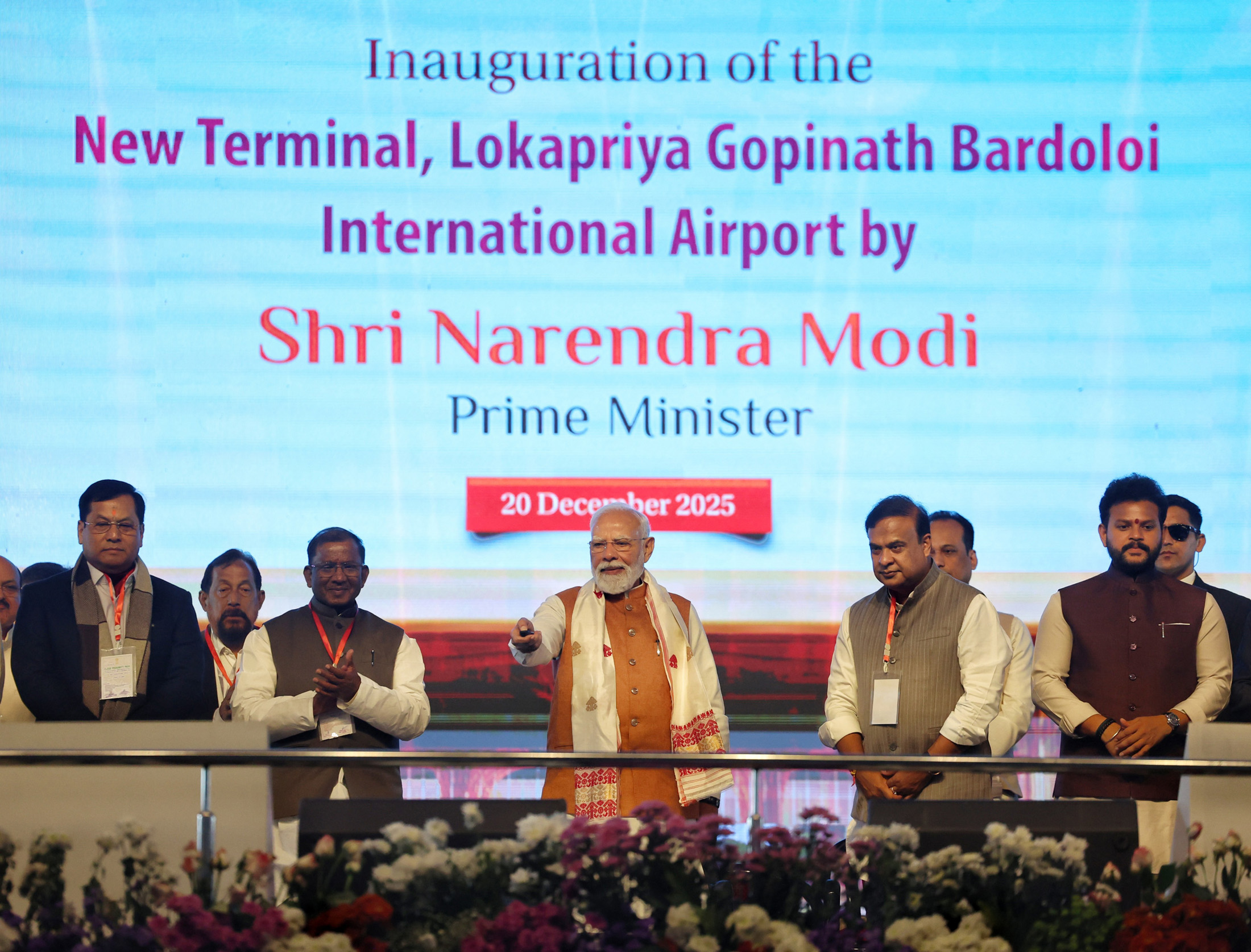
Prime Minister Narendra Modi inaugurates the New Terminal Building of Lokapriya Gopinath Bardoloi International Airport, in Guwahati, Assam on December 20, 2025.
India’s First Bamboo-Orchid Airport Opens in Assam
Guwahati Airport Gets New Terminal Under 50-Year Lease
Terminal Opens Under Adani Concession Model
Guwahati: A new integrated terminal building at Lokpriya Gopinath Bordoloi International Airport in Guwahati was inaugurated today, completing a major infrastructure project aimed at expanding passenger handling facilities at Assam’s principal airport.
Inaugurating the terminal, Prime Minister Narendra Modi said the facility would expand airport infrastructure and passenger handling capability. “Assam and the entire Northeast are becoming the new gateway of India’s development,” Modi said, highlighting that the vision of multi-modal connectivity had transformed both the condition and the direction of the region. He referred to rising air traffic volumes and the need for expanded aviation infrastructure.
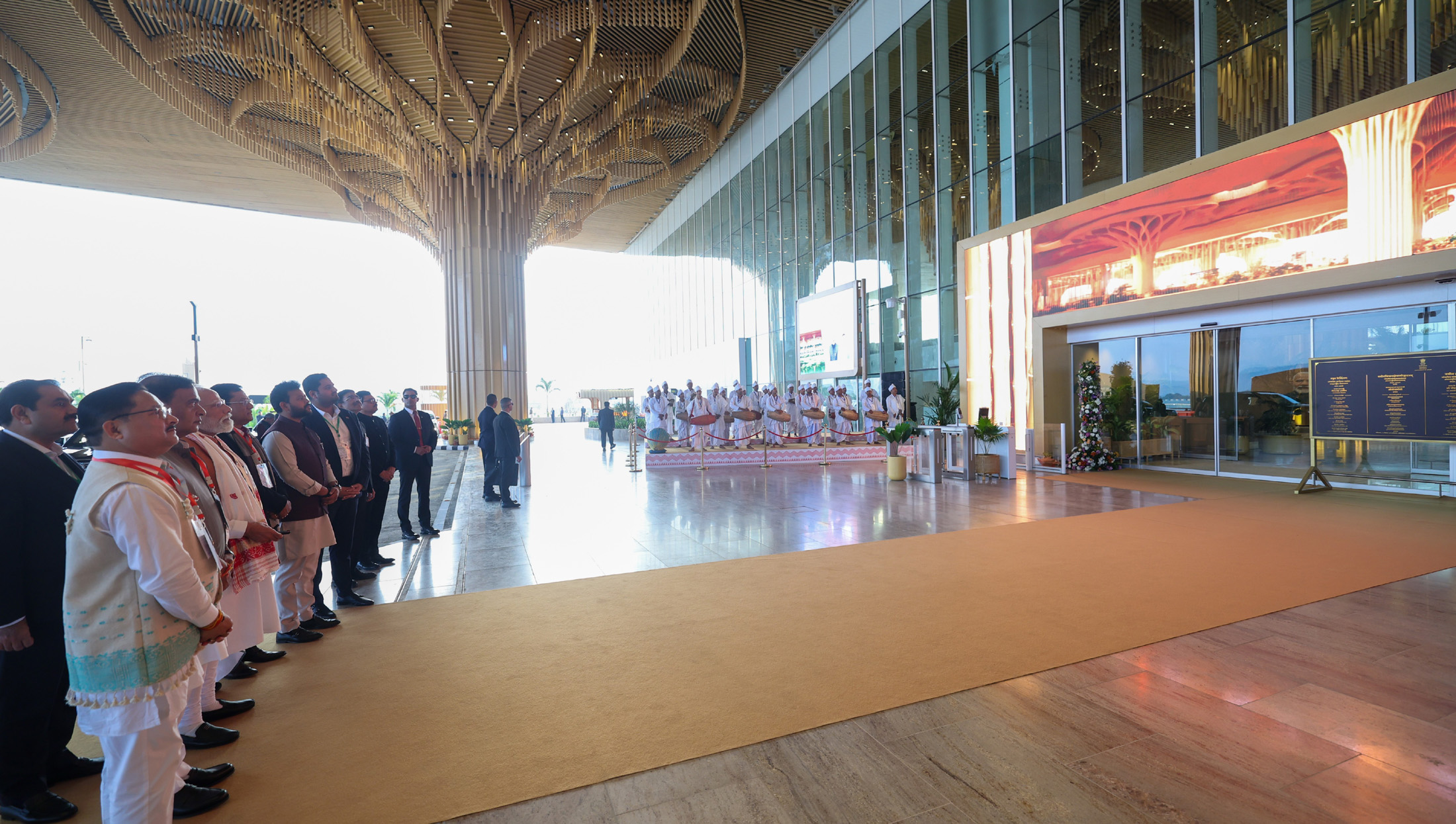
The newly completed integrated terminal building, spread over nearly 1.4 lakh square metres, has been designed to handle up to 1.3 crore passengers annually, raising the airport’s overall capacity from the previous design limit of about 3.4 million passengers per year under the older terminal configuration. The terminal has been supported by upgrades to runway infrastructure, airfield systems, aprons and taxiways to accommodate higher aircraft movement and passenger throughput. It includes expanded check-in areas, automated baggage handling systems, DigiYatra-enabled access points, additional immigration counters and larger passenger circulation zones. Following its commissioning, the new terminal is intended to handle the bulk of commercial passenger operations at the airport.
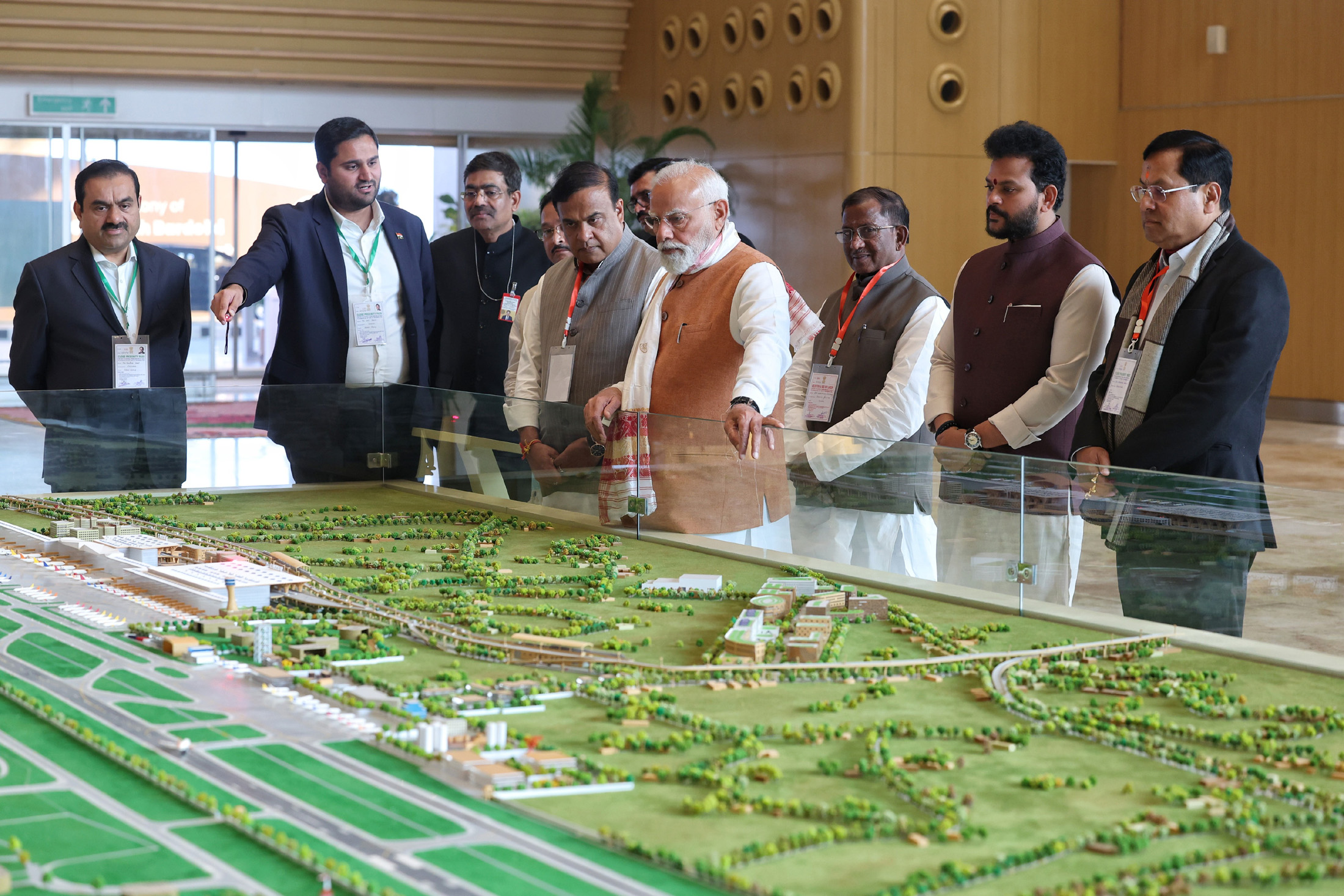
The terminal has been positioned as India’s first nature-themed airport facility. Its architectural design draws on Assam’s biodiversity and cultural heritage under the theme “Bamboo Orchids,” incorporating approximately 140 metric tonnes of locally sourced bamboo from the Northeast. Design elements include Kaziranga-inspired green landscapes, japi motifs, the rhinoceros symbol and 57 orchid-inspired columns reflecting the Kopou flower. A “Sky Forest,” comprising nearly one lakh plants of indigenous species, has been created within the terminal to provide a forest-like environment for arriving passengers.
Passenger processing at the terminal includes full-body scanners for security screening, DigiYatra-enabled contactless travel, automated baggage handling, fast-track immigration facilities and AI-supported operational systems intended to manage passenger flow and airport functions.
Operational control of the airport rests with Guwahati International Airport Limited, a special purpose vehicle under Adani Airport Holdings Limited, which assumed management in October 2021 after the airport was leased out by the Airports Authority of India for a period of 50 years. The lease followed a competitive bidding process conducted in 2019 under the Union government’s airport privatisation programme. Along with Guwahati, airports at Ahmedabad, Lucknow, Mangaluru, Jaipur and Thiruvananthapuram were transferred under the same process.
Guwahati Airport Expansion: Terminal and Concession Fees
Under the concession framework, the operator pays a per-passenger fee to the Airports Authority of India (AAI) as part of the contractual arrangement. These fees are revised periodically in line with contractual terms and applicable indices. Based on publicly disclosed 2019 bid documents, the original base fees at Guwahati were approximately ₹160 for domestic and ₹320 for international passengers. Other Adani-operated airports had similar base agreements: Ahmedabad ₹177/₹354; Lucknow ₹171/₹342; Jaipur ₹174/₹348; Thiruvananthapuram and Mangaluru had comparable initial schedules. These amounts represent base-year bid agreements and are illustrative; actual fees have been periodically escalated under contract indices. Government disclosures indicate that cumulative per-passenger fees and upfront concession payments from all six airports totaled around ₹4,790 crore by mid-2024, including ~₹2,032 crore in passenger fees and ~₹2,758 crore in upfront payments. While these concession fees are distinct from passenger-facing tariffs such as User Development Fees, they form part of the broader financial framework influencing airline operating costs and ticket pricing.
The Guwahati terminal project predates the transfer of airport operations. Its foundation stone was laid in 2018 when the airport was under AAI management, and construction progressed in phases. Responsibility for completion and commissioning passed to the concessionaire following the handover. The cost of the terminal project has been reported at close to ₹4,000 crore.
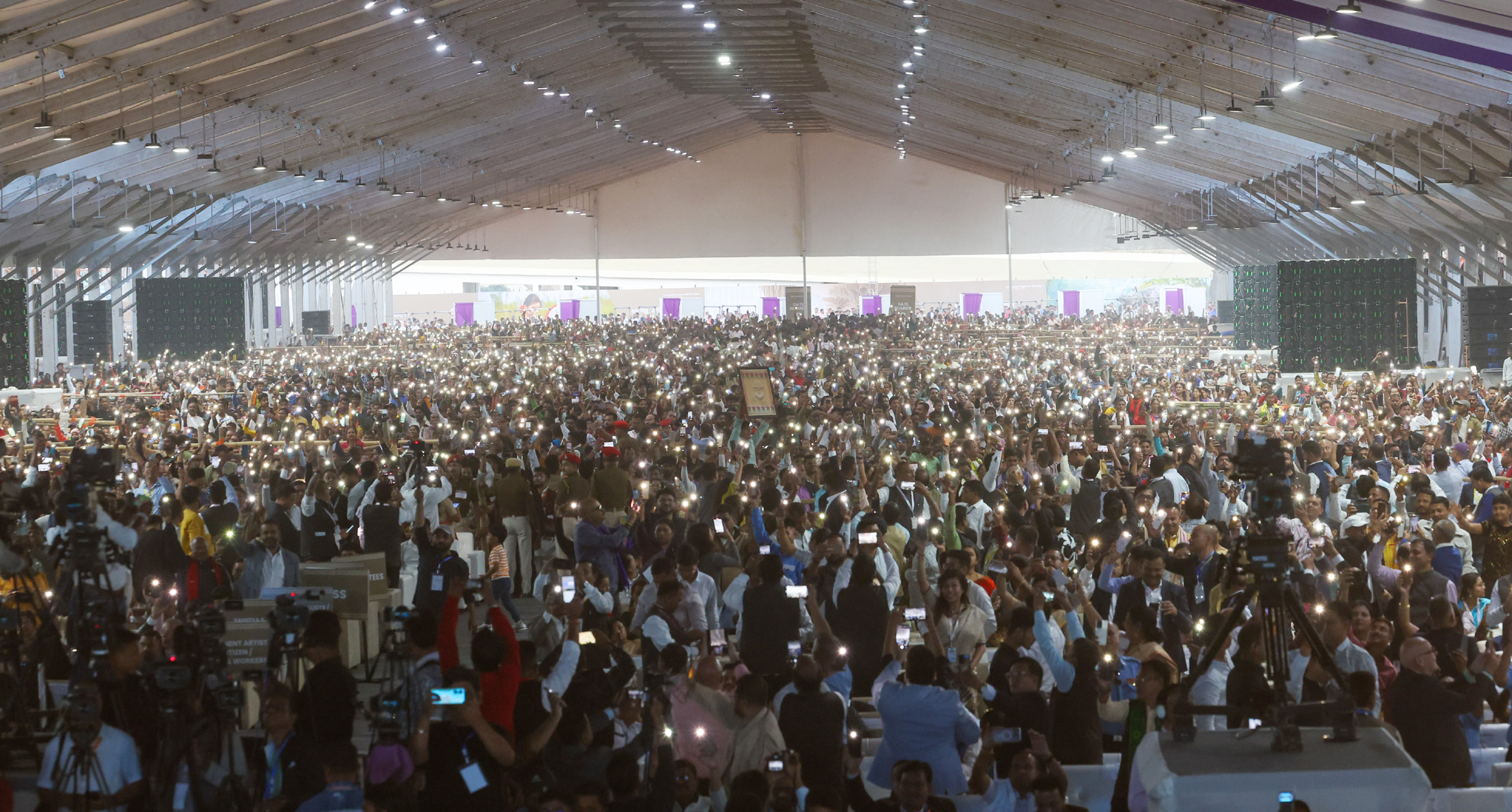
Union Minister Sarbananda Sonowal, who attended the inauguration, said the terminal would increase the airport’s passenger handling capacity and support air traffic operations serving Assam and other northeastern states.
Lokpriya Gopinath Bordoloi International Airport, commissioned in 1958, functions as the primary aviation gateway for Assam and neighbouring northeastern states. Passenger traffic at the airport has grown over the years, leading to congestion during peak hours under the earlier terminal configuration and prompting capacity augmentation plans.
Comparable developments have taken place at other airports operating under the same concession structure. Ahmedabad airport recorded a recovery in passenger traffic following pandemic-related disruptions after terminal and airside upgrades were completed. Jaipur saw increases in domestic passenger movement following capacity enhancements, while Lucknow’s passenger volumes rose after the commissioning of a new terminal and associated infrastructure works. At Thiruvananthapuram and Mangaluru, passenger growth occurred in phases alongside incremental expansion of terminal and apron facilities. In these cases, increases in passenger traffic followed infrastructure commissioning over time and reflected airline scheduling decisions, regulatory approvals and route deployment strategies rather than immediate post-inauguration shifts.
The Guwahati airport expansion has also been accompanied by disputes unrelated to the terminal building itself. Proposals involving runway extensions and airport-linked commercial development have faced objections from residents of nearby villages, including Azara and Mirzapur, over land acquisition procedures, compensation and the impact on agricultural land. Some matters have reached judicial forums at different stages. There is no order restraining operation of the newly commissioned terminal.
Passenger traffic levels at Guwahati airport remain subject to airline deployment decisions, regulatory clearances and prevailing tariff structures, including landing, parking and passenger-related charges applicable under the concession framework, as at other airports operated under similar arrangements.
The new terminal has been commissioned and opened for passenger operations, increasing the airport’s designed handling capacity.
– global bihari bureau