Seeking Truth Across Scriptures in Troubled Times
Small Delhi Meet Takes on Big Global Conflicts
New Delhi: The late-March afternoon in New Delhi carried its usual hum, but inside the Buddha Tri-Ratna Mission, the conversation drew meaning from a world in visible churn. A widening conflict centred on Iran—with hostilities involving Israel and extending into Lebanon—has unsettled much of West Asia. At the same time, the war in Gaza continues on its own trajectory, even as regional tensions complicate its humanitarian and political landscape. Beyond the region, the prolonged conflict between Russia and Ukraine and unrest in Sudan add to a wider sense of instability, while strains around Taiwan hint at further uncertainty. Layered onto this is the lingering imprint of COVID-19—a crisis that exposed human vulnerability and left behind deeper questions about suffering, resilience and meaning.
As Wars Rage, Faiths Reclaim Meaning
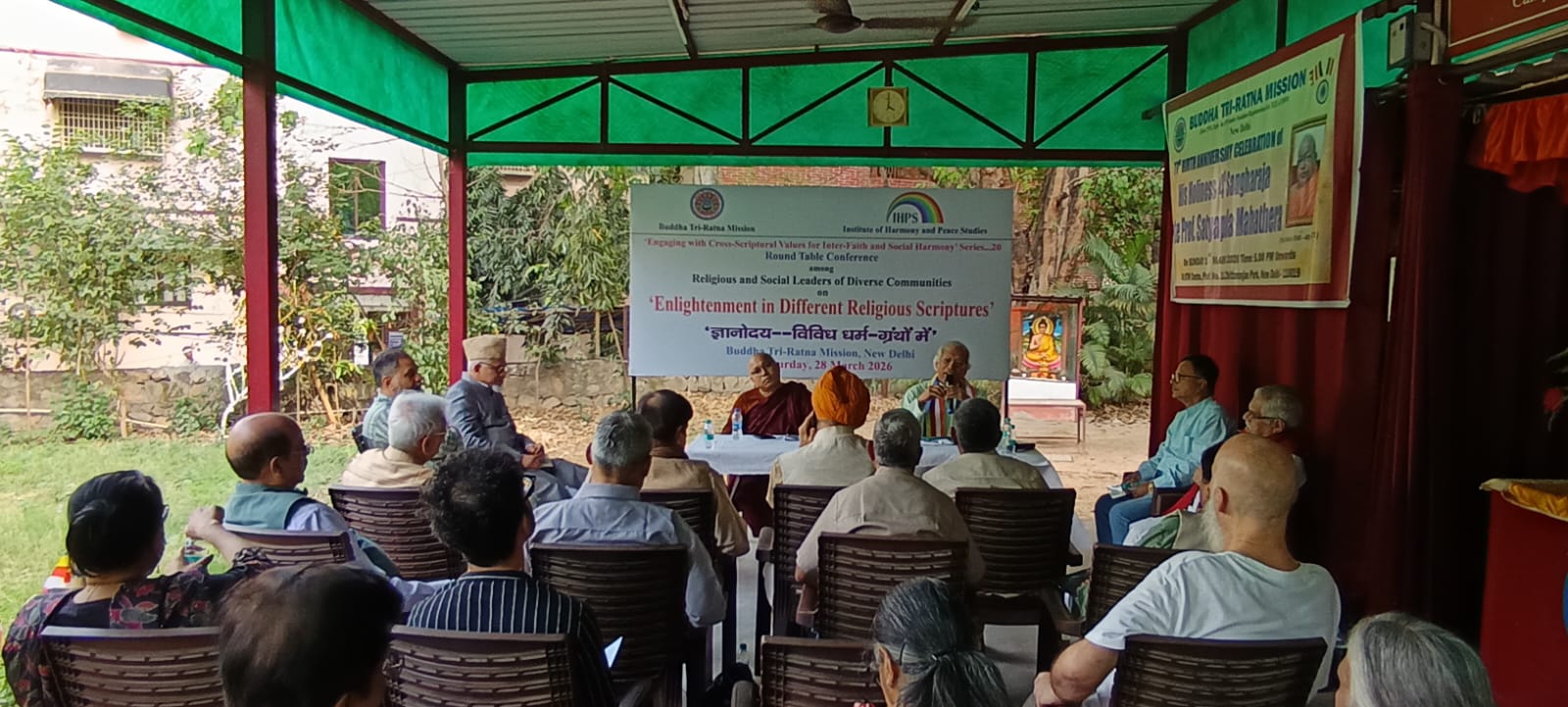
In many of these situations, struggles over power, territory and resources are often accompanied—at times amplified—by narratives that draw upon religion or identity, turning belief into a boundary rather than a bridge. It was against this backdrop that, on March 28, 2026, religious scholars, social thinkers and interfaith practitioners gathered in a quieter corner of the Indian capital to examine a theme rooted in both philosophy and lived reality—“Enlightenment in Different Religious Scriptures”.
Organised by the Institute of Harmony and Peace Studies in collaboration with the Buddha Tri-Ratna Mission, the round table formed part of an ongoing series titled Engaging with Cross-Scriptural Values for Interfaith and Social Harmony, an initiative designed not merely to present viewpoints but to draw out shared values across traditions through comparative reflection. Fr Dr M. D. Thomas, founder-director of the institute, who chaired and moderated the session, framed enlightenment as a universal human inheritance—one that transcends doctrinal boundaries. He encouraged participants to identify parallel values within their own and others’ scriptures, shaping the dialogue as a deliberate exercise in convergence rather than contrast. Subroto Barua, general secretary of the host mission, opened the proceedings and later offered the vote of thanks, anchoring the gathering in a spirit of welcome and closure.
A Quiet Interfaith Response to a Fractured World
What followed was not a sequence of isolated remarks, but a gradual layering of ideas. Bhikku Dr Nanda described enlightenment in Buddhism as bodhi—awakening to the true nature of reality, marked by insight into impermanence, non-self and the Four Noble Truths. It signifies liberation from suffering, craving and the cycle of rebirth (samsara), achieved through meditation, ethical living and wisdom, and expressed through compassion, freedom from fetters and the cessation of suffering.
Jain scholar Dr Ajay Jain located enlightenment in Keval Gyan, absolute knowledge that arises when the soul sheds the layers that obscure its inherent purity. He outlined the five forms of knowledge—Mati (sensory), Shrut (scriptural), Avadhi (clairvoyant), Manahparyaya (telepathic) and Keval (absolute)—noting that the highest state is attained through adherence to the five great vows.
Islamic scholar Prof. Junaid Haris drew attention to three foundational principles articulated in the Qur’an: Wahdat-e-Deen (unity of religion), Wahdat-e-Ilah (unity of God) and Wahdat-e-Adam (unity of humanity), suggesting that enlightenment lies in recognising this underlying unity and embodying it through akhlaq, or moral conduct.
Vedic thinker Arya Ravi Dev Gupt spoke of knowledge as both Nitya (eternal) and Naimittik (situational), the former rooted in daily discipline and spiritual practice, the latter in contextual understanding that aids progression toward realisation. Advocate Monika Sharma linked enlightenment to moksha, emphasising that liberation requires purity in thought, intention and speech, and that the wisdom of scriptures must be made accessible to shape future generations. Sikh representative Sardar Harvinder Singh Lamba invoked the Guru Granth Sahib’s teaching of Ik Onkar, underscoring the oneness of existence and the need to transcend divisions between “self” and “other.”
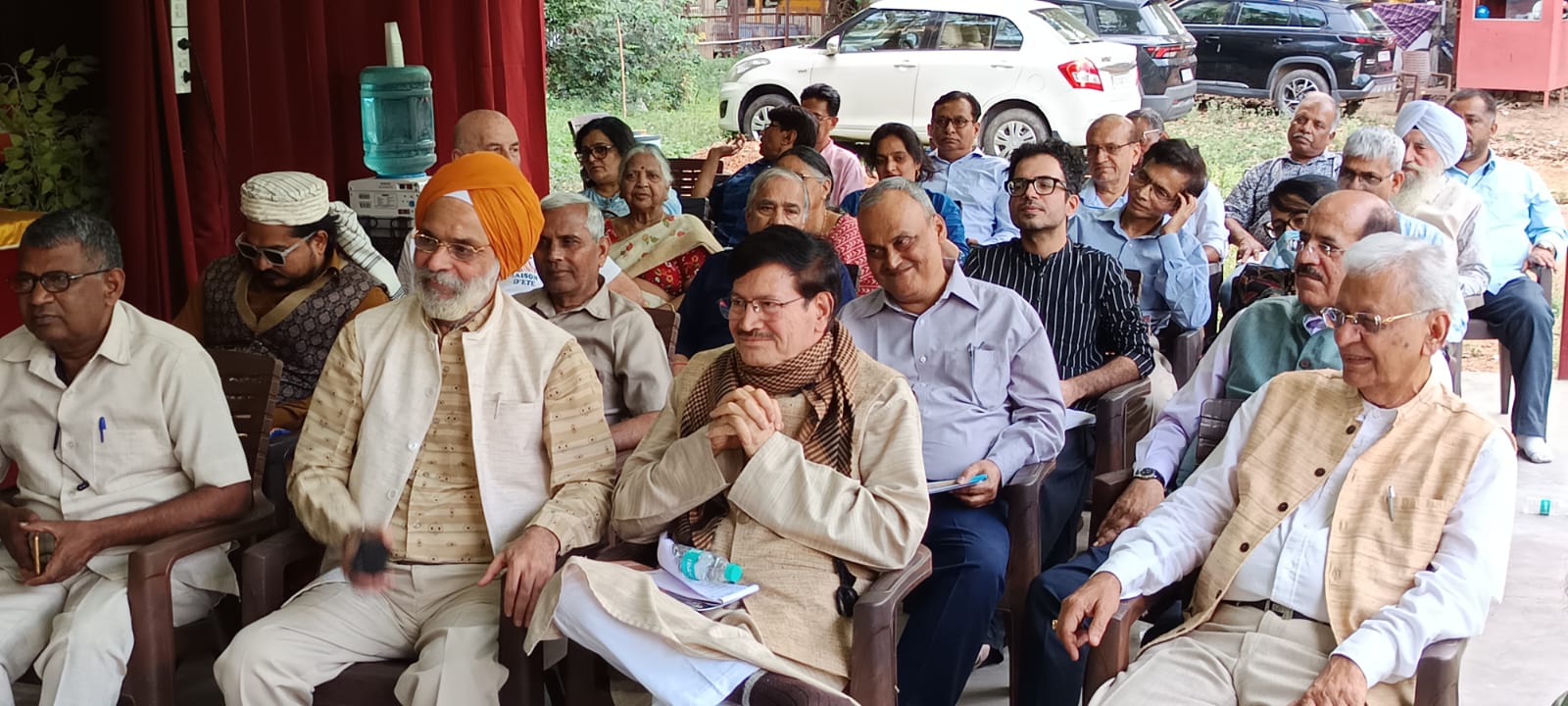
As the discussion gathered momentum, its strands began to echo across traditions. Educationist Prof. T. K. Mishra stressed the urgency of awakening spiritual awareness among the youth, particularly in times of mental distress, suggesting that sincere fulfilment of duty itself becomes a path to realisation. Interfaith voices like Yash Dhamija and Aniruddh Kumar returned to the idea that diversity does not divide but enriches, and that enlightenment requires transcending ego to recognise a deeper interconnectedness.
Former academic administrator Janab Firoz Bakht Ahmed described such gatherings as moments of renewal in a conflict-ridden world, urging a shift from war to wisdom, while Sufi scholar Ghulam Rasool Dehalvi likened diversity to the colours of a rainbow—distinct yet harmoniously coexisting. Sardar Surjit Singh Azad emphasised the importance of recognising goodness rather than fault, and Bahá’í representative Nilakshi Rajakhowa pointed to truthfulness as the foundational value that unites all paths.
When Conflict Grows, Faiths Turn Inward
Other interventions widened the philosophical frame. Prof. Salim Engineer described knowledge as having two dimensions—one acquired through intellect, reasoning and experience, and the other revealed through prophets—becoming meaningful only when used for the welfare of others. Dr Gopal Jee referred to the Bhagavad Gita, presenting yoga as a path that unites body, mind and soul in the journey toward liberation. Leadership expert Dr Vic Gaffiney reflected on humanity’s shared journey toward a higher state of being.
Among the more distinctive perspectives, Dr Chand Bharadwaj introduced the idea of “cosmic spiritual restructuring,” suggesting that enlightenment is not merely a religious aspiration but a fundamental human right. Using the metaphor of human beings as “intelligent atoms” originating from the Big Bang, he placed spiritual evolution within a broader cosmic process, noting that light and sound recur across traditions as symbols of transcendence.
From Gaza to Ukraine, Faiths Ask Hard Questions
If the global context lingered at the edges of the room, it was also present in the way the conversation repeatedly returned to first principles. Without directly invoking the conflicts that framed the day, many reflections appeared to respond to them—through an emphasis on humility over certainty, unity over division, and introspection over assertion. Enlightenment, in this telling, was less a claim to truth than a discipline of living, resistant to appropriation by power or distortion by ideology.
As the session drew to a close, Fr Thomas returned to a note that was both reflective and cautionary. Enlightenment, he said, must move beyond discourse into daily practice. Religion, while significant, is only one aspect of life and should not be given absolute importance or allowed to harden into rigidity and extremism. He urged a balanced approach—embracing what uplifts within traditions while rejecting what causes harm—and called for an openness to truth wherever it may be found. The refinement of one’s understanding, he suggested, is itself a form of enlightenment. “Keep moving forward—that is the essence of life,” he concluded.
Several participants from diverse communities were also present, adding to the inclusive tenor of the gathering.
Outside, the city moved on, largely untouched in any immediate sense. Yet within that room, the effort was not merely to compare scriptures, but to reclaim something more fundamental—to ask whether, in a time shaped by overlapping conflicts, contested narratives, competing ideologies and the lingering shadow of a global pandemic, the deeper ethical core of faith can still be retrieved from the forces that seek to divide it.
– global bihari bureau