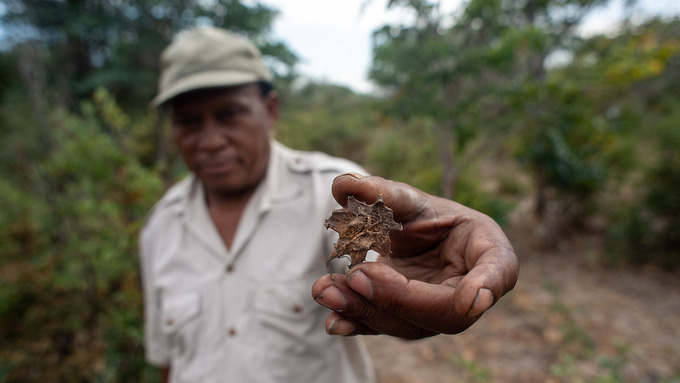
Naturally growing in Namibia, Botswana, Mozambique, South Africa, Zambia, Zimbabwe and Angola, devil’s claw is a traditional healing plant that sustains rural livelihoods while helping conserve biodiversity. ©FAO/David Mansell-Moullin
From Bwabwata’s Soil to Europe’s Pharmacies
A Tuber That Heals and Sustains
The earth in northeastern Namibia still radiates the memory of months without rain. In a sandy clearing inside Bwabwata National Park, Teon Rongwani bends to press loose soil back into a freshly dug pit. Around him, the savannah stretches in muted browns and dusty greens, worn thin by the long dry season now beginning to ease. Baskets brimming with fleshy tubers rest nearby—the reward for weeks spent searching beneath the surface for a plant whose hooked seed pods have earned it an ominous name: devil’s claw.
Rongwani, a member of the Khwe Indigenous Peoples and community representative of the Kyaramacan Association, has camped in the bush with fellow harvesters for much of the season. Their days begin at dawn. They walk miles across arid terrain under a relentless sun, scanning for the faintest signs of a plant that hides deep underground. Devil’s claw is not easily found, and extracting its tubers demands patience, experience and physical endurance.
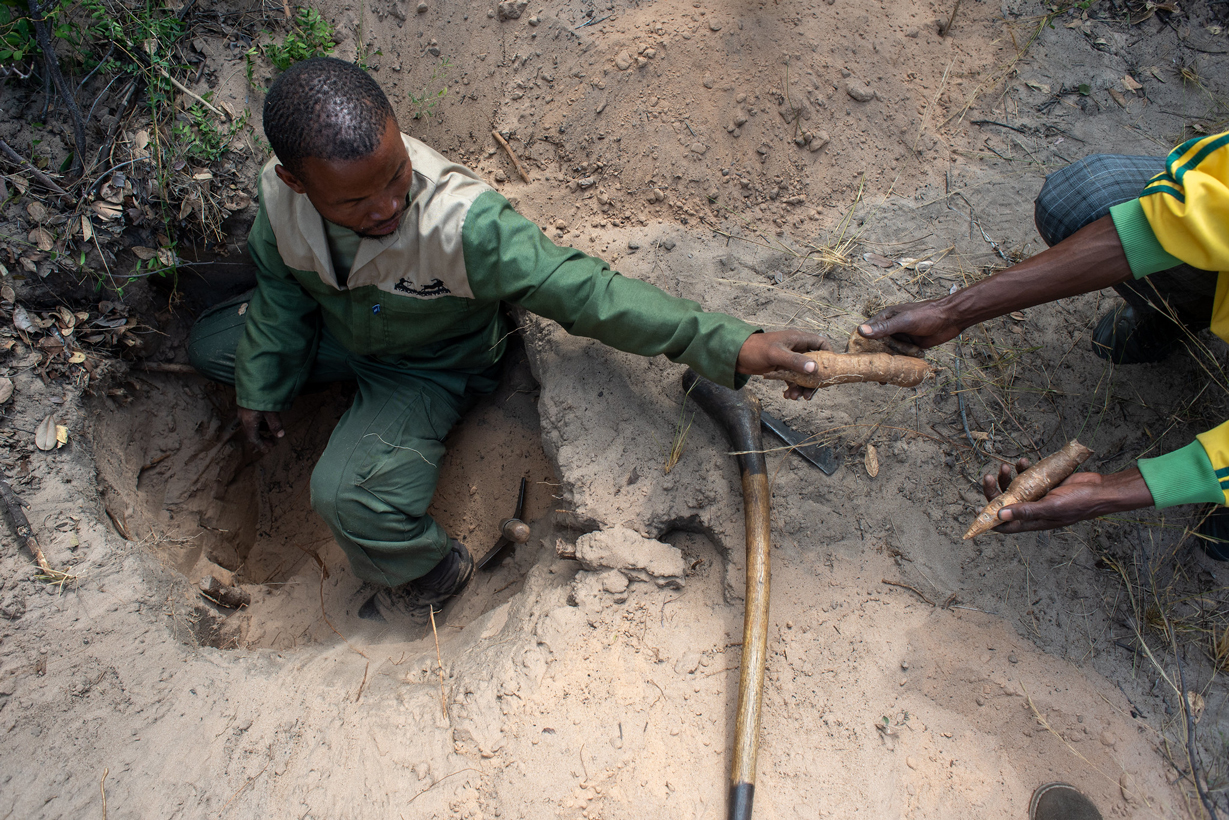
Restraint is as vital as effort. Only the secondary tubers are removed; the mother root—the plant’s living core—must remain intact. Damaging it would kill the plant and erase future harvests. Each pit is carefully refilled, both to allow regeneration and to prevent wildlife from stepping into open holes. In this shared landscape, sustainability is not an abstract principle but a daily discipline.
Across Namibia, between 5,000 and 10,000 harvesters undertake this work each year, seeking Harpagophytum procumbens and Harpagophytum zeyheri, the two species that supply a global herbal medicine market. Native to the arid savannahs of southern Africa, devil’s claw is prized for its anti-inflammatory properties and widely used to relieve joint pain and digestive disorders. In rural communities, it is brewed as tea. Internationally, it is processed into tablets and powders.
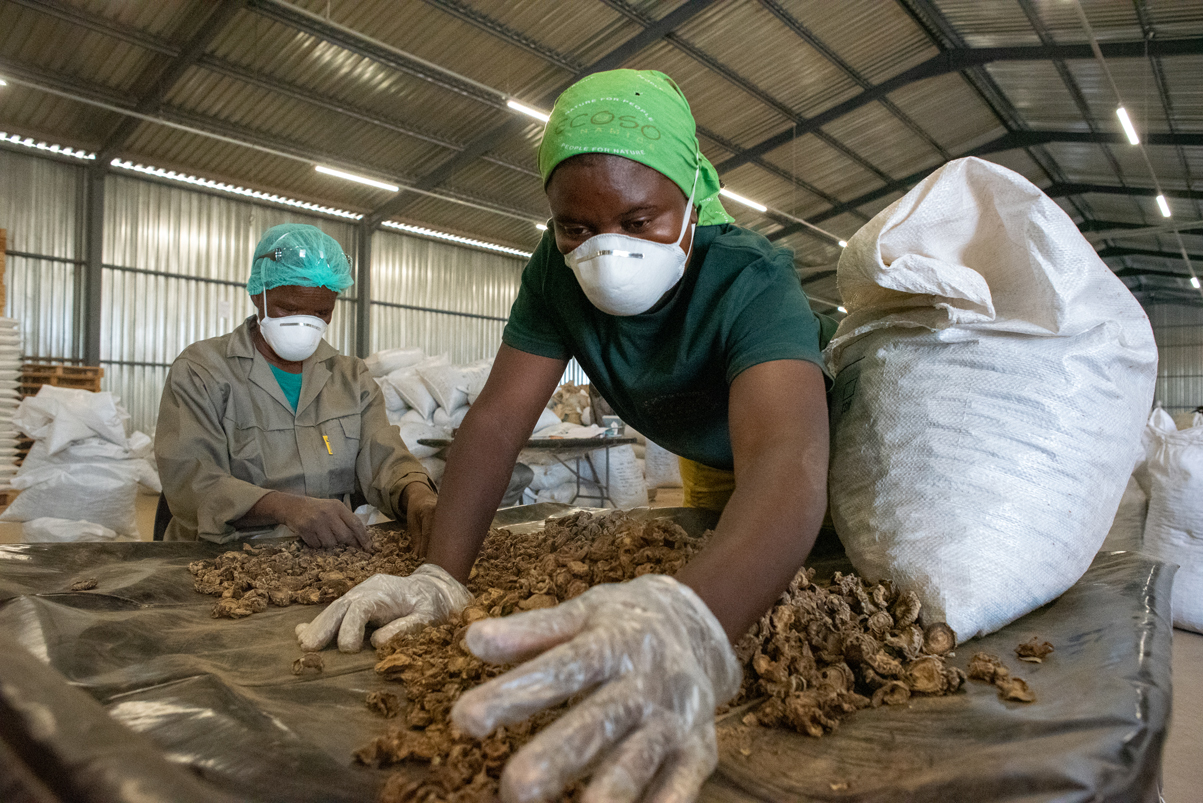
Namibia provides around 90 per cent of the world’s supply, exporting primarily to Europe, with Germany among the leading buyers. What begins as a painstaking search beneath sun-scorched soil ends on pharmacy shelves thousands of kilometres away.
For Rongwani’s family, the plant is more than a commodity. It pays for school fees and uniforms, food and healthcare. “Devil’s claw is the most important product for the Khwe. The Khwe have been using it since our ancestors,” he says. Its rising commercial value has strengthened incomes in remote areas where employment opportunities are scarce. “It’s a miracle plant indeed.”
Yet the plant’s growing demand brings risk. Devil’s claw is a protected species, vulnerable to overharvesting and illegal trade. Unsustainable extraction threatens not only fragile ecosystems but also the livelihoods that now depend upon them.
In response, harvesting is governed through a structured framework that blends Indigenous knowledge with formal regulation. The Sustainable Wildlife Management Programme, led by the Food and Agriculture Organization of the United Nations and funded by the European Union and the French Development Agency, works with World Wildlife Fund Namibia, the Kyaramacan Association and neighbouring communal conservancies, including George Mukoya and Muduva Nyangana, to ensure legal and sustainable practices.
Before entering the field, harvesters undergo training and register for permits. They are taught to record their collections, refill excavated soil and strictly avoid disturbing the mother root. The Food and Agriculture Organization-led Dryland Sustainable Landscapes Impact Program, funded by the Global Environment Facility and implemented by the Namibian government, further supports communities through training in Good Agricultural and Collection Practices, strengthening the long-term viability of the value chain.
“The number one rule, the unbreakable rule, no matter what, is you should never touch the mother root because then you’re destroying the whole plant,” says Justina Hamwaanyena, certification manager at a company that purchases tubers directly from harvesters. The company produces sustainably certified Fair for Life and Fair Wild devil’s claw products, linking remote savannah communities to regulated international markets.
Support extends beyond field training. Resource surveys help determine sustainable quotas. Assistance with fair buyer contracts seeks to safeguard harvester incomes. Measures to curb cross-border illegal harvesting reinforce compliance. A management commission on sales contributes to the operational costs of communal conservancies, strengthening wildlife protection in landscapes shared by people and animals.
“What the Kyaramacan Association is trying to achieve at the end of the day is to make sure that the benefits to the members are equitably shared and that the natural resources are sustainable,” Rongwani explains. The balance is delicate: conserving biodiversity while ensuring that rural communities derive tangible returns from stewardship.
“People only see devil’s claw as just devil’s claw, but there is a story to it,” Hamwaanyena says. That story stretches from Namibia’s drylands to European laboratories and retail shelves. Through initiatives now active in 16 countries, with partners including the French Agricultural Research Centre for International Development, the Centre for International Forestry Research and World Agroforestry, and the Wildlife Conservation Society, the Food and Agriculture Organization of the United Nations is investing in sustainable wildlife-based economies designed to conserve ecosystems while supporting rural livelihoods and the continuation of Indigenous knowledge systems.
As the season ends in Bwabwata, the carefully restored earth reveals little of the labour beneath it. Hidden below the sand, the mother roots remain, waiting for rain. For Rongwani and thousands like him, the future of devil’s claw depends not only on global demand, but on whether restraint can keep pace with opportunity—ensuring that the plant, and the knowledge surrounding it, endure for generations.
Source: The FAO News And Media Office, Rome
– global bihari bureau