Counterpoint: Between Ahimsa and Defiance
 By Vivekanand Jha*
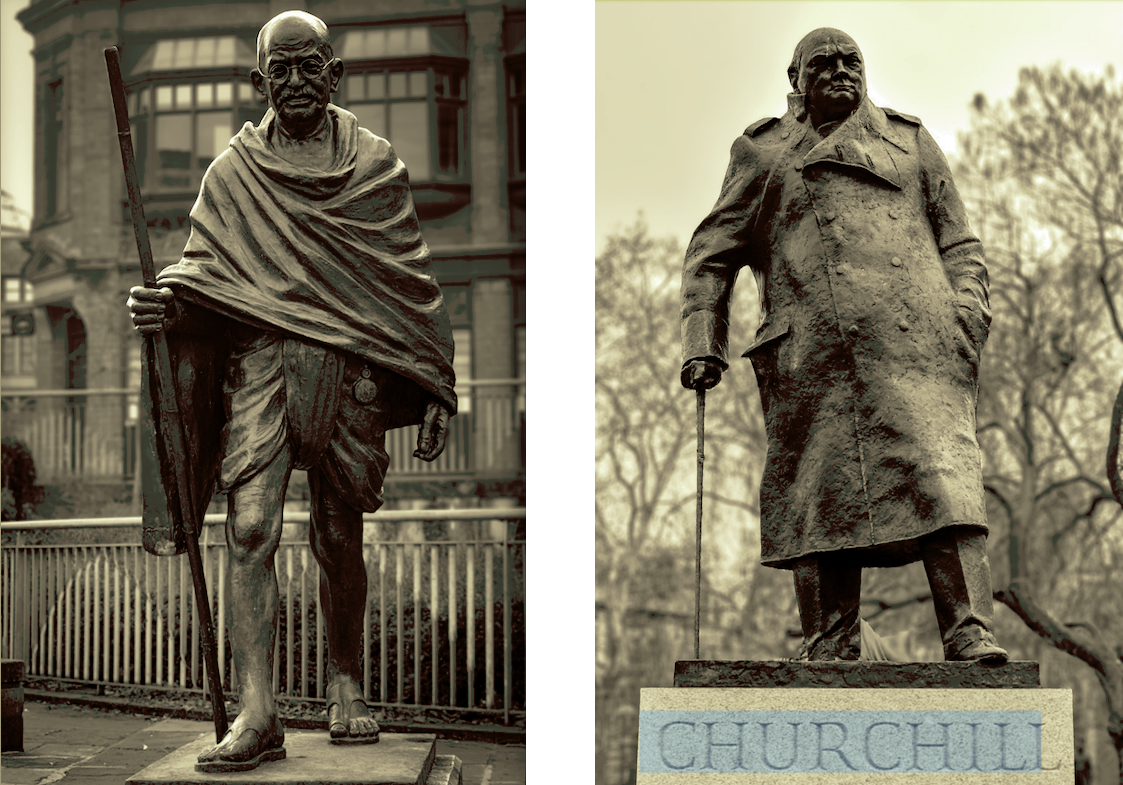
Gandhi and Churchill: Force or Conscience?
In a world once again scarred by war—from Russia’s grinding invasion of Ukraine to Sudan’s humanitarian catastrophe, Myanmar’s post-coup violence, fragile ceasefires amid Gaza’s suffering, and jihadist advances across the Sahel—the contrasting philosophies of Mahatma Gandhi and Winston Churchill have regained striking relevance. Their disagreement during World War II over how to confront aggression—through moral force and non-violence or through resolute armed defiance—echoes across today’s battlefields, diplomatic corridors, and protest movements.
Gandhi’s doctrine of ahimsa sought to defeat injustice not with weapons but through disciplined mass resistance, ethical appeal, and moral courage. In his July 1940 open letter “To Every Briton,” published in Harijan, he urged the British people to resist Nazism without arms, believing that organised non-violent non-cooperation—much as he had practised against colonial rule in India—could stand against even the most ruthless tyranny. He warned that violence, even in self-defence, risked corroding humanity and perpetuating cycles of hatred.
Churchill rejected this vision outright. To him, non-violent resistance against totalitarian aggression was dangerously impractical. He famously dismissed Gandhi as a “seditious fakir” and insisted that only unyielding armed resolve could preserve freedom. His speeches vowed that Britain would fight on beaches, landing grounds, fields, streets, and hills—never surrendering an inch. Strengthened by his partnership with President Franklin D. Roosevelt, the immense sacrifices of the Soviet Union, and the broader Allied effort, Britain held firm, contributing to the Axis powers’ military defeat.
History has vindicated neither approach completely, and therein lies the lesson. Armed resistance proved essential to halt the existential threat in 1940–45. Yet India’s independence struggle demonstrated that non-violent mass mobilisation could dismantle an empire without conventional warfare, achieving profound political and moral transformation.
For Indians, Churchill’s legacy remains deeply ambivalent. In Britain, he is celebrated as the leader who rallied a nation against fascism and preserved its independence. In India, he is remembered for his staunch opposition to self-rule, his contemptuous remarks about Gandhi, and policies that prolonged colonial dominance during the war. Gandhi, by contrast, stands as the embodiment of moral restraint and courage—even when his ideas appeared unrealistic to those facing immediate military peril. Their confrontation reflects the enduring tension between imperial power and anti-colonial aspiration, between force and conscience.
Churchill’s personal journey adds a quieter, inspirational layer. In My Early Life, he described struggling at Harrow School—often near the bottom in classics and mathematics, which he called a “hopeless bog.” Repeated exam failures closed conventional paths, yet he excelled in English and history, winning prizes for recitation and cultivating a lifelong passion for language. After initial setbacks, he entered Sandhurst, launched a career in soldiering and journalism, and eventually produced multi-volume histories of World War II and other works that earned him the 1953 Nobel Prize in Literature—the only British prime minister so honoured. His story shows how words can shape events as powerfully as weapons, turning personal adversity into global influence.
Today’s conflicts give this old dilemma fresh urgency. In Ukraine, resistance to Russian occupation echoes Churchill’s language of defiance, sustained by Western coalitions amid heavy civilian suffering and infrastructure devastation. In Sudan, the civil war between rival forces has produced famine conditions, mass displacement of millions, and widespread atrocities with scant diplomatic progress. Myanmar endures brutal repression, airstrikes, and displacement following the 2021 coup. Gaza and the West Bank remain caught between fragile ceasefires and recurring humanitarian crises, while jihadist insurgencies in the Sahel—now amplified by drones, cyber tools, and artificial intelligence—push violence toward urban centres and challenge state authority.
Where Churchill trusted arms to halt tyranny, Gandhi trusted conscience to erode it. Neither path has proven universally sufficient. Armed resolve can preserve existence in moments of acute danger, yet it rarely builds lasting peace on its own. Non-violence can inspire justice, legitimacy, and long-term change, yet it struggles against regimes that recognise no moral restraint.
The enduring question is not which man was definitively right, but when each approach becomes necessary. In moments of existential threat, Churchill’s logic of unyielding resistance may be unavoidable. In prolonged struggles for dignity, equality, and self-determination, Gandhi’s ethic of non-violence may prove more transformative.
Taken together, their lives offer not a verdict but a warning: power without conscience risks cruelty; conscience without strategy risks futility. Between Gandhi and Churchill lies the unresolved dilemma of modern politics—how to defend humanity without losing our own. In 2026’s fractured and heavily armed world, wisdom lies in blending resolute defence with ethical reflection, strength with restraint, to navigate threats from state aggressors to non-state actors.
*Vivekanand Jha is an Author, Academician & a Public Intellectual.