 By Deepak Parvatiyar*
AI as Diplomacy: India Signals a Third Path
New Delhi Rewrites the Rules of Global AI Power
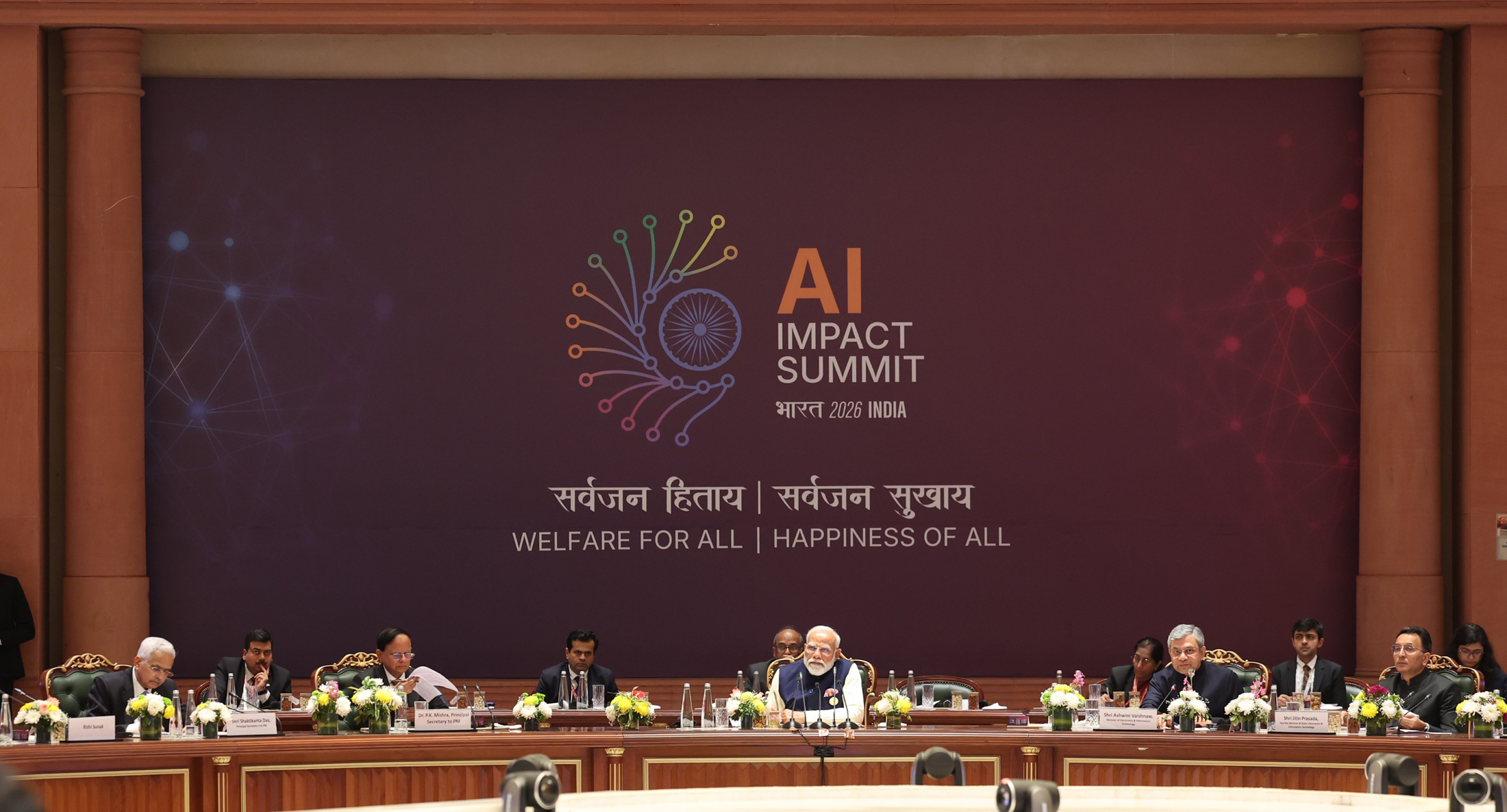
New Delhi: The India AI Impact Summit concluded today with a sequence of concrete institutional outcomes that transformed a week of dialogue into measurable policy and infrastructure commitments. Memoranda of understanding on quantum and artificial intelligence education, the launch of national frameworks for inclusive voice technologies, demonstrations of multilingual and privacy-preserving AI hardware, and the consolidation of indigenous foundational AI models together marked a shift from symbolic leadership to operational statecraft. By the close of the Summit, artificial intelligence had been positioned not merely as a technology agenda but as a new domain of diplomacy, public infrastructure and strategic autonomy.
One of the most visible indicators of this transition came from the Prime Minister’s roundtable at Seva Teerth with founders and chief executives of sixteen AI and deep-tech startups working across healthcare, agriculture, cybersecurity, space and social empowerment. The participating companies — including Abridge, Adalat AI, BrainSightAI, Credo AI, Eka Care, Glean, Innogle, Invideo, Miko, Origin, Prophaze, Rasen, Rubrik, SatSure, Supernova and Sypha AI — presented applications designed for population-scale deployment rather than laboratory pilots.
The Prime Minister urged innovators to develop solutions tailored to Indian realities, stressing data governance, misinformation safeguards and the expansion of AI tools for education in Indian languages. Drawing on India’s experience with UPI as a scalable digital public good, he framed domestic innovation as a trust-based model for global relevance. Startup leaders, in turn, described the Summit as evidence that India was no longer simply absorbing global AI trends but shaping them.
That theme was reinforced in keynote addresses by leaders from finance, research and global industry. Vijay Shekhar Sharma, Founder and Chief Executive Officer of Paytm, characterised the moment as the beginning of an “AI India” phase comparable to the Startup India wave, arguing that artificial intelligence was moving decisively into agriculture, finance and industrial systems rather than remaining confined to consumer applications. Ananya Birla, representing Birla AI Labs, articulated a dual mandate of applied enterprise solutions and frontier research, emphasising the need to test whether AI understands the structure of the world rather than merely recognising patterns. Takahito Tokita, President and Chief Executive Officer of Fujitsu, placed the discussion within a human-centric frame, warning that AI must augment rather than replace human judgment and creativity.
Together, these interventions moved the Summit away from speculative narratives toward questions of inclusion, productivity and human agency. Artificial intelligence was no longer treated as a disruptive curiosity but as a general-purpose technology embedded in economic and social systems.
A parallel strand of the Summit addressed the institutional foundations required for scaling AI. In the session on “AI and Open Networks: Creating Impact at Scale,” Nandan Nilekani, Kiran Mazumdar-Shaw, Sangbu Kim of the World Bank, Sunil Wadhwani and James Manyika of Google and Alphabet converged on the role of digital public infrastructure and open networks. Nilekani argued that the critical challenge was not innovation itself but diffusion, noting that open architectures similar to UPI enable multiple actors to build applications at the edge while reducing complexity for users. Mazumdar-Shaw highlighted the convergence of India’s digital health stack and AI as a potential global reference model for universal healthcare delivery. World Bank representatives stressed the importance of replicable governance frameworks that could travel across countries rather than remain nationally siloed.
These arguments were given institutional weight through the launch of a Policy Report and Developers’ Toolkit on inclusive voice technologies, jointly developed by ARTPARK at IISc, Digital Futures Lab and Trilegal with support from Digital India BHASHINI and Germany’s FAIR Forward initiative. The report proposed treating foundational speech datasets as digital public goods, strengthening openness and representativeness of models, and embedding safeguards against misuse. Its companion toolkit addressed structural gaps in India’s language technology ecosystem, including uneven data representation and fragmented governance. As Amitabh Nag, CEO of the BHASHINI Division, observed, voice technologies in India were not simply an innovation layer but an instrument of digital inclusion across linguistic and literacy divides.
The emphasis on multilingual and locally deployable systems was further illustrated by the live demonstration of a handheld open-source multilingual AI prototype developed by BHASHINI in collaboration with Current AI and Kalpa Impact. Designed to function even in low-connectivity environments and process data on-device, the prototype represented a practical response to concerns about AI monoculture and data dependence. Union Minister Ashwini Vaishnaw described it as aligned with the vision of “AI for All,” and a Global Innovation Challenge was announced to expand the prototype through student and early-career engineering participation.
Education and long-term capacity building emerged as another tangible outcome. The National Institute of Electronics and Information Technology signed an MoU with the Government of Andhra Pradesh to establish India’s first dedicated Quantum and Artificial Intelligence University campus in Amaravati. The institution will integrate undergraduate to doctoral programmes with industry-linked research centres in quantum computing, AI-quantum convergence and high-performance computing. Andhra Pradesh’s Quantum Valley initiative thus became part of a national strategy to anchor deep-tech education within public institutions rather than rely solely on private laboratories.
At the level of sovereign AI infrastructure, Sarvam AI was presented as a cornerstone of India’s indigenous model development under the IndiaAI Mission. With ₹246.72 crore in support, the company is building large language and speech models in Indian languages for public service delivery, including text-to-speech, speech-to-text and document understanding systems across all scheduled languages. Partnerships with UIDAI, the Government of Odisha and Tamil Nadu demonstrated how domestic foundational models were being embedded into governance functions ranging from Aadhaar services to industrial safety and skilling. This full-stack sovereign ecosystem — spanning compute, models, platforms and applications — signalled a deliberate effort to reduce reliance on foreign AI infrastructures while strengthening open innovation.
The cumulative effect of these developments was to elevate artificial intelligence into the realm of diplomatic statecraft. The Summit’s architecture revealed how India is using digital public infrastructure, multilingual AI and indigenous models as instruments of strategic positioning. Its engagement with European partners, African delegations and multilateral institutions showed an effort to build a coalition of middle and emerging powers around norms of open, accountable AI governance.
This positioning carried implicit signals to the United States and China. Alignment with trusted supply-chain frameworks and the visible presence of American technology leaders underlined India’s intention to act as a co-architect of democratic AI governance rather than a passive market for external platforms. At the same time, the inclusion of China in multilateral declarations and the absence of bloc-based rhetoric indicated that India seeks rule-setting through inclusive diplomacy rather than technological isolation. Yet the stress on sovereign compute, indigenous foundational models and digital public goods conveyed a parallel message: India will not outsource its AI future to any single ecosystem.
Also read:
- U.S. and India Sign Pax Silica to Strengthen AI Cooperation
- From Code to Policy: AI’s Political Turn in New Delhi
- वैश्विक एआई सम्मेलन: मानव विवेक पर निर्भर भविष्य
- As India Hosts AI Meet, US Unveils $200m Plan
- India’s AI Impact Summit and the New Politics of Technology
- India AI Summit Turns Infrastructure Into Statecraft
The Summit thus projected a third pathway between Silicon Valley’s market-led model and Beijing’s state-centric architecture — one rooted in population-scale inclusion, multilingual access and public accountability. For emerging economies, this offered a template in which AI is neither monopolised by corporations nor absorbed into surveillance-driven governance, but embedded in civic infrastructure.
What distinguishes the New Delhi gathering is that its outcomes were institutional rather than rhetorical. Policy frameworks on voice technologies, physical prototypes of multilingual AI, a dedicated quantum-AI university, and operational sovereign models transformed abstract principles into deployable systems. The presence of heads of state, global CEOs and multilateral agencies converted these technical initiatives into signals of geopolitical intent.
Yet the Summit’s ambition to project India as a new centre of gravity in global AI governance also exposed the distance between vision and execution. While the institutional announcements and diplomatic choreography underscored India’s confidence as a convening power, the event itself revealed the operational stresses inherent in translating scale into coherence. Widespread reports of overcrowding, long queues, disrupted access to exhibition halls, connectivity failures and transport bottlenecks on peak days drew attention to the irony that a summit devoted to intelligent systems struggled with basic human logistics. For policy observers, these frictions were not merely organisational lapses but a reminder that population-scale AI will demand administrative capacity, inter-agency coordination and last-mile service design as much as technological sophistication.
More substantively, the Summit’s rhetoric of inclusion and public accountability contrasted with the limited presence of civil society, labour organisations and rights-based groups in its formal deliberations. While panels repeatedly emphasised “human-centric” and “citizen-first” AI, critics noted that the dominant voices remained those of governments, corporations and multilateral institutions. Organisations such as Amnesty International and other advocacy groups questioned whether discussions on surveillance technologies, biometric systems and large-scale data infrastructures sufficiently addressed risks of bias, exclusion and political misuse. The absence of these perspectives highlighted a structural tension: India’s attempt to frame AI as a democratic public good still sits uneasily with concerns about how such systems are deployed in law enforcement, welfare delivery and political communication.
The Summit also surfaced deeper constraints within India’s AI ecosystem that remain unresolved despite the scale of new commitments. Experts repeatedly stressed that the principal barrier is no longer experimentation but diffusion—embedding AI into institutions with uneven data quality, limited digital literacy and fragile administrative capacity. India’s relatively low public R&D expenditure compared with leading AI powers, dependence on imported compute and semiconductor supply chains, and the energy demands of large data centres underscore the fragility of claims to technological sovereignty. Announcements such as the Quantum–AI university campus and sovereign model development mark important steps, but their impact will depend on sustained investment, faculty depth and integration with industry rather than symbolic visibility alone.
The Summit’s political theatre also competed at times with its substantive agenda. Isolated controversies—ranging from disputed technology demonstrations to high-profile absences and protests—momentarily diverted attention from policy frameworks and reinforced how easily spectacle can eclipse substance in large global convenings. These episodes, though marginal to the Summit’s outcomes, illustrated the risks of conflating innovation diplomacy with technological maturity.
At the level of global governance, a further tension emerged between the Summit’s emphasis on investment, sovereignty and “democratising AI” and the unresolved question of enforceability. The New Delhi Frontier AI Commitments and allied declarations remained voluntary in nature, reflecting consensus-building rather than regulatory convergence. Several analysts noted that this approach risks prioritising economic positioning and strategic autonomy over binding safeguards on labour displacement, market concentration and high-risk frontier models. Even as leaders such as Sundar Pichai warned that AI’s benefits were “not guaranteed,” the institutional architecture for managing those risks remains fragmented across jurisdictions.
Taken together, these fault lines do not negate the Summit’s achievements; rather, they clarify their significance. India demonstrated that it can convene the world, articulate an alternative pathway between US market-driven models and China’s state-centric approach, and anchor AI within digital public infrastructure and multilingual access. At the same time, the event revealed that legitimacy in AI governance will depend not only on diplomatic leadership and technological capability, but on inclusion of dissenting voices, administrative readiness and the capacity to convert voluntary principles into operational accountability.
In this sense, the India AI Impact Summit functioned both as a declaration of intent and as a stress test. It signalled India’s arrival as a geopolitical actor in artificial intelligence, while exposing the institutional, ethical and infrastructural work still required to sustain that role. The gap between aspiration and implementation—visible in logistics, governance and participation—may ultimately prove as instructive as the announcements themselves in determining whether India’s “third pathway” in global AI governance can mature from vision into durable practice.
The Summit’s conclusion, therefore, marked not an endpoint but the beginning of a new phase in technology diplomacy. Artificial intelligence was treated as a domain comparable to climate or nuclear governance, requiring shared standards, long-term capacity building and public trust. India emerged not merely as a host but as a system-builder — testing AI at a civilisational scale while offering its digital public infrastructure as a global reference.
The enduring question now lies in implementation: whether these frameworks can be translated into enforceable governance, whether indigenous models can remain interoperable while sovereign, and whether inclusion can keep pace with accelerating capital investment. What the Summit has demonstrated, however, is that AI has become inseparable from foreign policy and national strategy. In placing multilingual, inclusive and sovereign technologies at the centre of its agenda, India has signalled that it intends to shape the future of artificial intelligence not as a peripheral participant but as a principal architect of the next global order.
*Senior journalist