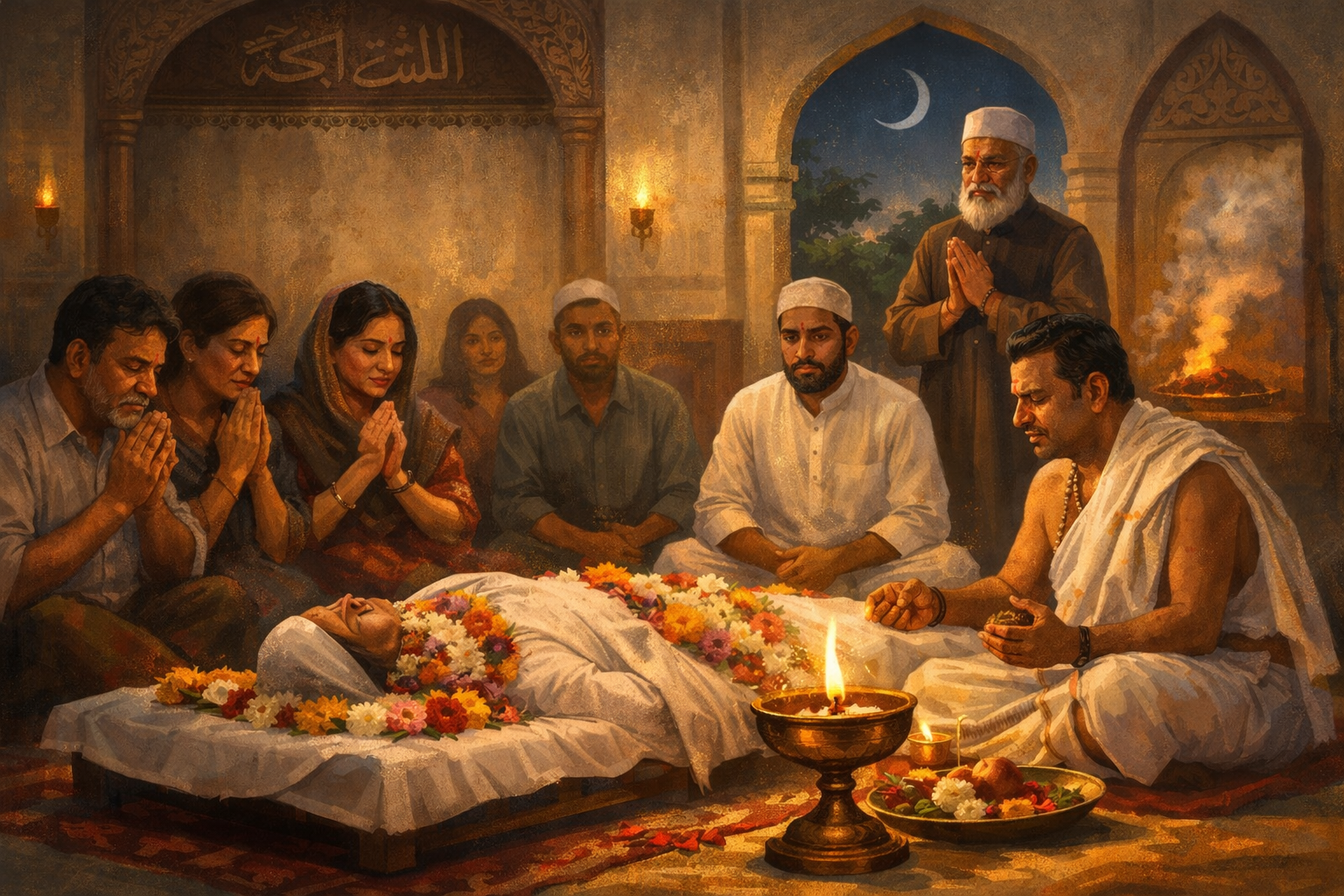
AI generated representational image
 By Shankar Raj*
Compassion Beyond Faith: Omana Rajendran’s Final Farewell
Madrasa Hall Becomes Symbol of Unity in Kottayam
Kottayam: In a rare scene in a world often divided by faith, a madrasa hall in Kerala’s Kottayam district — normally filled with the recitation of the Quran — resonated instead with Hindu mantras for a departed soul. At its centre lay the mortal remains of Omana Rajendran, 62, a ritual lamp casting its gentle glow across the floor. Omana, a longtime resident of Kumaranalloor near Kottayam, had passed away after a cardiac arrest, leaving her family in sudden grief. In that quiet hall, the boundaries of religion seemed to dissolve, replaced by an unmistakable human bond.
Her family, living in a rented house near the mosque, faced an unexpected challenge: the narrow road to their home could not accommodate a stretcher or a mobile freezer unit. With no way to bring her body home for the initial rites, her husband Rajendran and daughter Jyothika were searching for alternatives. At that critical moment, the Mecca Masjid at Kumaranalloor stepped forward, offering the madrasa hall as a space for Omana’s last rites, despite it normally being used for religious classes.
Committee president Muhammad Faisal quickly sought approval through the mosque’s WhatsApp group, and the decision was unanimous. By 10 p.m. Thursday, February 12, Omana’s body was placed in the hall, where it remained overnight for public homage until Friday afternoon, before being taken to the Muttambalam crematorium. The mosque authorities arranged all necessary facilities, ensuring that prayers and mantras could be performed without hindrance. Together, committee members and the grieving family cleared the hall, removing chairs and tables, creating a sacred space for the rituals.
Faisal reflected on the moment: “We consider it our duty to assist others, as taught by our sacred texts. Somewhere along the way, we lost this spirit of cooperation, and it must be revived.” He emphasised that the family was given full freedom to conduct the rituals according to their beliefs, and the hall remained open until the rites were complete.
The gesture echoed a longstanding tradition of goodwill. The mosque has long extended acts of kindness to the community, including distributing drinking water to Hindu devotees during the annual Kumaranalloor temple festival. Yet Friday’s events, with Omana’s body lying in a hall that usually resonated with Islamic teachings, stood out as a deeply moving reminder that compassion transcends religious boundaries. In a world often fractured by creed, caste, or community, the act of opening the madrasa hall for a Hindu woman’s last rites became a quiet but powerful testament to empathy, love, and human solidarity.
As ritual lamps flickered and mantras reverberated through the hall, neighbours and visitors alike bore witness not just to a funeral, but to a lesson in shared humanity. In the heart of Kerala, amidst its rich tapestry of traditions, the simple act of helping another — irrespective of faith — shone as a luminous beacon of unity and compassion.
*Senior journalist and a former editor of New Indian Express, Bengaluru and Thiruvananthapuram