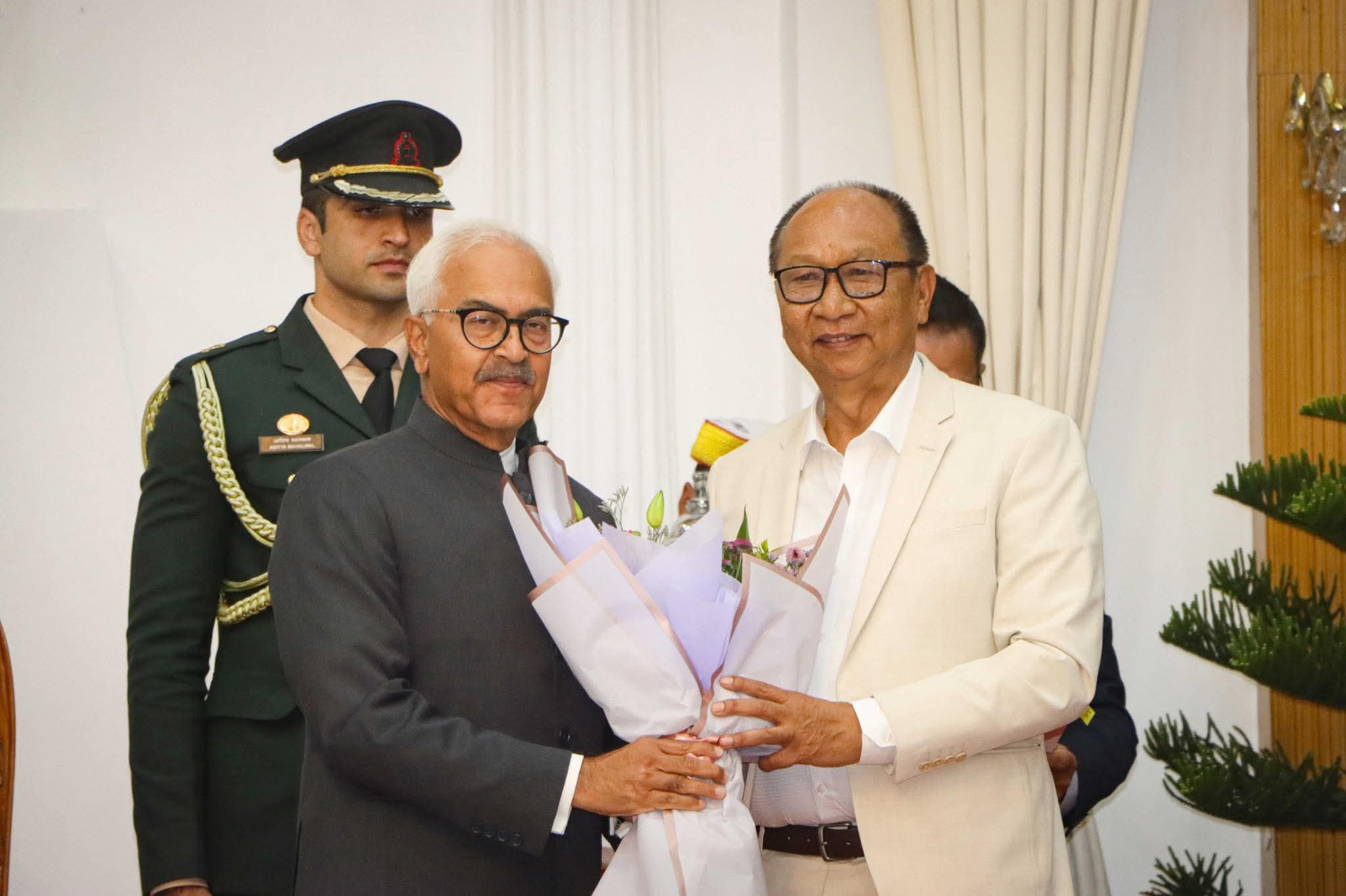
Yumnam Khemchand Singh (Right)
Khemchand Singh Takes Oath Amid Lingering Divide
Imphal: Manipur formally returned to elected government this week with the swearing-in of Yumnam Khemchand Singh as Chief Minister, ending an extended phase of President’s Rule that followed the collapse of the previous administration amid the state’s gravest ethnic turmoil in decades. The ceremony installed a carefully balanced leadership team that includes two Deputy Chief Ministers—Nemcha Kipgen and Losii Dikho—and ministers Konthoujam Govindas Singh and Khuraijam Loken Singh, reflecting an attempt to distribute power across Manipur’s fractured political and ethnic landscape.
New Delhi moved swiftly to bless the transition. Prime Minister Narendra Modi congratulated Khemchand Singh on taking oath as Chief Minister and conveyed his best wishes to Nemcha Kipgen and Losii Dikho on assuming office as Deputy Chief Ministers, as well as to Konthoujam Govindas Singh and Khuraijam Loken Singh on being sworn in as ministers. Expressing confidence in the new leadership, the Prime Minister said they would work diligently towards furthering development and prosperity for the sisters and brothers of Manipur. In a post on X, he reiterated that he was confident the new team would guide the state towards stability and growth.
The public language of unity, however, sits uneasily alongside the political and social realities on the ground.
The crisis that engulfed Manipur did not arise from routine law-and-order failure but from a constitutional dispute that rapidly mutated into ethnic confrontation. The violence was triggered in May 2023 by a controversial order of the Manipur High Court directing the state government to consider the inclusion of the Meitei community in the Scheduled Tribe list. The court asked the government to submit its recommendation to the Union Ministry of Tribal Affairs, reviving a long-pending demand by sections of the Meitei population for constitutional tribal status. Hill-based tribal groups, particularly the Kuki-Zo communities, strongly opposed the move, arguing that granting Scheduled Tribe status to the politically dominant and economically stronger Meiteis would endanger their land rights, employment quotas and constitutional protections reserved for existing tribal groups. Protests against the ruling escalated into large-scale ethnic clashes, leaving scores dead, thousands displaced, and entire districts effectively segregated along community lines.
President’s Rule froze the political machinery but did little to heal the social rupture. Security forces restored a measure of surface calm, yet parallel worlds emerged—relief camps instead of neighbourhoods, checkpoints instead of roads, and competing narratives of victimhood instead of shared citizenship. The new government now inherits this unresolved landscape.
Khemchand Singh’s elevation is widely seen less as a popular reset and more as an internal compromise within the ruling BJP and its allies, designed to signal inclusivity without reopening electoral politics. The appointment of Nemcha Kipgen, a prominent Kuki leader, as Deputy Chief Minister is meant to reassure hill communities, while Losii Dikho’s presence reflects outreach to Naga constituencies. On paper, the arrangement suggests balance. In practice, it exposes the limits of symbolism.
Markets in Imphal remain open, but the trust remains closed. Displaced families continue to wait for a safe return. Armed groups have not disappeared; they have simply become quieter. Civil society organisations from both sides insist that justice for killings, arson and forced migration has yet to be delivered. The High Court ruling that ignited the crisis has been politically sidestepped, not socially resolved. The fundamental dispute over land, identity and constitutional status remains suspended in legal and political ambiguity.
The Centre’s emphasis on “development and prosperity” risks sounding premature in a state where reconciliation has not begun in earnest. Roads and welfare schemes cannot substitute for political dialogue. A cabinet that looks inclusive in composition must still govern a society that no longer shares a common civic space. Authority has fragmented between security forces, community leaders and armed actors who command loyalty beyond the state’s institutions.
From a cynical political perspective, the new government represents not closure but containment. New Delhi appears to be wagering that representation at the top will dampen unrest below. Manipur’s recent history suggests otherwise: political settlements imposed before social wounds heal tend to postpone conflict rather than end it.
The Prime Minister’s confidence contrasts sharply with the guarded mood in both valley and hill districts. For many residents, the oath-taking ceremony marks a procedural return to governance, not a moral or political resolution of the crisis that tore their communities apart. President’s Rule ended because constitutional form demanded it, not because the conflict itself has run its course.
Whether Khemchand Singh’s government can move from symbolic stability to substantive peace will depend on choices yet to be made—on rehabilitation of displaced populations, on accountability for past violence, and on whether the administration is prepared to confront the political roots of the Scheduled Tribe dispute instead of merely managing its aftermath.
For now, Manipur has a Chief Minister again. What it does not yet have is reconciliation. The state stands suspended between ceremony and substance, between official optimism and lived uncertainty.
– global bihari bureau