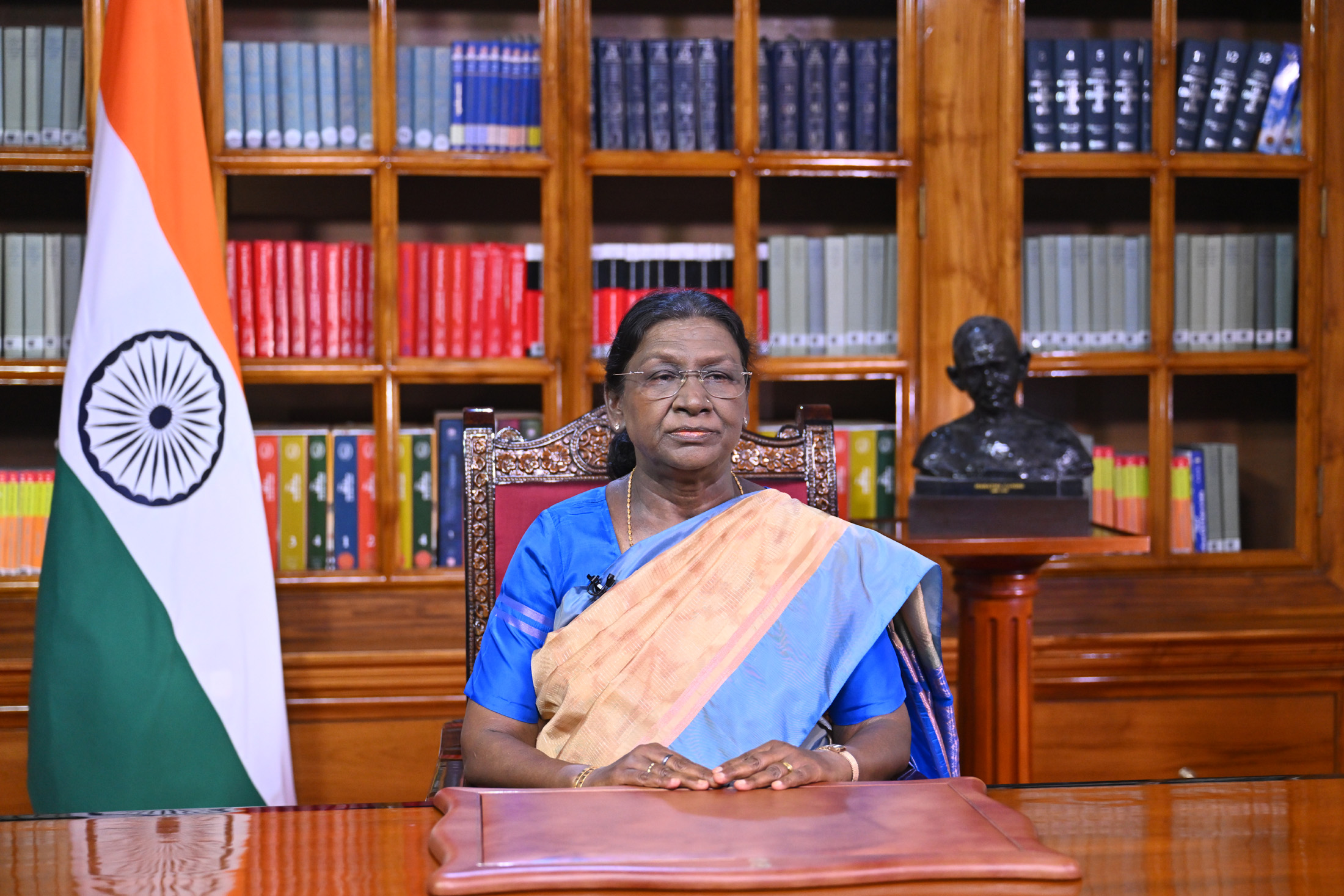
The President of India, Droupadi Murmu addressing to the Nation on the eve of the 77th Republic Day celebrations via video conferencing on January 25, 2026.
President Calls for Women-Led Growth, Youth Power, Peace in Republic Address
Murmu Highlights Democracy, Defence, Environment, Progress
New Delhi: Calling on citizens to draw strength from India’s constitutional ideals while pushing decisively toward a developed and inclusive future, President Droupadi Murmu today said women’s empowerment, youth participation, economic self-reliance and national unity would be central to building a “Viksit Bharat” by 2047, even as she highlighted India’s economic resilience, democratic vitality and defence preparedness amid global uncertainty.
Addressing the nation on the eve of the 77th Republic Day, the President said the Constitution remained the foundational document of the world’s largest republic and the guiding force behind India’s journey since January 26, 1950. She recalled that the ideals of justice, liberty, equality and fraternity enshrined in the Constitution continued to define the Republic and provide a strong bedrock for nationalism and unity.
Noting that January 25 is observed as National Voters’ Day, President Murmu highlighted the importance of electoral participation and recalled Dr B.R. Ambedkar’s belief that voting fostered political education. She said the growing participation of women voters reflected rising political awareness and added a powerful dimension to democracy.
Placing special emphasis on women-led development, the President said national efforts in health, education, safety and economic empowerment had expanded opportunities for women across sectors. She cited the Beti Bachao, Beti Padhao campaign and the Pradhan Mantri Jan Dhan Yojana, under which more than 57 crore bank accounts have been opened, nearly 56 per cent of them belonging to women. More than ten crore women associated with self-help groups were redefining development processes, she said, while women were excelling in fields ranging from agriculture and space to sports and the armed forces.
She also highlighted that women now constituted nearly 46 per cent of representatives in Panchayati Raj institutions and said the Nari Shakti Vandan Adhiniyam would further strengthen political empowerment and advance the idea of women-led development. The role of Nari Shakti, she said, would be crucial in the making of a developed India.
The President also conveyed special appreciation to Overseas Indians, saying they brought glory to the image of the Republic on the global stage through their achievements and conduct. Recalling India’s civilisational heritage, she said the country continued to draw strength from its cultural and spiritual traditions, including Ayurveda, Yoga and Pranayama, which have found acceptance worldwide. She noted that sacred sites associated with India’s spiritual legacy had in recent years been reconnected with the people’s consciousness, reinforcing national pride. Stressing the need to overcome remnants of a colonial mindset, she said initiatives such as the Gyan Bharatam Mission were preserving India’s vast manuscript heritage and advancing indigenous knowledge traditions.
On environmental responsibility, President Murmu said India’s call for a Lifestyle for Environment (LiFE) was rooted in its ancient belief in harmony with nature and urged citizens to protect Earth’s resources for future generations. At a time of conflicts in several parts of the world, she said India continued to spread the message of global peace, consistent with its long-standing tradition of praying for the welfare of all humanity.
Underscoring the role of citizens in strengthening the Republic, she lauded the contributions of soldiers, police and central armed police forces for safeguarding national security, farmers for ensuring food security, healthcare workers for protecting public health, and sanitation workers for maintaining cleanliness. She acknowledged teachers, scientists, engineers, entrepreneurs, artists and workers for shaping India’s development trajectory and praised the Indian diaspora for enhancing the country’s image globally.
Referring to recent sporting achievements, the President noted that Indian women had won the ICC Women’s Cricket World Cup and the Blind Women’s T20 World Cup, while the final of the Chess World Cup was contested by two Indian women players. She said these achievements demonstrated the growing dominance of India’s daughters on the global sporting stage.
Turning to tribal welfare, President Murmu referred to the observance of Janjatiya Gaurav Divas and the conclusion of celebrations marking the 150th birth anniversary of Bhagwan Birsa Munda. She said initiatives such as the Adi Karmayogi campaign, the Dharti Aaba Janajatiya Gram Utkarsh Abhiyan and the PM-JANMAN Yojana were empowering tribal communities, including particularly vulnerable tribal groups. Under the National Sickle Cell Anaemia Elimination Mission, more than six crore screenings had been conducted, while nearly 1.4 lakh students were receiving education in Eklavya Model Residential Schools, many of whom had performed well in competitive examinations.
Describing farmers as the backbone of the economy, the President said generations of farmers had made India self-reliant in food grains and enabled agricultural exports. She said priority was being given to fair prices, low-interest credit, insurance coverage, quality seeds, irrigation facilities, modern farming practices and organic farming. The PM Kisan Samman Nidhi scheme, she said, honoured farmers’ contributions and strengthened their efforts.
On poverty alleviation, she said millions had been lifted above the poverty line, and efforts were underway to prevent relapse into poverty. She described the PM Garib Kalyan Anna Yojana as the world’s largest scheme of its kind, benefiting nearly 81 crore people. More than four crore pucca houses equipped with electricity, water and toilet facilities had been constructed for poor families, giving concrete shape to Mahatma Gandhi’s ideal of Sarvodaya.
Highlighting the role of youth, President Murmu said India possessed the world’s largest young population and that young entrepreneurs, scientists and professionals were driving innovation and growth. The Mera Yuva Bharat (MY Bharat) initiative, she said, was connecting young citizens with opportunities in leadership and skill development. She expressed confidence that the youth would play a leading role in achieving the goal of a developed India by 2047.
On the economy, the President said India remained the world’s fastest-growing major economy despite global uncertainties and was moving toward becoming the third-largest economy in the near future. She stressed that Atma-nirbharata and Swadeshi were guiding principles of economic policy. The Goods and Services Tax had established the concept of “One Nation, One Market,” while labour reforms through four Labour Codes would benefit workers and accelerate enterprise growth.
She also spoke of India’s cultural and spiritual heritage, noting the global acceptance of Ayurveda, Yoga and Pranayama. Quoting Sree Narayana Guru, she reiterated the ideal of fraternity free from caste and creed. She said efforts were underway to eradicate the colonial mindset and preserve India’s knowledge traditions through initiatives such as the Gyan Bharatam Mission. The Constitution’s availability in all Eighth Schedule languages, she added, would strengthen constitutional nationalism.
Referring to governance reforms, President Murmu said the gap between government and citizens was being reduced through simplified rules, direct benefit transfers and the use of technology. She highlighted the rise of digital payments, noting that more than half of the world’s digital transactions now take place in India.
On national security, the President said India had launched precision strikes against terror infrastructure through Operation Sindoor last year and credited self-reliance in defence for its success. She said she had witnessed the preparedness of the armed forces at Siachen, flown in Sukhoi and Rafale aircraft, and observed the capabilities of the indigenous aircraft carrier INS Vikrant and submarine INS Vaghsheer.
Paying tribute to national icons, President Murmu referred to the legacy of Sardar Vallabhbhai Patel in unifying the nation and noted that commemorations marking his 150th birth anniversary had strengthened the spirit of national integration. She also highlighted celebrations marking 150 years of the composition of Vande Mataram, describing the national song as a prayer that instilled patriotism across linguistic and regional boundaries. She recalled the contributions of Bankim Chandra Chattopadhyay, Subramania Bharati and Sri Aurobindo in spreading the message of the song among the masses. The President also paid homage to Netaji Subhas Chandra Bose on his birth anniversary, observed as Parakram Diwas, and described his slogan “Jai Hind” as a declaration of national pride.
Invoking patriotism in her closing remarks, the President quoted Rabindranath Tagore’s line, “amar desher mati, tomar pore thekai matha,” which she translated as a pledge of reverence to the sacred soil of the motherland. She described Republic Day as an occasion to renew commitment to the spirit of “Nation First” and called upon citizens to work collectively to make the Republic stronger and more glorious.
Concluding her address, President Murmu extended greetings to all citizens on Republic Day and expressed confidence that the country would move forward with peace, security and harmony. “Let us all work together to strengthen our Republic,” she stressed.
– global bihari bureau