UNEP Flags $7.3 Trillion Nature-Negative Finance Gap
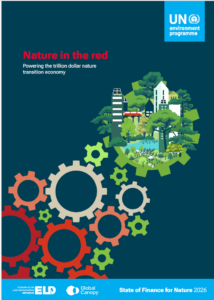 Nairobi: Global financial systems remain fundamentally misaligned with environmental sustainability, with the world investing nearly 30 times more in activities that degrade nature than in efforts to protect or restore it, according to the State of Finance for Nature 2026 report released by the United Nations Environment Programme (UNEP) today.
Drawing on global financial data for 2023, the report estimates that nature-negative financial flows reached approximately US$7.3 trillion, reinforcing what UNEP describes as a structural contradiction between economic growth models and the planet’s ecological limits. Of this total, around US$4.9 trillion originated from private sources, concentrated heavily in sectors such as energy, utilities, industrial manufacturing and basic materials. Public finance added a further US$2.4 trillion through environmentally harmful subsidies, primarily directed toward fossil fuels, agriculture, water use, transport infrastructure and construction.
By comparison, global investment in nature-based solutions (NbS)—initiatives designed to protect, restore and sustainably manage ecosystems while delivering economic and social benefits—amounted to roughly US$220 billion. Nearly 90 per cent of this funding came from public sources, including domestic budgets, development banks and international climate and biodiversity funds. Private sector investment remained limited at US$23.4 billion, or just 10 per cent of total NbS finance, despite increasing awareness among businesses and investors of their dependence on healthy ecosystems.
The report situates these financial patterns within a broader ecological and economic context, noting that seven of the nine planetary boundaries identified by scientists as critical to maintaining a stable Earth system have already been breached. UNEP warns that continued degradation of ecosystems is no longer only an environmental concern but a macroeconomic one, with climate- and nature-related shocks potentially reducing global gross domestic product by up to 15 per cent by 2050. The report also highlights projections that drought conditions could affect three out of every four people worldwide by mid-century if current trends continue.
Despite these risks, the scale of investment required to reverse nature loss remains relatively modest in economic terms. UNEP estimates that annual spending on nature-based solutions must increase to US$571 billion by 2030—around 2.5 times current levels—to meet global biodiversity, land restoration and climate targets. Even at that level, the required investment would amount to only about 0.5 per cent of global GDP, underscoring what the report characterises as a problem of capital allocation rather than affordability.
“If you follow the money, you see the size of the challenge ahead of us,” said Inger Andersen, Executive Director of UNEP. She noted that global finance is currently reinforcing systems that degrade ecosystems while funding for nature-positive solutions continues to advance slowly. According to Andersen, the choice facing policymakers and markets is increasingly binary: capital either accelerates environmental decline or supports recovery.
The report places particular emphasis on the composition of NbS finance. Biodiversity conservation accounts for the largest share of current spending, followed by investments in sustainable agriculture, forestry and fisheries. Smaller but growing allocations are directed toward wastewater management, pollution abatement and ecosystem services. On the private side, emerging channels include biodiversity offsets, certified commodity supply chains, carbon and biodiversity markets, green and sustainability-linked bonds, and philanthropic capital, though UNEP notes that these mechanisms remain fragmented and unevenly scaled.
A key analytical finding highlighted in the report is the cost-effectiveness of ecosystem protection relative to restoration. UNEP estimates that protection-focused interventions will account for nearly 80 per cent of the additional land area required to meet global targets by 2030, yet they currently receive only about 20 per cent of additional NbS finance. The report argues that prioritising protection could deliver faster and more economical outcomes while reducing long-term restoration costs.
The report also flags growing competition for land driven by climate mitigation strategies. Current climate pledges assume the use of nearly 1.2 billion hectares of land for carbon removal and sequestration, placing pressure on agriculture, biodiversity conservation and land-based livelihoods. UNEP warns that without integrated land-use planning, climate action could inadvertently increase the cost of nature-based solutions and exacerbate social and ecological trade-offs.
To address these systemic challenges, UNEP introduces a new policy and investment framework known as the Nature Transition X-Curve. The framework is designed to help governments, regulators and businesses sequence reforms by gradually phasing out environmentally harmful subsidies and investments while simultaneously scaling up high-integrity, nature-positive alternatives across entire value chains. The approach aims to manage economic transition risks while building long-term resilience.
The X-Curve framework also outlines pathways toward what the report describes as a potential “trillion-dollar nature transition economy.” Examples cited include greening urban spaces to mitigate heat-island effects and improve public health, embedding ecosystem services into transport and energy infrastructure, restoring degraded landscapes to enhance water security, and developing construction materials capable of delivering net-negative emissions by utilising captured carbon dioxide.
Beyond capital flows, the report highlights growing legal, regulatory and liability risks associated with continued investment in nature-damaging activities. It points to evolving interpretations of fiduciary duty, increasing environmental litigation, and recent international legal developments—including advisory opinions affirming state responsibility for climate harm—as signals that governments and financial institutions may face rising legal exposure if nature-related risks are ignored.
In this context, UNEP underscores the importance of financial disclosure and supervision. The report calls for mandatory reporting of nature-related dependencies, impacts, risks and opportunities, and highlights emerging frameworks such as the Taskforce on Nature-related Financial Disclosures (TNFD). It also argues for integrating nature-related risks into central banking, monetary policy and financial regulation, positioning nature loss as a core concern for financial stability rather than a peripheral environmental issue.
Germany’s Federal Minister for Economic Cooperation and Development, Reem Alabali-Radovan, said the report demonstrates the urgency of redirecting global financial flows away from environmental harm and toward nature-based solutions, noting that the private sector will play a decisive role. She highlighted Germany’s support for partner countries in valuing natural capital so that it can be reflected in economic planning and policy decisions.
The report also stresses that nature-positive investments must be grounded in local ecological, cultural and social contexts to ensure durability and fairness. Inclusivity and equity, UNEP notes, are essential to avoid undermining livelihoods or exacerbating inequalities, particularly in developing countries and Indigenous territories.
Acknowledging data gaps and methodological limitations, the report notes the absence of globally standardised taxonomies for nature-based solutions and inconsistencies in data availability across regions. UNEP argues that improving data quality and harmonising definitions will be critical for scaling finance effectively.
Framing its findings as a call for a “Big Nature Turnaround,” the State of Finance for Nature 2026 concludes that incremental change will be insufficient. Without decisive reform of subsidies, investment practices and financial governance, the report warns that global biodiversity, climate and sustainability goals will remain out of reach.
– global bihari bureau