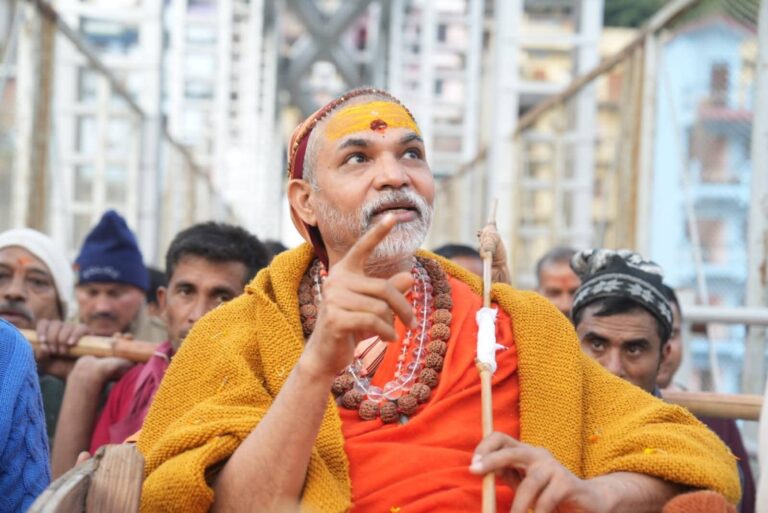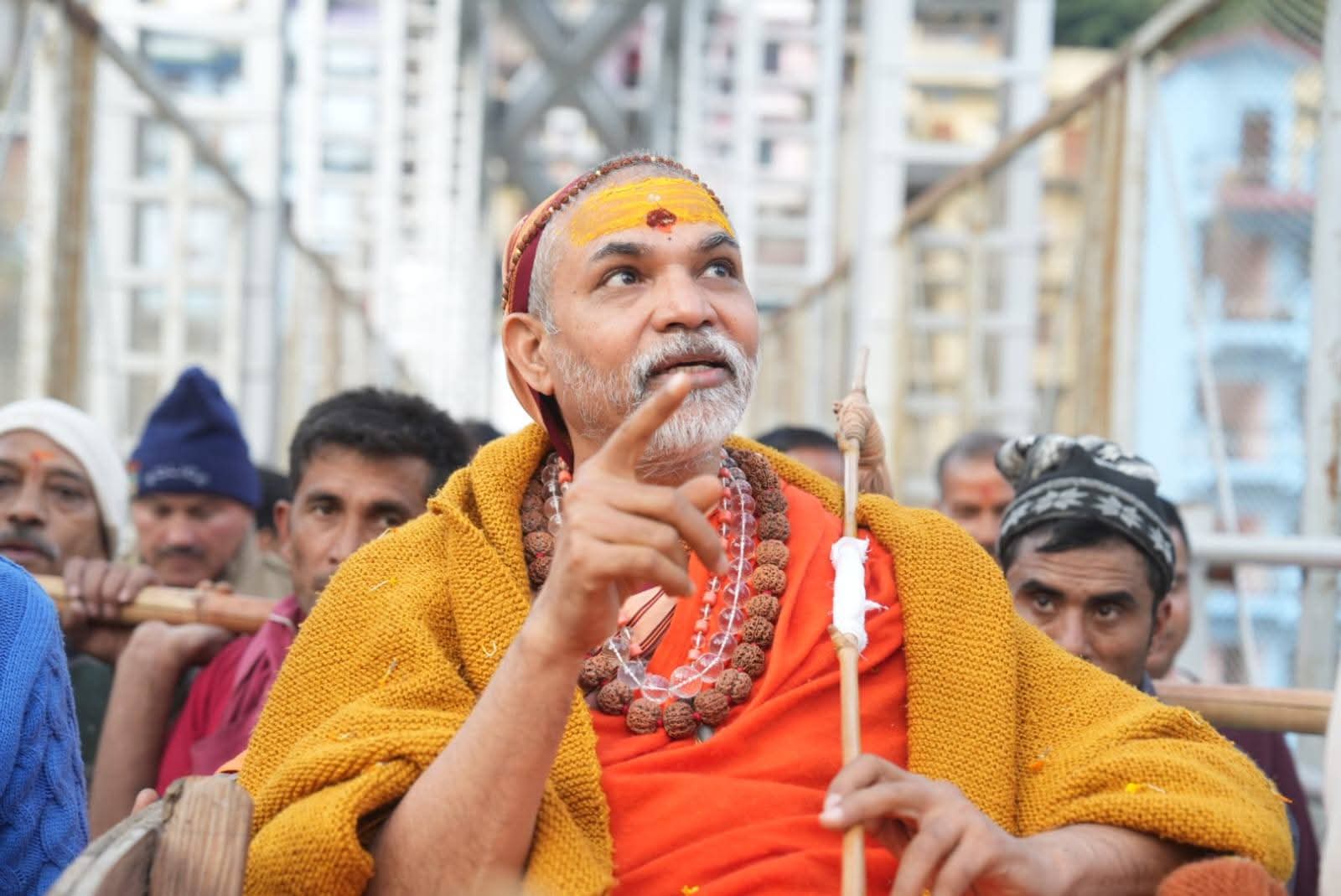
Shankaracharya Swami Avimukteshwaranand Saraswati of Joshimath.
 By Onkareshwar Pandey*
Proof, Power and the First Dip: A Test for Hindu Autonomy
Is the State Overstepping into Sanatan Dharma?
Prayagraj/New Delhi: In the reign of a Hindu Prime Minister, Narendra Modi, and a Hindu Chief Minister, Yogi Adityanath, a Shankaracharya—whose blessings the Prime Minister himself once sought—has been asked by the state to furnish proof of his spiritual office. Legal documentation has already been placed on record, yet the question that now confronts the nation is stark: by what Constitutional authority does a Mela official intrude into matters of Hindu faith, religious freedom, and the sanctity of Dharma?
Across large sections of the Hindu community, particularly among followers of Swami Avimukteshwaranand Saraswati, this action is being perceived as a humiliation of a centuries-old spiritual institution. Their anger is not confined to paperwork alone. It stems equally from the denial of the Shankaracharya’s customary right to take the first ceremonial dip (pratham snan) in the Ganga during the Magh Mela—an age-old tradition that symbolises spiritual precedence, not administrative privilege.
To many devotees, this episode represents not routine regulation but a disturbing conflation of religion with bureaucratic authority—an inversion of a civilisation that has always treated religion as religion, not as politics.
Can a Magistrate Ask a Shankaracharya for “Proof”?
Is it conceivable that a government officer can ask a saint—especially a Shankaracharya—“Show us proof that you are Shankaracharya”? Yet this is precisely what the notice issued by the Prayagraj Mela Authority to Swami Avimukteshwaranand Saraswati appears to do.
The notice has triggered a confrontation that goes beyond one individual. It has reopened a fundamental debate between Constitutional guarantees of religious freedom and the expanding reach of administrative discretion. For the faithful, the issue is not documentation but legitimacy—something that flows from scripture, tradition, and guru-shishya parampara, not from state files.
Irrefutable Constitutional Basis
Article 26 of the Constitution of India guarantees every religious denomination the right to manage its own affairs in matters of religion, including the appointment and succession of religious office-bearers. The office of a Shankaracharya falls squarely within this protected domain.
The state may regulate logistics of large congregations, but it cannot adjudicate spiritual legitimacy, nor reorder religious hierarchies, nor condition ritual rights upon bureaucratic validation.
Supreme Court Precedent: Shirur Mutt Case
The Supreme Court’s landmark ruling in Commissioner, Hindu Religious Endowments, Madras v. Sri Lakshmindra Thirtha Swamiar of Shirur Mutt (AIR 1954 SC 282) remains unequivocal: “A religious denomination enjoys complete autonomy in deciding what rites and ceremonies are essential according to the tenets of the religion they hold, and no outside authority has jurisdiction to interfere.”
The consecration of a Shankaracharya and the customs attached to that office—including ritual precedence at sacred congregations—are matters of religion, not administration.
The First Dip: Custom, Not Concession
What has deepened the sense of grievance is that Shankarcharya of Joshimath, Swami Avimukteshwaranand Saraswati, was allegedly prevented or delayed from performing the first ceremonial dip in the Ganga, traditionally accorded to a Shankaracharya at the Magh Mela.
For devotees, the pratham snan is not a courtesy extended by officials; it is a recognised religious custom that publicly affirms spiritual order. Denial of this right is therefore viewed as interference in religious practice, not crowd management.
It is in this context that the subsequent demand for “proof” has been read not as an isolated procedural act, but as part of a continuum of administrative overreach.
What the Mughals Did Not Do, Is a ‘Hindu Government’ Doing?
Akbar’s fort at Prayagraj, built in 1575, still stands as a reminder of imperial authority. Yet historical records show that even under Mughal rule, saints arrived unhindered at sacred congregations, rituals were facilitated, and no Shankaracharya was ever asked to produce a certificate of consecration.
Royal farmans issued during Aurangzeb’s reign (1658–1660) concerning institutions such as Jangambari Math demonstrate that while the state administered revenue and order, it did not challenge internal religious succession.
These comparisons, widely echoed by followers on the Shankaracharya’s official social-media platforms, are moral in nature. They reflect a deep anxiety that a government identifying itself as culturally Hindu is today venturing where even overtly imperial regimes did not.
British Rule and Legal Recognition
Under British administration, the Religious Endowments Act of 1863 acknowledged positions such as Jagadguru and Shankaracharya as Corporation Sole—a legal recognition of sovereign religious offices with perpetual succession.
The irony, as critics point out, is that a post-colonial constitutional republic now appears less restrained in questioning spiritual authority than regimes with no civilisational stake in Sanatan Dharma.
The Lawyer’s Reply and the Timeline
The administration has reportedly relied on an order dated 14 October 2022. However, this order was prospective. Swami Avimukteshwaranand Saraswati’s consecration took place on 12 September 2022, following established Vedic rites.
In a detailed reply dated 20 January 2026, Advocate Anjani Kumar Mishra pointed out that:
- The consecration had already been completed publicly,
- The Supreme Court, on 21 September 2022, recorded that other Shankaracharyas and the Bharat Dharma Mahamandal supported the appointment, and
- Any administrative action intruding into this domain risks interfering with matters pending before the Court.
Recognition Already on Record
The Shankaracharya’s supporters point to multiple forms of recognition already on record:
- Written confirmation from Sringeri Peeth prior to the consecration,
- Public interactions with national leaders,
- Official Uttar Pradesh government publications have listed him as Shankaracharya in previous Mela guides.
Against this backdrop, the demand for further “proof” appears, to them, redundant at best and punitive at worst.
Double Standards and a Troubling Signal
Critics also question why the Mela administration extends extraordinary facilities to politicians, influencers, and celebrities, while raising objections to a Shankaracharya arriving with a limited number of disciples. The contrast has reinforced the perception that spiritual authority is being subordinated to political and administrative convenience.
https://www.facebook.com/share/r/16ga8BQ8mt/
The Larger Question
Chief Minister Yogi Adityanath himself rose from the office of Mahant of Gorakhpur Peeth to constitutional authority. That under such a government, a Mela officer can question a Shankaracharya’s legitimacy—and deny him customary ritual precedence—has sent a troubling signal across the Hindu religious landscape.
If today a Shankaracharya is asked for proof, tomorrow a priest may be asked for a licence. This is Rajdanda pressing into Dharmadanda, a precedent fraught with long-term consequences.
Swami Avimukteshwaranand Saraswati’s legitimacy rests not merely on documents but on scripture, tradition, and the faith of millions—proof that no magistrate can manufacture or annul.
History rarely repeats itself, but it does remember who crossed boundaries in moments of institutional overconfidence.
*Onkareshwar Pandey has been an active journalist for 40 years in Hindi and English, serving as editor across print, television, digital, and news agencies more than ten times. He has authored and edited 13 published books and founded 11 knowledge networks, including the Commonwealth Thought Leaders Forum. The views expressed are personal.