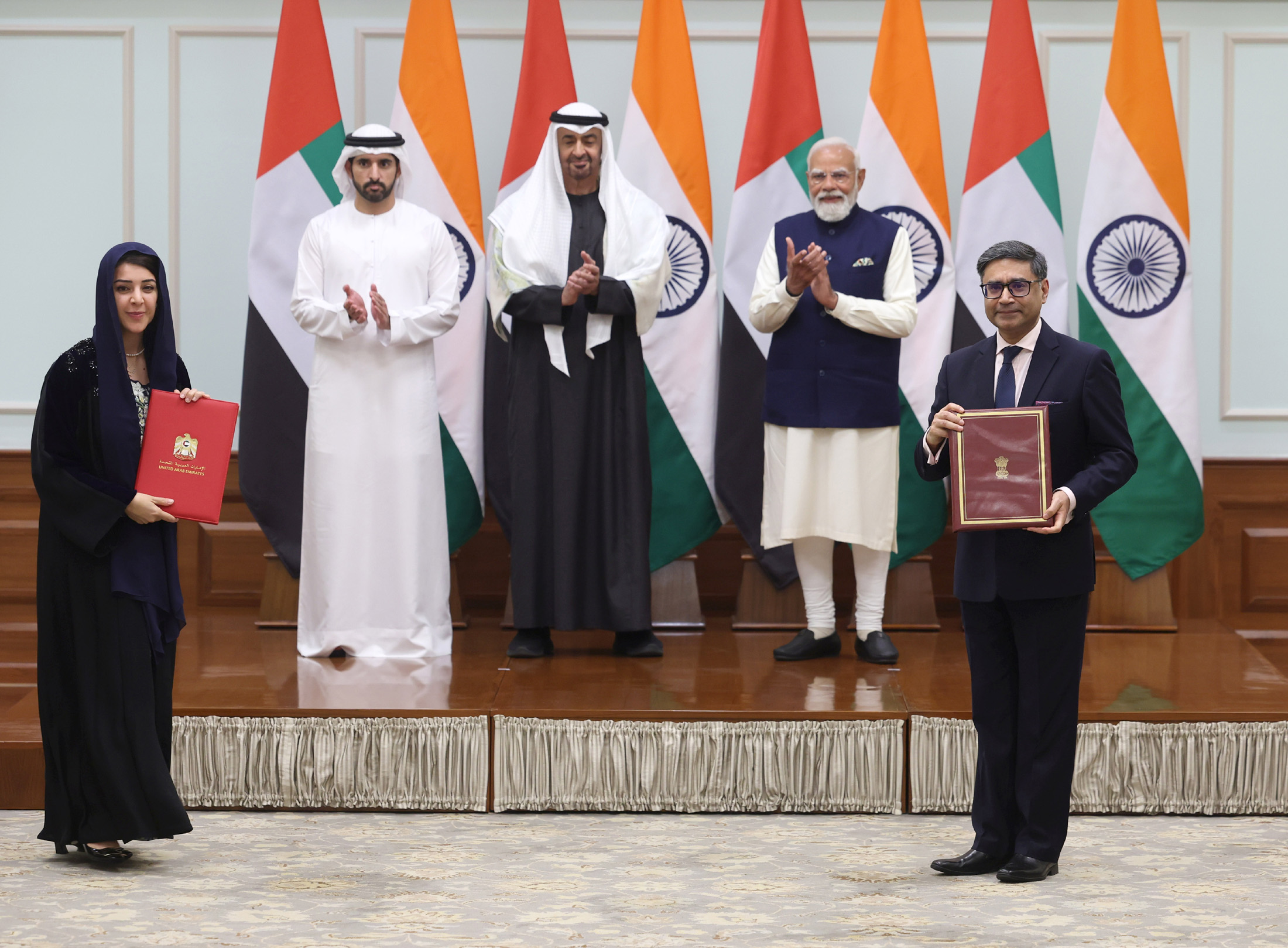
Prime Minister Narendra Modi and the President of the United Arab Emirates, Mohamed bin Zayed Al Nahyan witnessing the Exchange of MoUs between India and UAE at 7, Lok Kalyan Marg, in New Delhi on January 19, 2026.
India, UAE Chart Wider Strategic Cooperation During Talks
Modi, Sheikh Mohamed Expand Defence, Tech and Trade Links
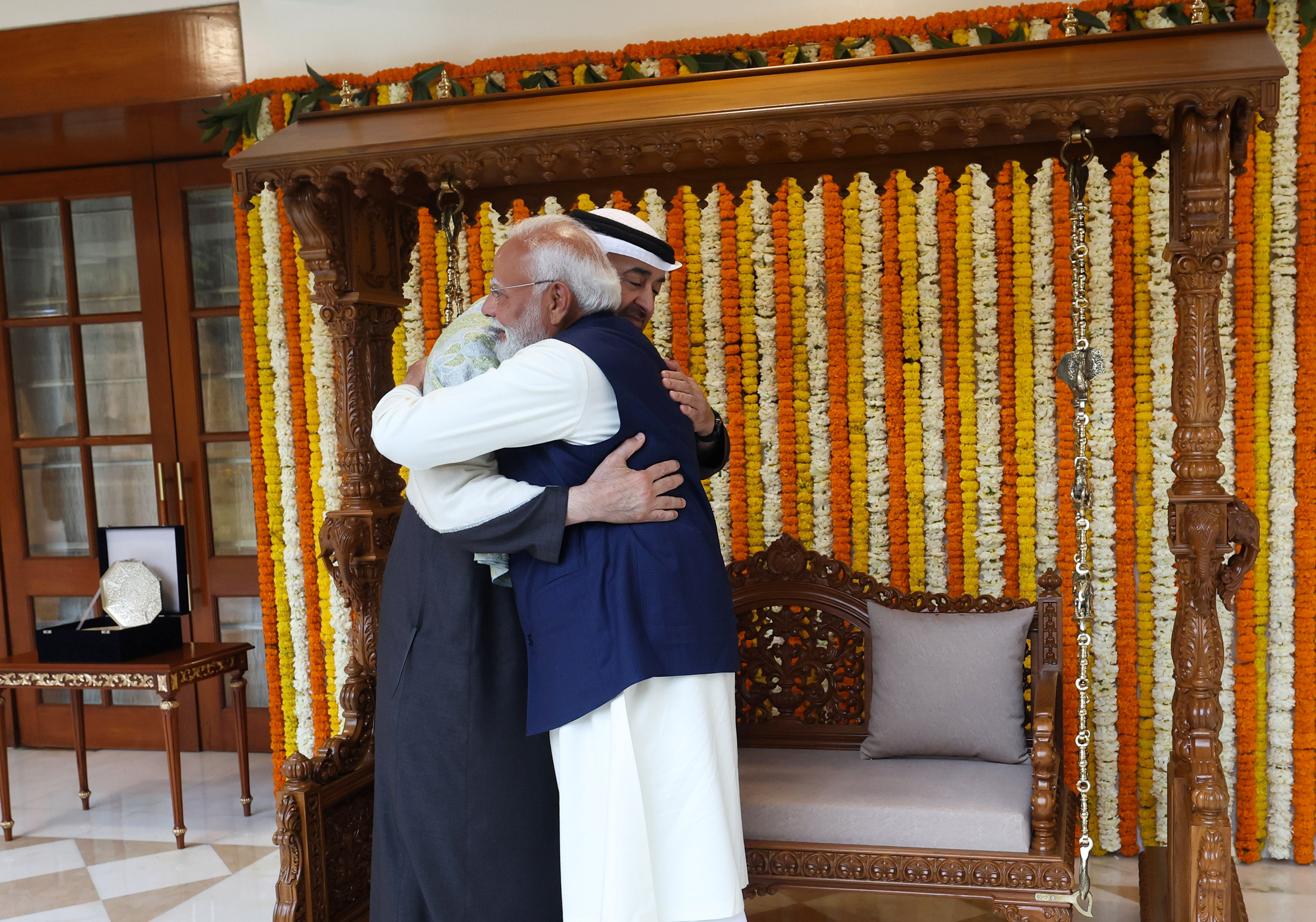
New Delhi: India and the United Arab Emirates (UAE) today agreed to significantly deepen their strategic partnership across trade, investment, defence, energy, advanced technology, and people-to-people ties, setting an ambitious target of doubling bilateral trade to more than United States Dollars (USD) 200 billion by 2032. The announcement followed high-level discussions between Prime Minister Narendra Modi and UAE President Sheikh Mohamed bin Zayed Al Nahyan, reflecting a convergence of geoeconomic and geopolitical priorities.
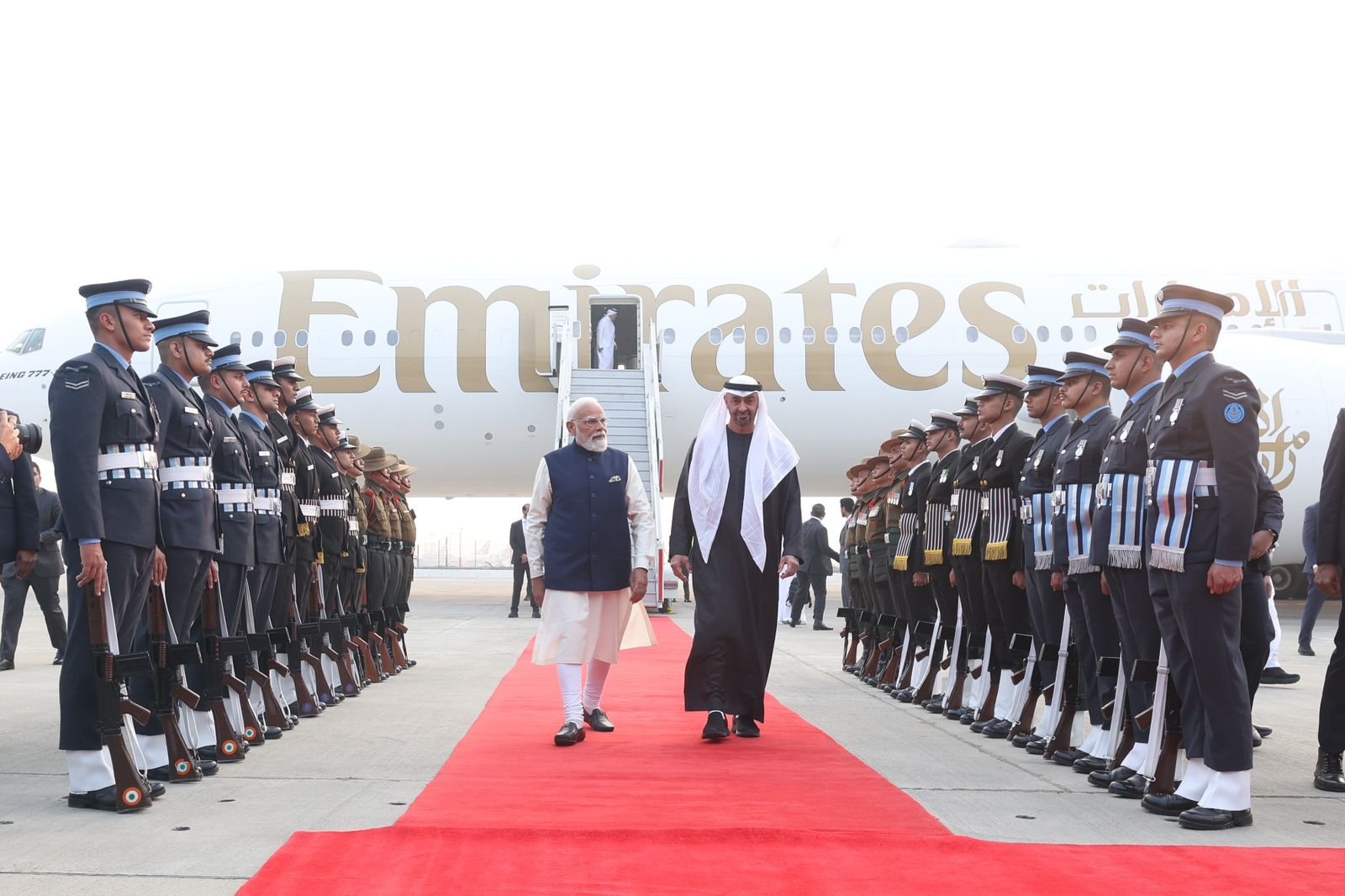
Prime Minister Modi welcomed the UAE President at the airport, tweeting, “Went to the airport to welcome my brother, His Highness Sheikh Mohamed bin Zayed Al Nahyan, President of the United Arab Emirates. His visit illustrates the importance he attaches to a strong India-UAE friendship. Looking forward to our discussions.” The two leaders examined the progress of the India-UAE Comprehensive Strategic Partnership, which has matured over the past decade into a robust framework for bilateral cooperation, regional stability, and broader engagement across the Indo-Pacific and West Asian corridors.
A series of agreements and letters of intent were concluded to operationalise these objectives. A Letter of Intent on investment cooperation between the Government of Gujarat and the UAE Ministry of Investment aims to develop the Dholera Special Investment Region, incorporating an international airport, pilot training school, maintenance, repair, and overhaul (MRO) facility, greenfield port, smart township, railway connectivity, and energy infrastructure. Discussions included potential participation of UAE sovereign wealth funds in the second National Investment and Infrastructure Fund (NIIF), underlining the strategic integration of finance and industrial development.
Energy and industrial collaboration featured prominently. Hindustan Petroleum Corporation Limited (HPCL) and Abu Dhabi National Oil Company Gas (ADNOC Gas) signed a ten-year liquefied natural gas (LNG) supply agreement for 0.5 million tonnes per year starting in 2028. Civil nuclear cooperation, enabled under India’s Sustainable Harnessing and Advancement of Nuclear Energy for Transforming India (SHANTI) Act 2025, will focus on advanced reactors, Small Modular Reactors (SMRs), operations, and nuclear safety. President Sheikh Mohamed said, “These initiatives will strengthen energy security and provide mutual technological benefit,” highlighting the strategic value of energy cooperation in volatile global markets.
In technology and innovation, India’s Indian National Space Promotion and Authorisation Centre (IN-SPACe) and the UAE Space Agency agreed on a joint initiative to commercialise space technologies, promote start-ups, and expand industrial capabilities. A supercomputing cluster in India, to be developed by the Centre for Development of Advanced Computing (C-DAC) in partnership with the UAE’s G-42 company, will support artificial intelligence (AI) research, applications, and technology transfer. Both sides agreed to explore “Digital Embassies” and the integration of India’s Digilocker platform with UAE systems, facilitating cross-border recognition of credentials, trade, and services.
Defence cooperation was formalised with a Letter of Intent establishing a Strategic Defence Partnership, covering industrial collaboration, advanced technology, cyberspace, counter-terrorism, and operational interoperability. Both leaders reaffirmed that terrorism in all forms is unacceptable. Prime Minister Modi stated, “We unequivocally condemn terrorism in all its forms and manifestations, and no country should provide safe haven to those who finance, plan, support or commit terrorist acts.” Bilateral military exercises and exchanges between Service Chiefs reinforce operational trust and readiness.
Trade initiatives target doubling bilateral commerce from USD 100 billion in the financial year (FY) 2024-25 to USD 200 billion by 2032, with emphasis on Micro, Small, and Medium Enterprises (MSME) integration via Bharat Mart, Virtual Trade Corridor, and Bharat-Africa Setu. Cultural and educational cooperation includes a “House of India” in Abu Dhabi, youth exchange programs, offshore campuses of the Indian Institute of Technology (IIT) Delhi and Indian Institute of Management (IIM) Ahmedabad, innovation labs, and collaboration on polar research and climate science. Food security collaboration, including a Memorandum of Understanding (MoU) between the Agricultural and Processed Food Products Export Development Authority (APEDA) and the UAE Ministry of Climate Change and Environment, strengthens sustainable supply chains for agricultural exports.
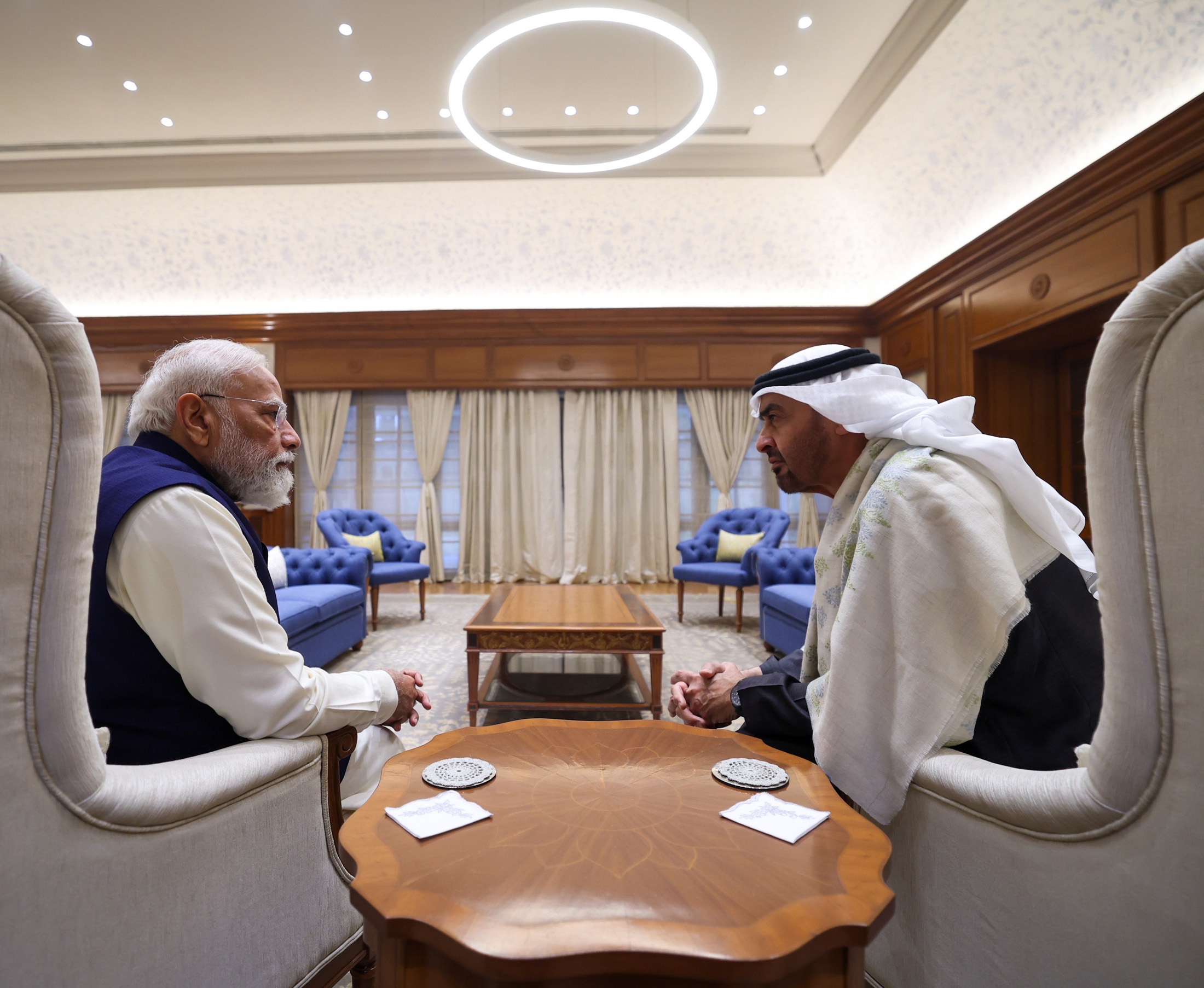
The visit also reinforced the geopolitical alignment of India and the UAE. Both sides emphasised the importance of regional stability, multilateral cooperation, and global governance engagement. They affirmed support for India’s BRICS (Brazil, Russia, India, China, South Africa) Chairmanship in 2026 and for the UAE’s co-hosting of the United Nations (UN) Water Conference later this year, signalling shared commitment to shaping multilateral norms. Analysts note that by combining strategic investments, technological collaboration, and defence coordination, India and the UAE are signalling a deepening partnership that extends from the Indian Ocean and Gulf region to Eurasian trade routes and global governance structures, projecting influence beyond immediate bilateral concerns.
Financial integration and commercial facilitation were further strengthened with First Abu Dhabi Bank establishing a branch in Gujarat International Finance Tec-City (GIFT City) and DP World commencing operations there, improving maritime logistics, trade flows, and investment linkages. Both leaders highlighted that these initiatives create bridges for Indian and UAE businesses to expand in the Gulf Cooperation Council (GCC), the Middle East, Africa, and Eurasia markets.
Energy, technology, defence, trade, finance, culture, and global governance are now interwoven into a multi-layered strategic architecture between India and the UAE. The partnership demonstrates a deliberate effort to combine economic pragmatism with geopolitical foresight, positioning the bilateral relationship as a key driver of regional stability, sustainable development, and global influence.
– global bihari bureau